TRANSMISSION // 2611.28350v1
Why one action may not teach an AI how actions work
Source published
A JEPA world model may predict recorded behavior yet struggle to compare alternatives. Fork-JEPA uses paired outcomes from the same starting state to teach action effects.
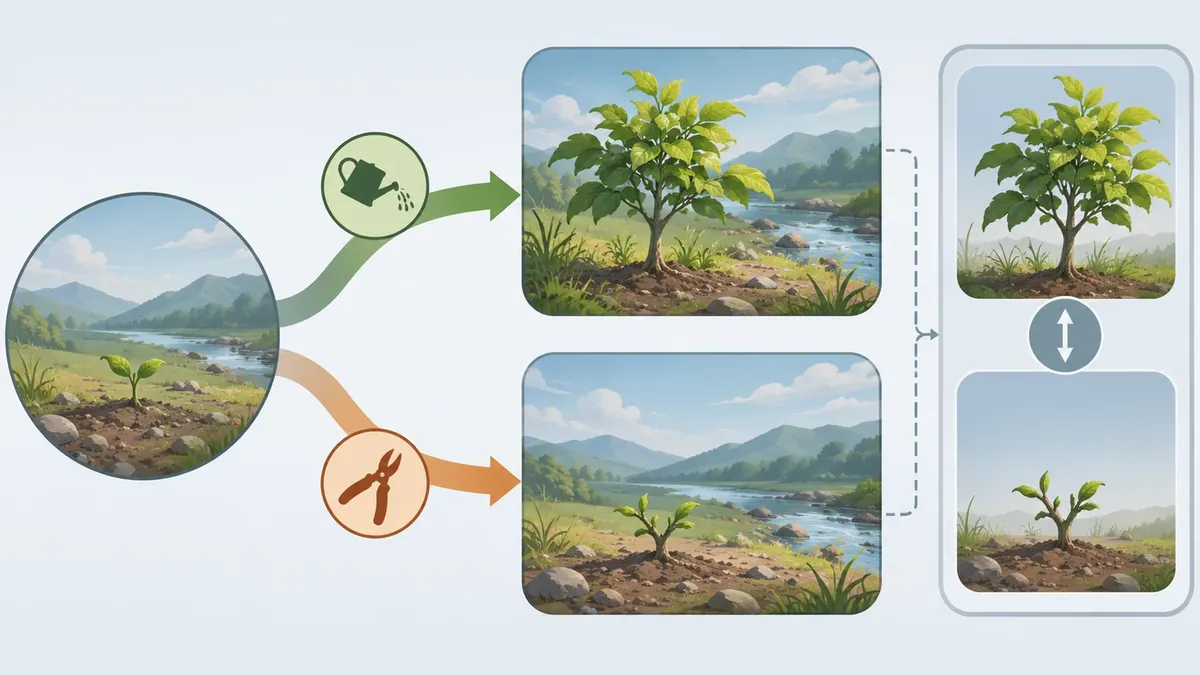
To compare possible actions, an AI needs evidence about how each one changes what happens next. A new preprint proposes collecting two outcomes from the same starting state so a model can learn that difference more directly.
The problem: prediction versus comparison
A world model predicts how an environment changes. In settings where a system learns from recorded behavior, its training data may show only the action that was actually taken in each state. If the behavior policy rarely varies its choices in a particular situation, those records may not show how alternatives would have changed the outcome.
In Two Actions from One State: Fork Futures Teach JEPA World Models to Compare, the authors analyze this problem under a local linear approximation. Their theoretical result is that action effects cannot be identified along directions where the policy does not vary its actions within a state. Put simply, observing one choice and its outcome may not reveal the effect of a different choice.
Two futures, one starting point
The authors propose supplementing behavior records with “fork futures”: execute two actions from a restored copy of the same state and measure both outcomes. Under the paper’s local linear approximation, the shared state contribution cancels when the outcomes are subtracted. This makes it possible to identify action responses on the span covered by the sampled action pairs. It is not a general guarantee that the comparison isolates action effects in every system or for every possible action.
The method, called Fork-JEPA, uses these pairs to train a JEPA world model. The model is taught to match its predicted difference between action outcomes to the measured difference. Training also includes predicting the successor recorded in the behavior data and a “lookback” head intended to keep the predecessor recoverable. According to the abstract, these changes happen during training; the planning procedure is left unchanged.
Findings reported in the abstract
Across three visual control tasks, the authors report that behavior-only training predicts action effects no better than a constant guess. With Fork-JEPA, the action effect becomes more readable, and planning success rises by up to 14% over LeWM, the base model. In settings where action responses change across hidden zones, the authors report that cross-zone success nearly doubles. They also report that 1,024 fork pairs outperform 1.2 million additional behavior steps.
These are claims reported by the paper’s authors, not guarantees for other tasks. “Up to 14%” gives the largest reported improvement; it does not mean every task improved by that amount. The abstract does not provide the task names, detailed evaluation protocols, or uncertainty estimates, so those details cannot be assessed from the supplied evidence alone.
What the evidence does—and does not—show
The theoretical result depends on a local linear approximation. The experiments described in the abstract cover three visual control tasks; they do not establish that the method works equally well in other environments. Collecting fork futures also involves restoring a state and measuring outcomes under different actions. The abstract does not say how practical or costly that process is in the evaluated tasks, or report tests on physical robots.
This article is based on the supplied abstract, not a review of the full paper. The source is an arXiv preprint, and the available information does not establish whether it has been peer reviewed. Its claims should be treated as preliminary until the full methods and results can be examined and the findings tested independently. Read the preprint.
- world models
- JEPA
- counterfactual actions
- visual control
- artificial intelligence
Related reading
Automatically matched by shared topic keywords. These links do not imply that the sources agree or establish a consensus.
Fast-JEPA speeds planning in simulated visual-control tasks
Source published
Shared keywords: visual control
WARP-JEPA speeds up AI planning by learning which routes to try
Source published
Shared keywords: visual control
How LeHami changes AI’s imagined futures
Source published
Shared keywords: artificial intelligence, world models
Could AI World Models Help Plan Mars Terraforming?
Source published
Shared keywords: artificial intelligence, world models
Teaching World Models Which Actions Matter
Source published
Shared keywords: visual control, world models