TRANSMISSION // 2611.28334v1
What CHIME’s second catalog reveals about FRBs
Source published
A population analysis of CHIME’s second FRB catalog estimates burst rates, energies and host-galaxy dispersion, while finding an unexplained mismatch in the observed sample.
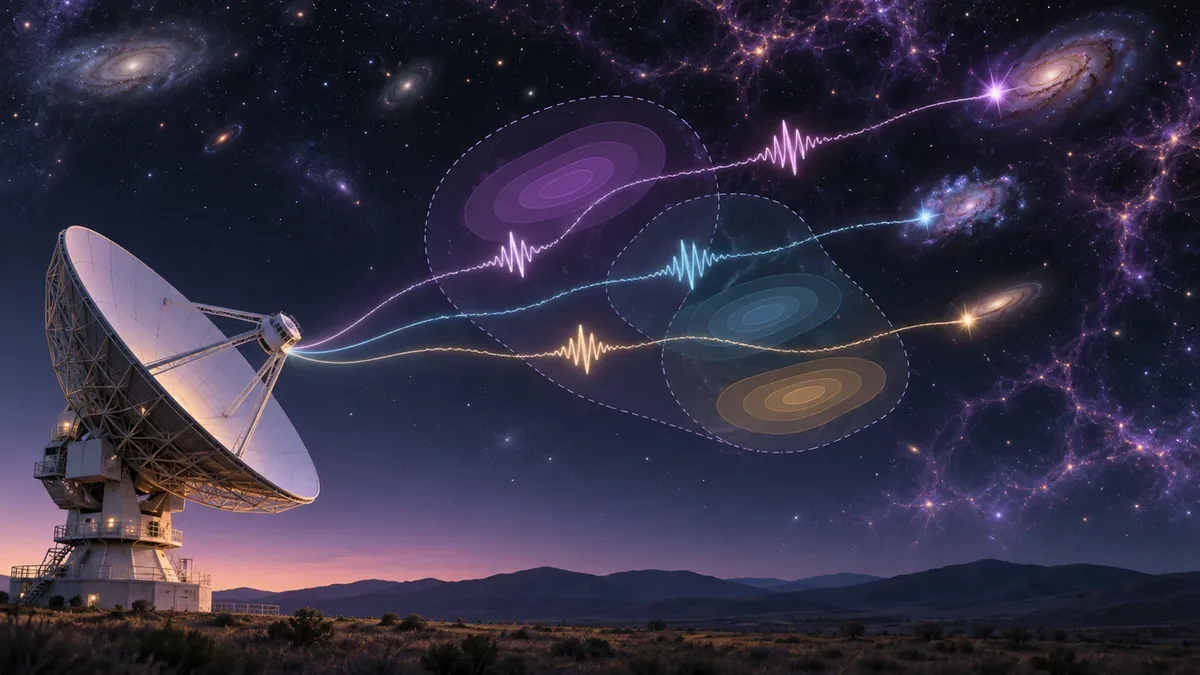
How often do fast radio bursts occur, and what can their population tell us about their energies and host galaxies? A study of CHIME’s second catalog estimates these properties while accounting for the telescope’s detection effects—and reports a mismatch its best-fit model does not explain.
Fast radio bursts (FRBs) are brief bursts of radio emission from beyond the Milky Way. A study using the Second CHIME/FRB Catalog fits several properties of the FRB population at once, while calibrating for instrumental selection effects: the ways a telescope’s sensitivity can shape which events it detects.
The researchers estimate the burst rate, the distribution of burst energies, how the rate may change over cosmic time, and the contribution of host galaxies to measured dispersion. Their results are model-based population estimates, rather than direct measurements of every FRB.
Rates and cosmic history
For bursts above an isotropic-equivalent energy of 10³⁹ ergs and below a scattering timescale of 30 milliseconds at 600 MHz, the inferred local rate is 1.1 × 10⁵ events per cubic gigaparsec per year. The reported uncertainty is asymmetric: +0.4 and −0.3 × 10⁵. These limits matter; the estimate does not describe all bursts regardless of energy or scattering.
The analysis does not statistically constrain how the FRB rate evolves relative to the cosmic star-formation rate. It therefore cannot determine from these data whether the two rates change together over cosmic history.
Energies and host-galaxy contribution
For the energy distribution, the researchers assume a Schechter-function form, isotropic emission and an emission bandwidth of 1 gigahertz. Under those assumptions, they estimate a characteristic maximum energy of 2.0 × 10⁴¹ ergs, with uncertainty of +2.6 and −1.0 × 10⁴¹ ergs. The reported differential power-law index is −1.41, with statistical uncertainty of +0.27 and −0.21, and systematic uncertainty of ±0.35. These estimates depend on the specified model and assumptions.
The team models the host-galaxy contribution to dispersion measure (DM) as a log-normal distribution. Assuming a total Milky Way contribution of 80 parsecs per cubic centimeter, they estimate a median host contribution of 199 parsecs per cubic centimeter in the host galaxy’s rest frame, with uncertainty of +34 and −36. This is an inferred population value conditional on the adopted model and Galactic contribution.
The average FRB spectrum is described by a spectral index of −1.0, with uncertainty of +0.5 and −0.6. The authors report that a flat average spectrum is inconsistent with their result at roughly the 2σ level. This indicates some evidence against a flat spectrum, but does not amount to a definitive result.
An unexplained feature
The observed sample contains an excess of high-signal-to-noise bursts at low DMs that the best-fit model does not predict. Testing alternative models did not remove this tension. The authors suggest that future population studies may mitigate the issue by incorporating robust measurements of burst fluence and redshift; the abstract does not claim that this will resolve it.
This account is based on the paper’s abstract alone. It does not provide the full methods, catalog-selection details or uncertainty analysis needed to assess the fitting in depth. The source is an arXiv preprint, and the available abstract does not establish whether it has undergone peer review. The reported values should therefore be understood in light of their stated assumptions and these source limitations.
- fast radio bursts
- CHIME/FRB
- radio astronomy
- FRB population
- dispersion measure
- astrophysics preprint
Related reading
Automatically matched by shared topic keywords. These links do not imply that the sources agree or establish a consensus.
Radio bursts offer tentative clues to gas around nearby galaxies
Source published
Shared keywords: astrophysics preprint, dispersion measure, fast radio bursts
What Two Radio Telescopes Reveal About Fast Radio Bursts
Source published
Shared keywords: fast radio bursts, radio astronomy
Fast Radio Bursts Map the Clumping of Cosmic Electrons
Source published
Shared keywords: dispersion measure, fast radio bursts
A Cross-Signal Search for the Universe’s Missing Baryons
Source published
Shared keywords: fast radio bursts
A probability-based way to flag fast-radio-burst sightlines
Source published
Shared keywords: dispersion measure, fast radio bursts