TRANSMISSION // 2611.28319v1
A food-picking robot learns what its scoop may leave behind
Source published
A model trained on production picks predicts food portions and changes to the pan’s surface, but its weak response to pick settings and failures on unseen targets limit its usefulness.
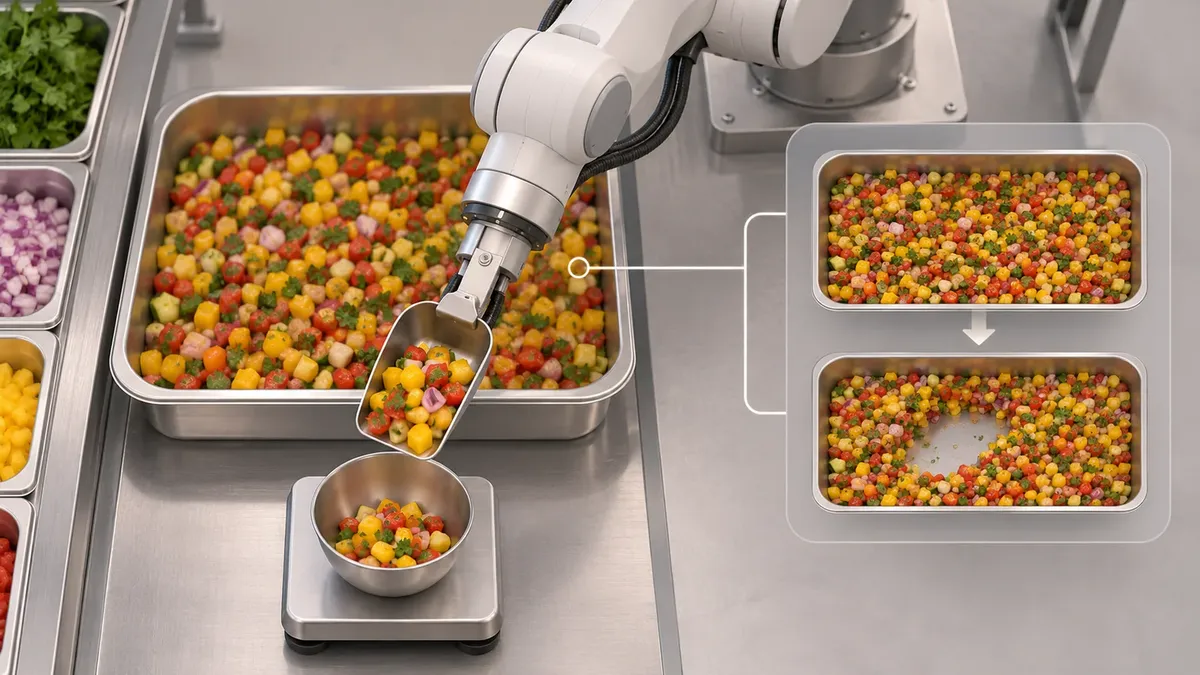
A robot portioning meals needs to do more than scoop a chosen amount: each pick changes the food surface it will encounter next. Researchers trained a model on production records to predict both the picked mass and the pan’s next surface state—and found important limits to what those records taught it.
A scoop of rice leaves a different surface from a scoop of broccoli. Sauce may flow back into a crater, while pieces can roll or fall. For a food-assembly robot, that changing surface matters: it must portion each ingredient near a requested weight, and its next pick starts from a pan altered by the last one.
A team of researchers trained a model to predict two outcomes of a pick: how much food the robot removes and how the pan’s surface changes. The work asks whether ordinary production records—rather than specially staged experiments—can teach a robot a useful model of those changes.
Learning from picks made in production
The researchers used records from food-assembly robots, where a top-down depth camera observes the pan and a scale measures the removed food. They checked and paired the records, then used 61,773 picks from nine foods for training. The model takes a pre-pick map of the pan’s height, the commanded pick and information about the food and utensil. Its neural network predicts the post-pick height map and the picked mass, along with an estimate of uncertainty for each.
For the mass evaluation, the team tested on 12,294 held-out picks. These were separated from training by production session, but the training and test sets still shared robots, sites and days. The authors compared predictions with the commanded target, a per-food average, the robot controller’s own mass estimate, and a gradient-boosted-tree model using 20 manually designed features. They also tested whether the model’s uncertainty could identify picks to leave unestimated; in that case, the robot would still pick, but the scale would be used to check the portion.
Better than some baselines, not the strongest mass predictor
With a correction based on earlier errors in the same production session, the model’s mass predictions had a root-mean-square error (RMSE) of 10.93 grams. That was about 9% lower than the error for either the commanded target or the per-food average, and 24% lower than the controller’s internal estimate. RMSE summarizes prediction errors while giving larger errors extra weight.
But the tree-based model did slightly better on mass alone: its RMSE was 10.73 grams, a difference of 0.20 grams in its favor. The neural network’s additional output is the predicted next surface, which could matter for planning future picks. In tests of that surface prediction, results depended on the region measured: near the next pick, one network performed better than a simple average crater, but near the current pick the crater baseline did better. The authors report that a flaw in the training mask—one that revealed some of the outcome—contributed to the near-pick result.
Using the model’s uncertainty to select which picks to answer, it returned estimates for 89.4% of picks, with an RMSE of 10.28 grams on those estimates. This is a selective result: the remaining picks were not answered by the model, and the scale still checked portions. The model’s uncertainty helped on average, but it did not reliably rank errors within each food.
Production data did not teach the effect of the command
The most consequential limitation concerns action. In normal operation, a controller chooses pick settings to stay close to the requested portion. As a result, the settings vary little. When the researchers changed commanded volume and depth in a test, the model’s mass prediction barely changed compared with what a mass proportional to volume would predict. The model had learned typical outcomes for foods and utensils more than the effect of changing the pick.
A replay at a new station showed another risk. The model worked on a few picks at a target weight seen during training, but substantially overestimated picks at target weights absent from training. Its uncertainty did not flag these predictions as unreliable. Thus, uncertainty-based rejection did not protect against this example of unfamiliar inputs.
The findings are evidence that production records can support a model that predicts both mass and surface change, but not that the model is ready to control a robot. The evaluation replayed recorded picks; the model had not been run on a robot. The authors also report that 16% of training records contained maps taken after the pick, and that two design choices were made using the final test split. These issues, together with the shared robots and sites across splits, limit how confidently the results show performance on new settings. The paper is a preprint submitted to IEEE for possible publication, not a peer-reviewed result in the version described here. The authors propose collecting more varied actions and improving the record checks as next steps.
- robotics
- food assembly
- world models
- robot learning
- production data
- uncertainty estimation
Reviewed cross-references
These connections were reviewed by a model, not independently fact-checked by a human. Similarity does not imply agreement; consult the original papers and the evidence below.
How robots can estimate when their actions are uncertain
Supporting evidence: Both studies report using predictive uncertainty to inform decisions, but in different settings and with different uncertainty estimates: the food-picking study declines its most uncertain production picks and reports 10.28 g RMSE on 89.4% of picks answered; CoMP is evaluated on simulated manipulation benchmarks for failure detection and demonstration selection. These results support the bounded proposition that uncertainty estimates can help guide selective or monitoring decisions, not that the methods or outcomes are directly comparable.
Model review: · openai-codex/gpt-6-luna
Evidence and provenance
Selected excerpts, not complete papers. PDF extraction can omit figures or damage equations, tables and reading order; sources may be preprints.
2611.28319v1 — Original paper
Excerpt reference:
static/papers/2611.28319v1.md:534-649
Basis: Paper text
Source SHA-256:0ffc905e1954bfaa134b0504c06ac122995d9d3e315660d4be912722a0e6d00d2611.26855v1 — Original paper
Excerpt reference:
static/papers/2611.26855v1.md:13-58
Basis: Paper text
Source SHA-256:d754f54ea3baef661a6e4ae8c5e820b2e3b71061c238c8fdf3faf38ba69579d8
Related reading
Automatically matched by shared topic keywords. These links do not imply that the sources agree or establish a consensus.
How robots can estimate when their actions are uncertain
Source published
Shared keywords: uncertainty estimation
How a Robot Can Predict a Moving Target
Source published
Shared keywords: robot learning, world models
A graph-based approach to robot world-model drift
Source published
Shared keywords: robot learning, world models
How an event camera can help track a spacecraft
Source published
Shared keywords: uncertainty estimation
Teaching Robots Through Verified Synthetic Touch
Source published
Shared keywords: robot learning, world models