TRANSMISSION // 2611.28250v1
What Two Radio Telescopes Reveal About Fast Radio Bursts
Source published
A study of 15 bursts detected by CHIME and DSA-110 compares their signals in separate radio bands and examines how propagation and survey selection shape what is detected.
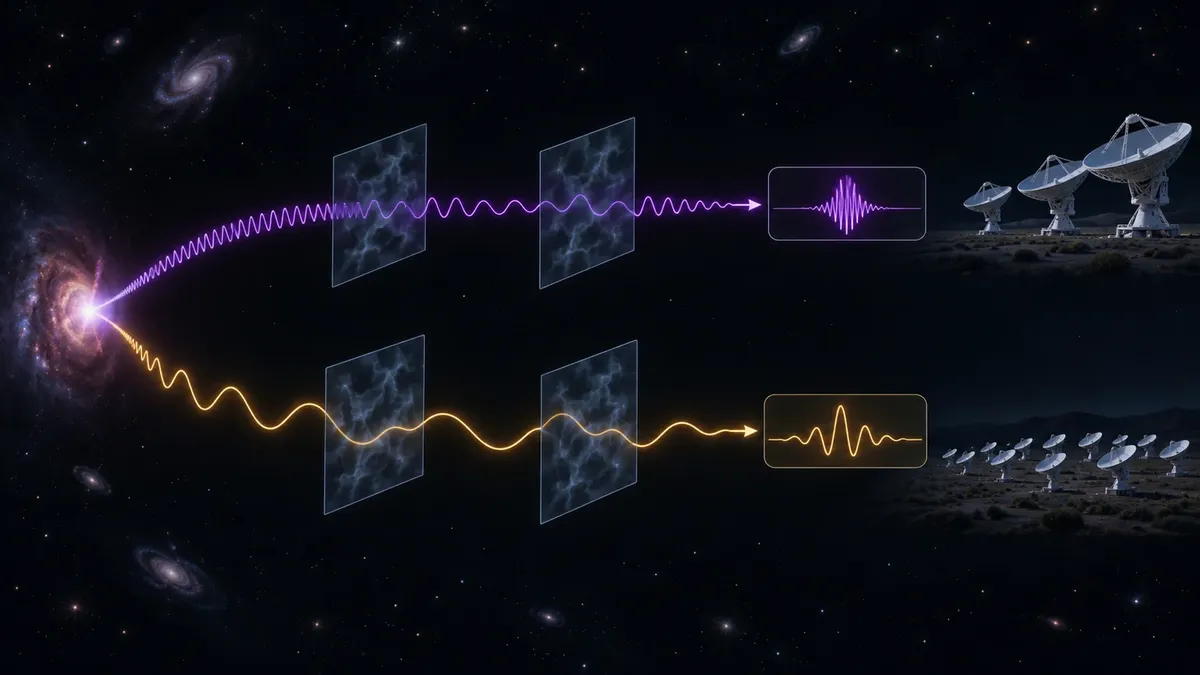
Fast radio bursts are brief radio signals whose spectra and pulse shapes can be altered as they travel. A study of 15 bursts detected by both CHIME and DSA-110 uses observations in the instruments’ separate frequency bands to examine their spectral properties and propagation effects.
Fast radio bursts (FRBs) are short-lived radio signals. Their observed spectra and pulse shapes can reflect both the bursts and the material their signals pass through. Comparing detections of the same event at different frequencies can help researchers study these effects.
In an arXiv preprint, S. K. Ocker and colleagues report 15 FRBs detected by both the Canadian Hydrogen Intensity Mapping Experiment (CHIME) and the Deep Synoptic Array (DSA-110) between 2022 and 2024. CHIME observes from 400–800 megahertz, while DSA-110 observes from 1,280–1,530 megahertz. The frequency bands do not overlap. Twelve bursts have channelized voltage data from both instruments, and nine have secure redshifts. All but one are not known to repeat.
Spectra across the two observing bands
Most bursts span the full bandwidth of each instrument. The authors say the detections expand the number of FRBs known to emit across more than one gigahertz of spectral bandwidth, helping constrain spectral evolution and propagation effects.
On average, the bursts have higher spectral energies in CHIME’s band, by as much as about a factor of 10, but lower peak flux densities there. The abstract attributes the lower peaks to substantial pulse broadening. It does not provide further detail about how that broadening affects the relationship between measured peak flux and energy.
The sample’s mean spectral index is −0.4 ± 0.4, and its median is −0.3 ± 0.4. These values are shallower than spectral indices reported previously; the authors suggest selection effects as a likely explanation. The finding concerns this jointly detected sample, and does not establish that its spectral properties represent FRBs more generally.
About a third of the sample shows evidence for a spectral turnover. The authors describe these as comparable to turnovers seen in GHz-peaked pulsar and magnetar spectra. This is a comparison of spectral features, not evidence that the bursts share a source or mechanism with those objects.
Scattering and which bursts are detected
The researchers combine constraints from scintillation and pulse broadening. Their analysis indicates that nearly all bursts encounter multiple scattering screens, with the pulse broadening originating within the host galaxies.
The jointly detected bursts are among the most scattered in the CHIME/FRB sample, while being the narrowest in the DSA-110 sample. The abstract says this indicates that CHIME/FRB and DSA-110 select different subsets of the FRB population. It also points to a narrow window for joint detection, shaped by the interplay between a burst’s intrinsic width, scattering, and the search’s time resolution.
The authors present these findings as a blueprint for future ultra-wideband FRB surveys. The results highlight that the properties of a jointly detected sample can depend on how instruments search, as well as on the bursts and their propagation.
What the evidence can and cannot show
This account is based on the paper’s abstract, not its full text. It therefore cannot assess the detailed methods, uncertainty analysis, or qualifications presented elsewhere in the paper. The work is an arXiv preprint; the supplied source does not establish whether it has been peer reviewed. The reported patterns apply to the 15 co-detections and should not be taken as conclusions about every FRB.
- fast radio bursts
- CHIME
- DSA-110
- radio astronomy
- pulse broadening
- scintillation
- radio surveys
Related reading
Automatically matched by shared topic keywords. These links do not imply that the sources agree or establish a consensus.
What CHIME’s second catalog reveals about FRBs
Source published
Shared keywords: fast radio bursts, radio astronomy
Why sparse scintillation makes fast radio bursts harder to measure
Source published
Shared keywords: fast radio bursts, radio astronomy
Can Fast Radio Bursts Reveal Hidden Hydrogen?
Source published
Shared keywords: fast radio bursts, radio astronomy
Radio bursts offer tentative clues to gas around nearby galaxies
Source published
Shared keywords: fast radio bursts
Fast Radio Bursts Map the Clumping of Cosmic Electrons
Source published
Shared keywords: fast radio bursts