TRANSMISSION // 2611.28236v1
Using Scintillation to Study the Double Pulsar
Source published
A scintillation analysis estimates the Double Pulsar’s distance and finds two scattering screens, while its nearly edge-on orbit limits precision.
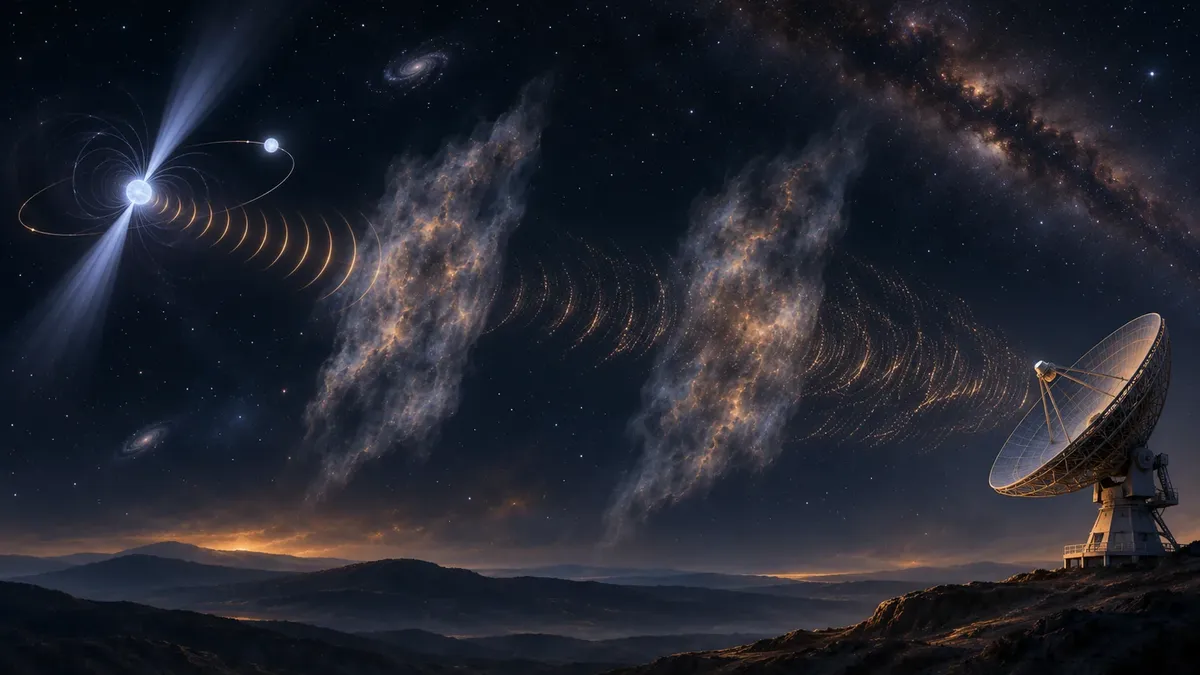
The Double Pulsar is useful for testing gravity, but existing distance estimates from pulsar timing and very long baseline interferometry disagree. Researchers explore a complementary approach: reading distance information from patterns in the pulsar’s scintillating radio signal.
PSR J0737−3039A, part of the Double Pulsar system, is a valuable target for tests of gravity. A more precise distance could also support future efforts to measure the fast pulsar’s moment of inertia, which would help constrain how matter behaves inside neutron stars.
Distance estimates from pulsar timing and very long baseline interferometry (VLBI) are in tension. This study explores scintillation as another source of distance information. Scintillation occurs when radio waves are scattered by material between the pulsar and Earth, producing changing patterns in the received signal. In this system, rapid orbital motion makes those patterns difficult to interpret.
Accounting for orbital motion
The researchers introduce an orbital-motion “resampling” technique to address that difficulty. They use it to fit for the binary’s properties and the material scattering the pulsar’s radio signal. The abstract also reports simulations designed to benchmark the technique and assess its uncertainties, but does not describe their setup or results in detail.
The resulting pulsar distance is 781 parsecs, with an uncertainty range of +62 and −94 parsecs. The authors say this estimate is in better agreement with the VLBI-based distance. The abstract does not specify how it compares with the timing estimate. The authors also find that the system’s nearly edge-on orbit prevents a precise distance measurement, so the result does not settle the disagreement.
Two scattering screens
For the principal scattering screen, the study estimates a distance of 270 parsecs, with uncertainties of +24 and −23 parsecs. It also reports an orientation of 73.1 ± 2.6 degrees east of north and a transverse speed of −15.2 ± 1.0 kilometres per second. The abstract gives the speed with a negative sign but does not specify the direction convention, so its meaning should not be inferred from the sign alone.
The researchers also report evidence for a second screen. Its properties are only partly determined: it is oriented roughly perpendicular to the principal screen and is at a distance of at least about 547 parsecs. The abstract does not provide a more precise distance or orientation for this screen.
These results provide a scintillation-based distance estimate and evidence that more than one scattering screen affects the signal. They do not directly measure the pulsar’s moment of inertia or constrain the neutron-star equation of state. The authors suggest that improvements to the method and use of information from the second screen could enable a more precise distance measurement.
This account is based on the paper’s abstract rather than a full examination of the manuscript, so details of the observations, modelling and simulations cannot be assessed here. The source is an arXiv preprint; the supplied information does not establish whether it has been peer reviewed. The estimates should be understood in light of those limitations and the authors’ stated precision constraint.
- Double Pulsar
- pulsar scintillation
- neutron stars
- radio astronomy
- scattering screens
- pulsar distance
Reviewed cross-references
These connections were reviewed by a model, not independently fact-checked by a human. Similarity does not imply agreement; consult the original papers and the evidence below.
What Two Radio Telescopes Reveal About Fast Radio Bursts
Supporting evidence: Both studies report evidence for multiple scattering screens in their respective settings: Montalvo et al. identify a second screen toward the Double Pulsar, while Ocker et al. infer multiple screens for nearly all bursts in their co-detected FRB sample. This supports only the bounded comparison that multiple screens occur in both studied settings, not a shared screen population or physical origin; both papers are preprints.
Model review: · openai-codex/gpt-6-luna
Evidence and provenance
Selected excerpts, not complete papers. PDF extraction can omit figures or damage equations, tables and reading order; sources may be preprints.
2611.28236v1 — Original paper
Excerpt reference:
static/papers/2611.28236v1.md:50-114
Basis: Paper text
Source SHA-256:79a2a5cca21e02932c67cd75a6ecde4a1e071d2b4d7b0b07db3235d750673ce42611.28250v1 — Original paper
Excerpt reference:
static/papers/2611.28250v1.md:44-89
Basis: Paper text
Source SHA-256:10855d97aff6170f63eea5bf382343bbb71a3ec217362cb3c6bdebe3e720b9db
Related reading
Automatically matched by shared topic keywords. These links do not imply that the sources agree or establish a consensus.
What Two Radio Telescopes Reveal About Fast Radio Bursts
Source published
Shared keywords: radio astronomy
Quieter satellites could protect radio astronomy and Earth-rotation measurements
Source published
Shared keywords: radio astronomy
How MAASAI coordinates astronomy analysis
Source published
Shared keywords: radio astronomy
FAST Reveals Filaments in a Magellanic Stream Field
Source published
Shared keywords: radio astronomy
A hybrid approach to calibrating radio arrays
Source published
Shared keywords: radio astronomy