TRANSMISSION // 2611.28231v1
Can an AI Agent Remember the Right Thing at Work?
Source published
Memanto completed 503 of 600 simulated workplace tasks, but the comparison changed the AI model and settings, so memory alone cannot be credited.
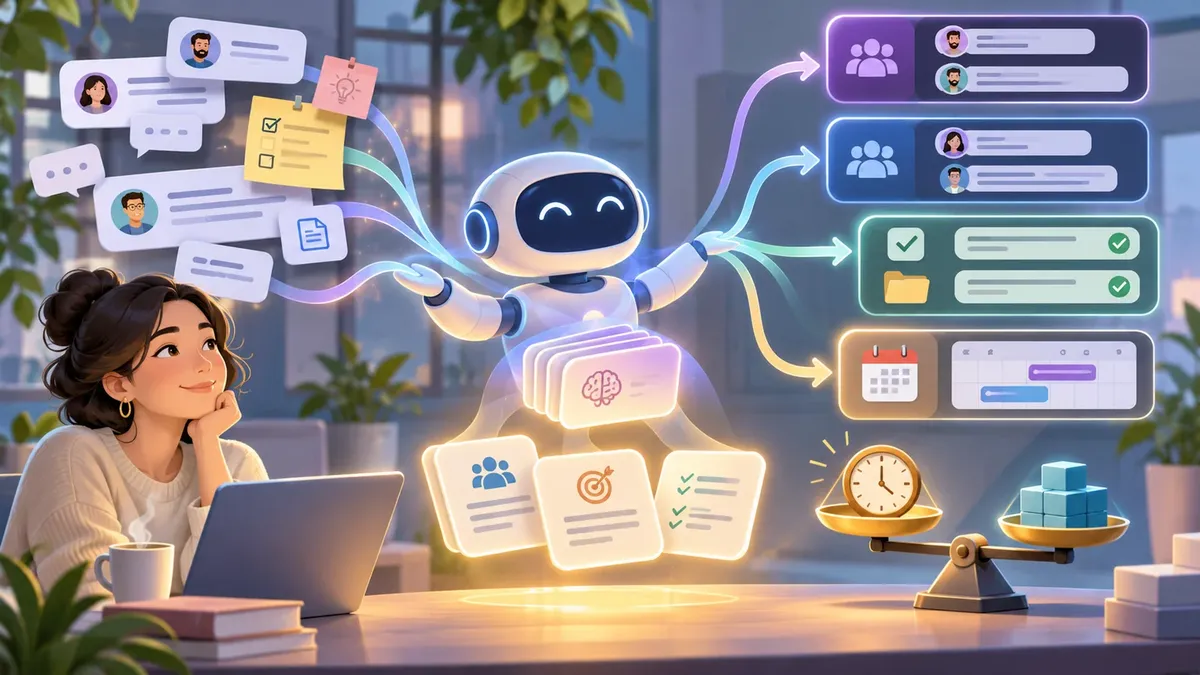
Workplace requests often leave important details unstated. To post an update, an AI agent may need to recall which channel the team uses and then act through an app. A preprint tests Memanto on simulated work tasks—and compares its completion, cost and speed with previously reported systems.
Workplace memory is more than answering questions
Many memory tests ask an AI agent a direct question about a past conversation: “Which messaging platform does the team use?” But a request to post an update in the team’s channel does not name the needed information. The agent must recognize that it needs past context, retrieve the relevant detail and use it correctly in a tool call.
The study evaluates Memanto, a memory agent that ranks stored information using an information-theoretic relevance score, on DolphinBench. The benchmark contains 600 simulated workplace tasks across three personas: a startup CEO, an infrastructure engineer and a product manager. Each persona has a history spanning several years and thousands of messages, including details that change over time.
DolphinBench’s authors retained a task only if GPT-5.6-Luna passed it in two runs with the relevant history and failed it in two runs without that history. This screening is intended to show that each task is solvable and genuinely depends on memory. Tasks are performed through simulated workplace applications and graded with deterministic checks and an AI judge.
How the Memanto run worked
The researchers ran Memanto in the Hermes agent harness with GPT-6-Luna. First, the agent processed each persona’s history and saved selected information to memory. The researchers then froze that memory and ran 200 tasks per persona, each in a fresh conversation. During task execution, the agent could retrieve up to 50 memories, subject to a relevance threshold, and had at most six iterations per conversation.
The comparison figures came from results previously reported by the DolphinBench authors; the researchers did not rerun those baseline systems. The reported Hermes baselines used GPT-5.6-Luna, high reasoning effort and up to 60 iterations per conversation. The Memanto run instead used GPT-6-Luna, medium reasoning effort and at most six iterations. The benchmark’s GPT-5.6-Sol judge graded the Memanto run using the benchmark’s grading process; the reported comparisons used that same judge. This common judge does not make the agent systems otherwise identical.
Strong results, but not a memory-only comparison
Memanto’s run passed 503 of 600 tasks, or 83.83%. The strongest reported Hermes baseline, Mem0, passed 424 tasks (70.67%). Memanto’s run reported a total cost of $10.86 and median task latency of 15.32 seconds. The cheapest reported Hermes baseline was built-in memory, at $61.48; the fastest reported Hermes run was Mem0, at 37.69 seconds median latency.
These are results for complete systems, not a controlled contest between memory designs. The agent model, reasoning effort and iteration limit differed. Those factors can affect completion, cost and speed, so the study cannot establish how much of the observed gap came from Memanto’s memory system. The authors also note that baseline figures were reported by another study, rather than collected again under matched conditions.
The Memanto run passed 170 of 200 tasks for Morgan, 166 for Alex and 167 for Riley—pass rates between 83.0% and 85.0%. The authors suggest that retrieving both an original fact and a later correction might help agents handle changing information. They did not isolate that effect, however. Matched-model comparisons, tests varying retrieval settings and analysis of the 97 failed tasks would help assess the explanation.
What the benchmark can—and cannot—show
The study illustrates why memory evaluation can include actions, not just answers: recalling a fact is not the same as using it correctly to complete a task. DolphinBench also reports cost and latency alongside task completion, making resource use visible. Still, these results concern a particular benchmark with synthetic personas and simulated applications; they do not establish how Memanto would perform in a real workplace.
This is an arXiv preprint, and the supplied source does not establish that it has undergone peer review. Several authors are affiliated with EdgeAI Innovations, which develops Memanto and the retrieval engine it uses. The authors report releasing scripts and results for reproduction. Independent replication and comparisons with matched models and settings would provide a stronger basis for attributing any advantage specifically to memory design.
- AI agents
- agent memory
- Memanto
- DolphinBench
- workplace simulations
- AI benchmarking
Related reading
Automatically matched by shared topic keywords. These links do not imply that the sources agree or establish a consensus.
When an AI agent remembers more—but has it learned?
Source published
Shared keywords: agent memory, ai agents
Can Minecraft agents find what they cannot see?
Source published
Shared keywords: ai agents
Task-specific memory helps coding agents retain useful skills
Source published
Shared keywords: agent memory, ai agents
MemSidecar puts AI memory retrieval on a separate track
Source published
Shared keywords: agent memory, ai agents
SumOne Trains a Small Model to Condense AI Agent Histories
Source published
Shared keywords: agent memory, ai agents