TRANSMISSION // 2611.28219v1
How surface codes can correct qubit leakage
Source published
Simulations compare foliated and SWAP-based surface-code circuits for skip-gate leakage. Which performs better depends on the leakage pattern and task.
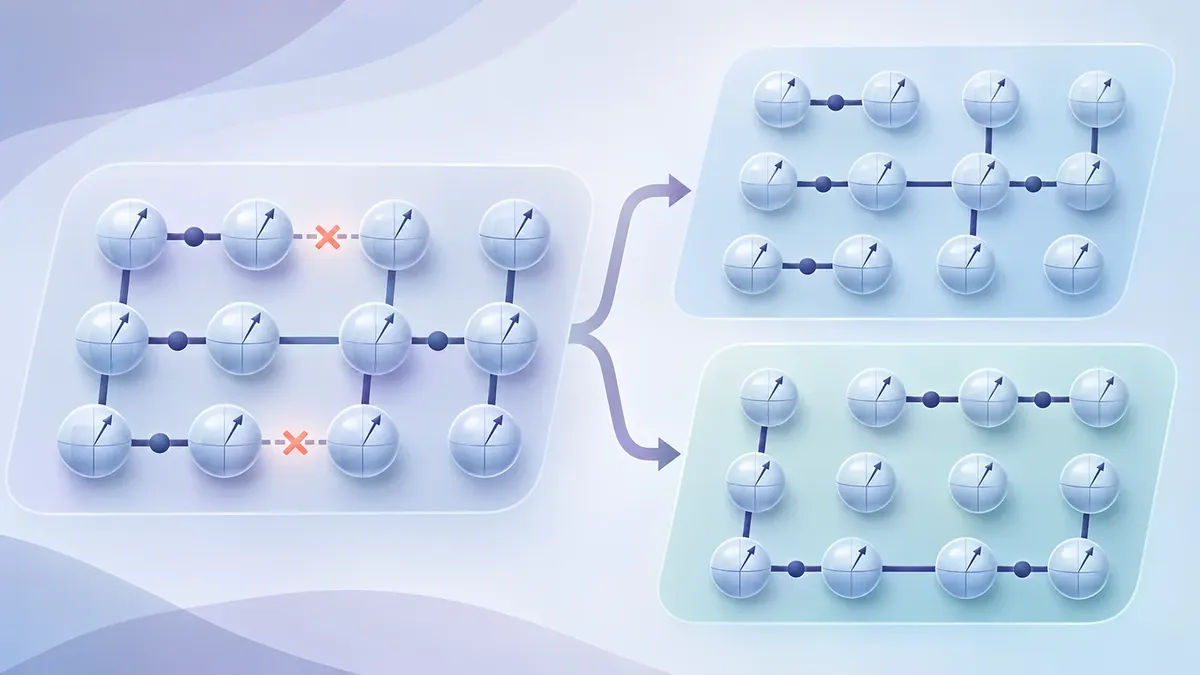
Some hardware errors take a qubit outside the states used to store quantum information. If later gates then skip that qubit, error-correction circuits must be designed with this possibility in mind. A new preprint compares two surface-code approaches using numerical simulations.
A qubit can leave its computational subspace through leakage—for example, when an atom is lost from a neutral-atom array or a photon is lost in a superconducting dual-rail qubit. In the scenario studied here, gates scheduled to act on a leaked qubit no longer act on it. The challenge is especially relevant when leakage is only detected when the qubit is measured: the circuit may need to measure all qubits periodically so the error can be identified.
Runjiang Bi and colleagues compare surface-code circuits built around SWAP operations with a foliated surface code. The abstract does not describe the circuits in enough detail to explain their construction, but it frames the comparison around how well each design handles leakage patterns extending across space or time.
The authors define a code as “optimal” if it corrects as many leakage errors as it can detect. By this measure, they report that the best SWAP-based surface code is optimal against space-like leakage configurations but not time-like ones. The foliated surface code, they report, is optimal against both.
What the simulations report
The evidence described in the abstract comes from numerical simulations. In one simulated setting, two-qubit gates have a leakage probability of 0.5%. For a distance-4 rotated stability experiment, the authors report that foliation suppresses time-like errors by a factor of 1380(50) per two added rounds, compared with 63(1) for the best SWAP-based circuit. These are results for that stated experiment and comparison, not a general performance rule. The abstract says the two approaches are comparable in memory tests.
The authors also simulate an experimentally motivated neutral-atom noise model. In that model, foliation outperforms SWAP-based circuits in stability tests for both rotated and unrotated code geometries. The reported result holds across a parameter sweep from computational-error-dominated noise toward atom-loss-dominated noise. There is an important qualification: for unrotated-code memory, a SWAP-based circuit performs best when computational noise dominates over loss.
Taken together, the findings do not identify one circuit as best in every setting. The authors argue that error-correction circuit design should be matched to the dominant error patterns and considered alongside the logical operations the computer needs to perform.
What remains uncertain
These are simulated results, not a report of a hardware demonstration. The abstract does not provide the details needed to assess the full noise models, decoding methods, parameter ranges or how far the results extend beyond the cases tested. In particular, the suppression factors belong to a specified distance-4 stability comparison and should not be treated as universal guarantees. The abstract also does not explain the stability experiment’s protocol, so its label alone does not establish precisely what was measured.
This account is based on the preprint’s abstract rather than a full examination of the paper. The supplied source information does not establish whether the work has undergone peer review. Its conclusions are therefore best understood as claims supported by the authors’ numerical simulations, not as demonstrated hardware performance.
- quantum error correction
- surface codes
- quantum leakage
- foliated surface codes
- neutral-atom quantum computing
- numerical simulations
Reviewed cross-references
These connections were reviewed by a model, not independently fact-checked by a human. Similarity does not imply agreement; consult the original papers and the evidence below.
A proposed shortcut to addressable quantum gates
Shared method: Both papers use teleportation within quantum error-correction circuits: the origin paper teleports logical information to fresh qubits each syndrome cycle to remove leakage, while Pecorari et al. use gate teleportation with an auxiliary code to implement addressable logical Clifford operations. The shared method is teleportation; the papers study different goals and do not establish comparative performance.
Model review: · openai-codex/gpt-6-luna
Evidence and provenance
Selected excerpts, not complete papers. PDF extraction can omit figures or damage equations, tables and reading order; sources may be preprints.
2611.28219v1 — Original paper
Excerpt reference:
static/papers/2611.28219v1.md:66-153
Basis: Paper text
Source SHA-256:bfe0e14ab3d25d0fe1791b6d0427c11d391d62b52865b7ccaa9017d2794ccb242511.06124v2 — Original paper
Excerpt reference:
static/papers/2511.06124v2.md:65-137
Basis: Paper text
Source SHA-256:4ce5e80365ee5a034433100f59f31c002cfc0843b23d73827ad0bad021d71d78
Related reading
Automatically matched by shared topic keywords. These links do not imply that the sources agree or establish a consensus.
A confidence score could speed up atom-array readout
Source published
Shared keywords: neutral atom quantum computing
GARI++ splits quantum error correction into a fast first pass and a smaller cleanup
Source published
Shared keywords: quantum error correction, surface codes
Why finite surface codes can obscure coherent-error recovery limits
Source published
Shared keywords: quantum error correction, surface codes
Tracing photon noise from atomic scattering to quantum algorithms
Source published
Shared keywords: quantum error correction, surface codes
Why trapped-ion error correction may need cooling built into the schedule
Source published
Shared keywords: quantum error correction, surface codes