TRANSMISSION // 2611.28154v1
Medical-image AI needs more than realistic-looking synthetic scans
Source published
A toolkit called ScoreCard evaluates synthetic medical images across multiple dimensions, revealing gaps that image-realism metrics alone can miss.
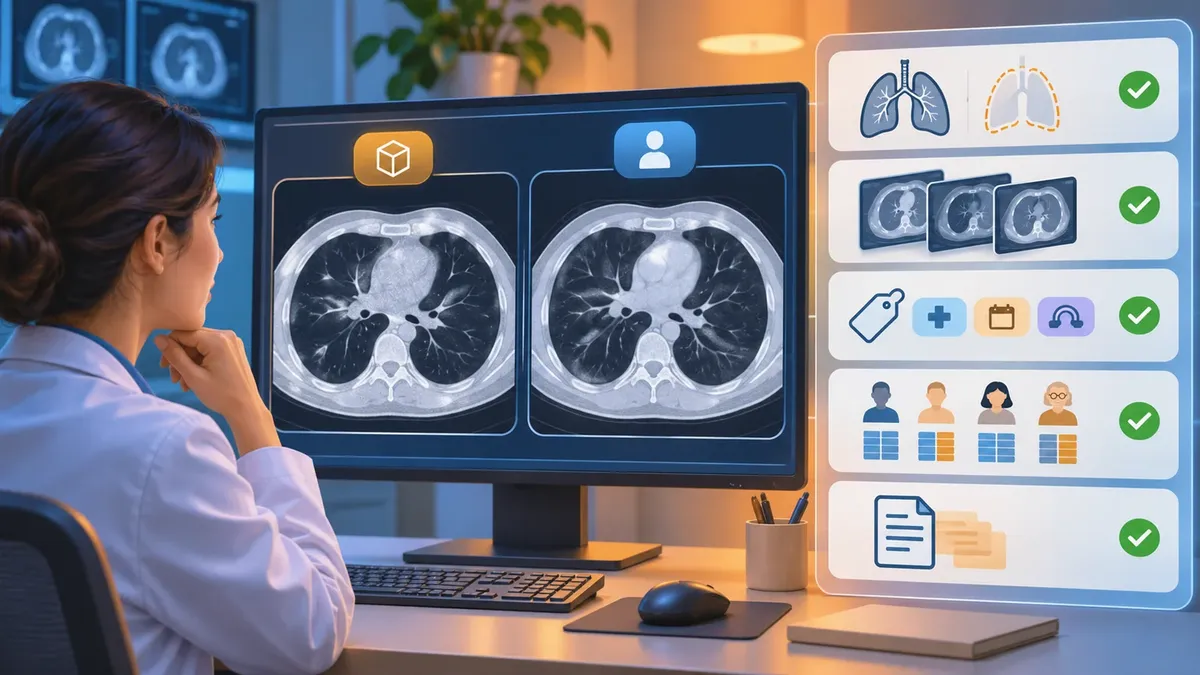
Synthetic scans may help researchers work around limited medical data, but looking realistic is not the same as being useful. ScoreCard offers a broader way to inspect what generated datasets contain—and what they leave out.
A synthetic medical scan can look convincing and still be a poor stand-in for patient data. It might omit important variation, contain implausible anatomy, or lack metadata researchers need. A new open-source toolkit, ScoreCard, is designed to help examine those differences rather than reduce dataset quality to a single measure of visual realism.
The study’s central question is practical: what should researchers check before using synthetic medical images to develop or evaluate machine-learning systems? Common image-generation metrics, such as Fréchet Inception Distance, compare image features or distributions. But they do not directly establish whether anatomy is plausible, subgroups are represented consistently, metadata is complete, or the generation process is well documented.
A scorecard with several dimensions
ScoreCard organizes its evaluation around six dimensions from the 7Cs framework: Congruence, or how closely synthetic and patient data align in selected features; Coverage, or how much of the patient-data variation the synthetic set represents; Completeness, including whether expected metadata is present; Consistency, including differences across subgroups; Constraint, which checks specified clinical or anatomical rules; and Comprehension, which concerns documentation and transparency.
The seventh dimension, Compliance, is not measured by the toolkit. The authors say responsibility for assessing relevant regulations, institutional policies, and ethical obligations remains with dataset providers. Comprehension is also different from the numerical image-based checks: it is assessed using qualitative documentation criteria.
The toolkit’s pipeline preprocesses patient-reference and synthetic data, extracts selected features, calculates metrics, and assembles a report. Researchers can choose among features such as intensity, texture, shape, and features from machine-learning models. The choice matters: results describe data in the selected feature space, and a feature set that misses a clinically important property cannot assess that property. The authors do not propose universal pass-or-fail thresholds.
Three kinds of images, different issues
The team demonstrated the workflow on synthetic whole-slide pathology patches, mammography, and head CT angiography. The examples were not a clinical trial of AI systems; the aim was to show how the assessment pipeline works and what kinds of dataset characteristics it can surface.
In the pathology example, the scorecard identified metadata gaps even where image-feature comparisons suggested generally strong alignment and coverage. The synthetic set had more missing metadata than its patient reference, according to the paper. The analysis also found a small number of feature-level constraint violations, including differences in appearance-related measures. This illustrates why visual or distributional similarity alone does not settle whether a dataset is complete or plausible for a particular use.
For mammography, the tested synthetic sets differed in how their extracted features aligned with the patient reference. For head CT, the phantom-based synthetic datasets represented a narrower range of measured variation than the patient scans. These are findings about the particular datasets and features examined—not evidence that synthetic mammography or CT data are generally inadequate.
What the results do—and don’t—show
ScoreCard’s main contribution is a structured way to report multiple kinds of evidence side by side. Its outputs can help researchers spot distributional gaps, missing information, or potential constraint violations that a fidelity-focused metric might not reveal. The toolkit is available as open-source Python software, with reporting and visualization components.
The study does not show that a high ScoreCard result guarantees clinical usefulness, or that a low result predicts poor performance in a specific AI task. The authors explicitly say the analysis does not establish clinical validity or suitability for a particular intended use. They also note that their demonstrations use one patient-reference dataset per modality, which may limit how much variation is represented. Their analyses linking the toolkit’s measures to downstream model performance are ongoing.
Feature selection is another important uncertainty: the toolkit’s conclusions depend on which characteristics are measured and how relevant those characteristics are to the intended application. The paper presents ScoreCard as a way to inform assessment alongside expert judgment, not replace it. It is an arXiv preprint, so readers should treat the reported demonstrations as research in progress rather than as established clinical guidance.
- synthetic medical imaging
- medical AI
- dataset evaluation
- ScoreCard
- medical data quality
- artificial intelligence
Reviewed cross-references
These connections were reviewed by a model, not independently fact-checked by a human. Similarity does not imply agreement; consult the original papers and the evidence below.
Synthetic surgical images with labels: a bleeding-detection test
Supporting evidence: Both papers motivate evaluating medical-image data beyond generic visual or fidelity measures: Kahaki et al. describe clinically relevant properties ScoreCard is designed to assess, while Nataraj et al. identify limits of traditional image-quality metrics for clinical relevance in surgical-image synthesis. This supports the bounded point that image-quality metrics alone may not establish clinical usefulness; the studies use different methods and datasets, and neither directly validates the other’s evaluation approach.
Model review: · openai-codex/gpt-6-luna
Evidence and provenance
Selected excerpts, not complete papers. PDF extraction can omit figures or damage equations, tables and reading order; sources may be preprints.
2611.28154v1 — Original paper
Excerpt reference:
static/papers/2611.28154v1.md:60-99
Basis: Paper text
Source SHA-256:cc5f60a756a9c21a06e88af64000808842d31a4c66e85ec5be2786a750b22bdc2611.28154v1 — Original paper
Excerpt reference:
static/papers/2611.28154v1.md:488-525
Basis: Paper text
Source SHA-256:cc5f60a756a9c21a06e88af64000808842d31a4c66e85ec5be2786a750b22bdc2506.14303v2 — Original paper
Excerpt reference:
static/papers/2506.14303v2.md:257-313
Basis: Paper text
Source SHA-256:ad51f03740cc6566bec93c9c3b3411075de762046bc0de469bbe7104331c6246
Related reading
Automatically matched by shared topic keywords. These links do not imply that the sources agree or establish a consensus.
When a Better AI Score Means an Easier Cheese-Recognition Task
Source published
Shared keywords: artificial intelligence, dataset evaluation
A broader test for medical AI recommendations
Source published
Shared keywords: medical ai
Federated AI generates brain MRI scans with a diversity trade-off
Source published
Shared keywords: synthetic medical imaging
Testing Control in Text-to-CT Generators
Source published
Shared keywords: synthetic medical imaging
MedicalRSI aims to help medical AI learn from mistakes
Source published
Shared keywords: medical ai