TRANSMISSION // 2611.28144v1
Could an unusual quantum starting state ease inflation’s ACT tension?
Source published
A theoretical study finds that scale-dependent excited scalar modes could bring two inflation models closer to ACT DR6 results, under specific assumptions.
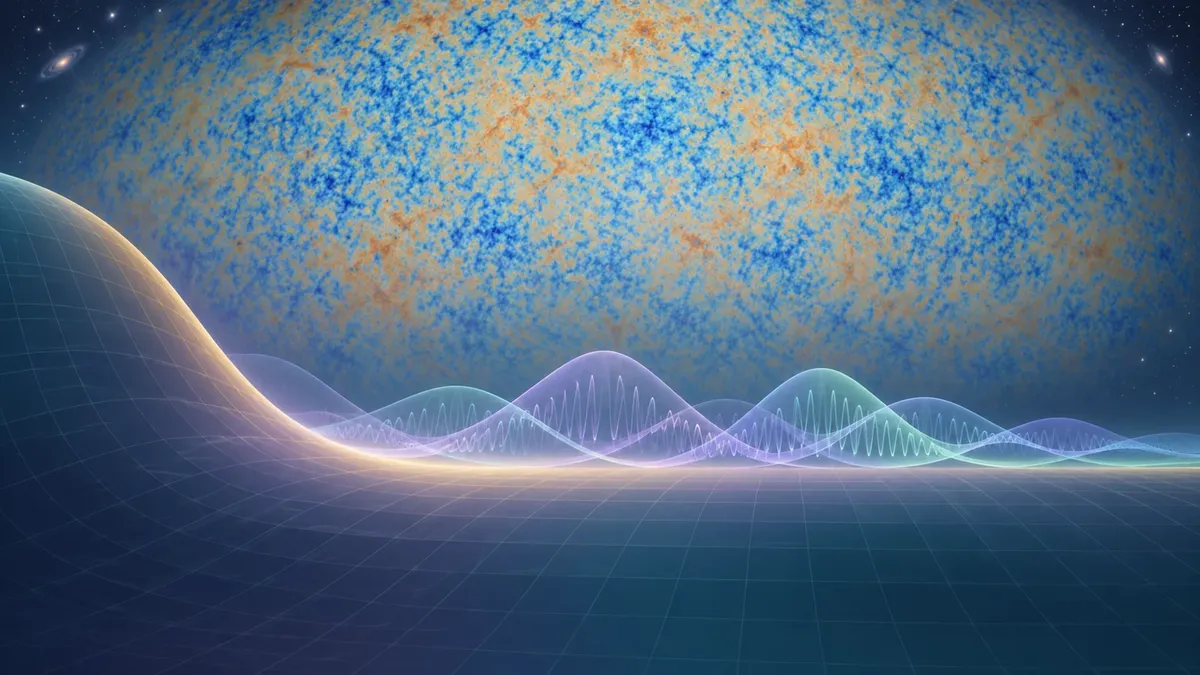
New measurements of the cosmic microwave background pose a challenge for two familiar inflation models. A preprint explores whether changing the assumed quantum starting state of primordial fluctuations—not the models’ underlying potentials—could ease that tension.
The early universe’s tiny fluctuations eventually grew into the cosmic structure we see today. Inflationary models describe how those fluctuations began, and observations of the cosmic microwave background (CMB), the afterglow of the hot early universe, help test their predictions.
A new theoretical study asks whether two well-known models—Starobinsky inflation and quadratic chaotic inflation—can better match recent results from the Atacama Cosmology Telescope (ACT). The authors’ proposed adjustment is not to alter either model’s inflaton potential, the energy landscape that drives inflation. Instead, they relax an assumption about the initial quantum state of the fluctuations.
Changing the assumed starting point
The usual choice is the Bunch–Davies vacuum, a standard reference state for quantum fluctuations during inflation. The authors consider “excited” alternatives for scalar perturbations—the fluctuations associated with the density variations that later seed cosmic structure. In their framework, the effects of this state are described by an excitation parameter and a phase. If these quantities vary with scale, they can change the predicted scalar spectral index, which describes how fluctuation strength varies across scales, and its running, or the change in that index.
The team derives how those scale-dependent quantities shift the predicted index and running. It then maps combinations of excitation and phase that can fit within the paper’s stated one-standard-deviation ACT DR6 ranges, meet an upper limit on the tensor-to-scalar ratio (a measure of gravitational-wave strength relative to scalar fluctuations), and satisfy a theoretical requirement that the new-physics scale remain above the Hubble scale during inflation.
For this analysis, the ACT values are taken from a combination that includes Planck data, CMB lensing and DESI baryon acoustic oscillation measurements. The authors also assume that tensor modes remain in the Bunch–Davies state and examine cases where either the excitation parameter or the phase varies with scale, rather than allowing both to vary together.
What the calculations find
In the standard starting state, both models have a scalar spectral index and running that the authors describe as being in tension with the combined ACT results. The quadratic chaotic model also predicts a tensor-to-scalar ratio above the bound used in the study. The Starobinsky model’s ratio, by contrast, is already below that bound.
The calculations identify allowed excited-state parameter ranges for both models. For Starobinsky inflation, the authors report that scale dependence can provide the needed shifts across much of the parameter space they examine, with limited excluded regions. For the quadratic model, the state must also suppress the tensor-to-scalar ratio. That requirement calls for a comparatively substantial excitation, with the new-physics scale limited to roughly six times the Hubble scale or less. The authors say this makes the quadratic-model option more constrained.
When the excitation parameter alone varies with scale, the analysis finds a minimum magnitude for its rate of change in both models. For the quadratic model, it also derives narrower ranges for that rate and its second derivative. These are conditions within the authors’ theoretical setup, not measurements of an actual excited state.
A possible test—and important caveats
If scalar modes are excited while tensor modes stay in the standard state, the paper predicts a departure from the usual inflationary consistency relation linking the tensor-to-scalar ratio and the tensor tilt. Future measurements of the tensor spectrum and its tilt could test that prediction. The authors also point to primordial non-Gaussianity—patterns beyond simple Gaussian fluctuations—as another possible observational probe.
This is a model-based reconciliation, not evidence that excited initial states occurred in the universe. The study focuses on two benchmark models, fixes the duration of inflation at 60 e-folds, and treats the phase and excitation parameter as scale-dependent separately. Allowing both to vary would open up a broader parameter space, while exciting tensor modes would change the analysis. Its conclusions therefore depend on assumptions that future work and observations can examine.
The source is a preprint prepared for submission to the Journal of Cosmology and Astroparticle Physics; the supplied record does not establish that it has passed peer review. Its results should be read as a theoretical proposal rather than a settled interpretation of ACT data.
- cosmic inflation
- ACT DR6
- cosmic microwave background
- Starobinsky inflation
- quantum initial states
- early universe
Related reading
Automatically matched by shared topic keywords. These links do not imply that the sources agree or establish a consensus.
Inflation models face a small-scale test—and a black-hole problem
Source published
Shared keywords: cosmic inflation, cosmic microwave background, early universe
No convincing cosmic ripple yet
Source published
Shared keywords: cosmic inflation, cosmic microwave background
A Python tool traces possible signals from the early universe
Source published
Shared keywords: cosmic inflation
A simpler route through Planck’s large-scale polarization data
Source published
Shared keywords: cosmic microwave background
ACT’s cosmic map looks ordinary overall—with a few curious patches
Source published
Shared keywords: act dr6, cosmic microwave background