TRANSMISSION // 2611.28123v1
AI can map radio coverage—but struggles to trace signal paths
Source published
RadioVISTA tests vision-language models on simulated cities. Leading models often judge radio coverage well but struggle to identify the paths that produce it.
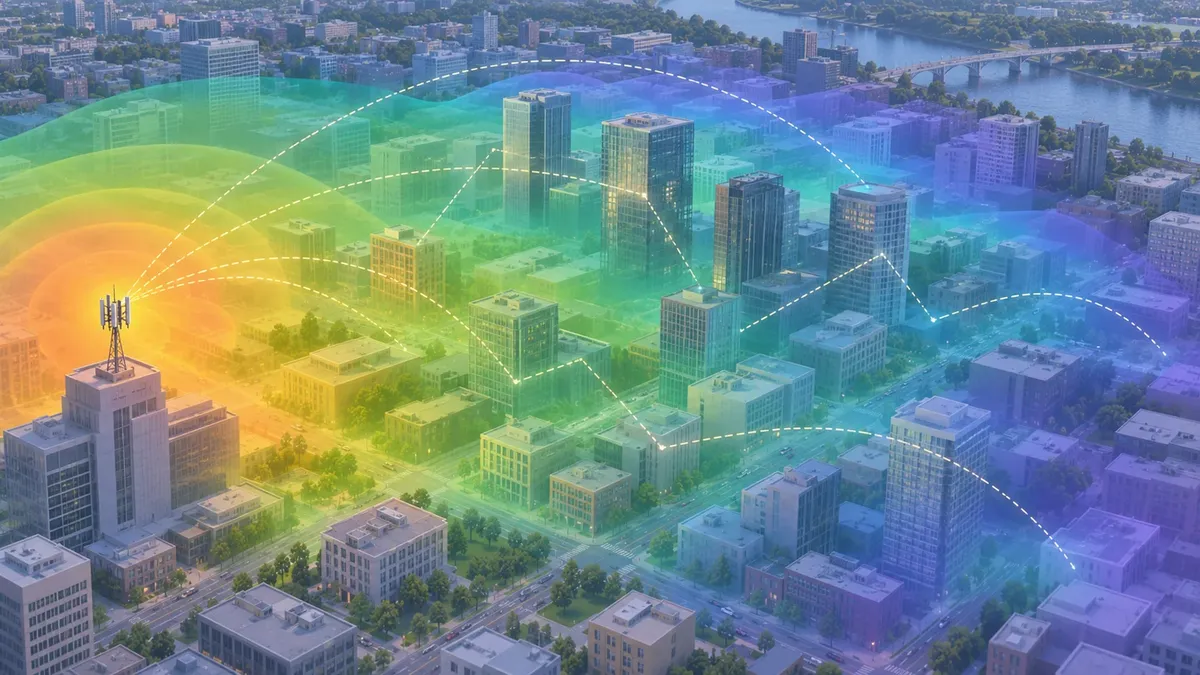
Radio waves are invisible, but buildings and streets shape how they travel. A benchmark using simulated cities tests whether vision-language models can infer the hidden radio field—and finds a gap between judging coverage and tracing individual paths.
A city image can show buildings, streets and trees, but not the radio signals moving among them. Those signals matter for wireless networks, and their strength depends partly on visible structures. Could a vision-language model (VLM)—an AI system that processes images and text—infer radio coverage from a view of a city?
A paper introducing the RadioVISTA benchmark tests that question. Its central finding is a mismatch: some leading models can identify areas with strong radio coverage yet struggle to decide whether a signal has a particular route, such as a direct path or one involving a single wall reflection. The authors call this “field–path dissociation.”
Building a simulated city test
Testing this ability requires reference answers and comparisons where one physical factor changes while others stay fixed. Real-world measurements cannot easily switch off reflections or alter ground materials while leaving the rest of a city unchanged.
The authors built an automated system that combines open geographic data to create ray-traceable city scenes. A radio-propagation simulator calculates signal fields and creates matched scenarios that vary physical conditions, including propagation modes and ground materials. The paper reports a benchmark spanning 100 cities across six continents, with test cities held apart from those used for training. Questions and answers are generated from simulated geometry and fields, without human annotation.
RadioVISTA tests three related abilities: recognizing spatial geometry, reasoning about signal propagation, and judging the combined coverage field. The authors evaluated 19 VLMs on 1,200 questions from 17 held-out cities. They also fine-tuned a 9-billion-parameter open model using data generated by their system.
Reading the field is not tracing a path
The strongest proprietary models performed well on several tasks involving the overall field. The paper reports that the two leading models identified the best-covered urban region in roughly nine out of ten cases. But on a narrower question—whether a direct or one-wall signal path exists—accuracy was 76.5% for one leading model and 61.8% for the other. The task’s random-guessing baseline was 50%.
Open models had a different difficulty: in the initial evaluation, they struggled to read the displayed fields. None exceeded 36.3% on physics-aggregation tasks, against a 25% random baseline. Fine-tuning changed that picture for one model. On unseen test cities, its overall score rose from 36.0% to 77.5%, while its physics-aggregation score rose from 27.9% to 89.7%. Yet the fine-tuned model answered “No” to every question about the single-path task. Its accuracy there reflected how often “No” was the right answer, rather than reliable path tracing.
The authors interpret this gap as evidence that learning to predict an overall outcome does not necessarily teach the intermediate geometry that produces it. A radio field combines contributions from many possible routes; identifying one route calls for a different judgment. In these experiments, neither supervised fine-tuning nor reinforcement fine-tuning improved path tracing.
What the findings can tell us
RadioVISTA’s matched simulations let researchers compare controlled scenarios and calculate answers from simulated geometry and fields. Those answers are exact within the benchmark’s setup; they are not direct measurements of radio coverage in real cities. The results describe performance on the models, questions, prompts and simulated conditions tested. They do not establish how the models would perform across every city, frequency, network design or real-world measurement task.
The study also shows why a strong score on an outcome can leave important reasoning untested. A model may identify where coverage is high without correctly identifying a route that contributes to it. The authors’ training experiments suggest that supervising final answers alone did not teach the tested model to trace single-path geometry; they propose that training on intermediate physical reasoning may be needed.
This work is available as an arXiv preprint. The supplied paper text does not establish its peer-review status, and the findings should be understood as the authors’ reported results rather than independent confirmation. RadioVISTA offers a way to test a specific kind of physical reasoning, but its conclusions remain bounded by the benchmark and experiments described in the paper.
Source: RadioVISTA preprint on arXiv.
- vision-language models
- radio propagation
- RadioVISTA
- AI benchmarks
- wireless networks
- ray tracing
Related reading
Automatically matched by shared topic keywords. These links do not imply that the sources agree or establish a consensus.
A Transformer Tries to Read the Geometry Hidden in Wireless Echoes
Source published
Shared keywords: ray tracing
MedUIGym tests whether AI can navigate clinical software
Source published
Shared keywords: ai benchmarks, vision language models
Why a personal AI assistant needs to find the right person first
Source published
Shared keywords: ai benchmarks, vision language models
Can AI Write a Game Controller, Not Just Pick a Move?
Source published
Shared keywords: ai benchmarks, vision language models
When Should a Driving AI Admit It Hasn’t Seen Enough?
Source published
Shared keywords: ai benchmarks, vision language models