TRANSMISSION // 2611.28068v1
A probability-based way to flag fast-radio-burst sightlines
Source published
A model that accounts for uncertain host-galaxy gas ranks individual fast radio bursts for searches of possible foreground structures—but its candidates are not detections.
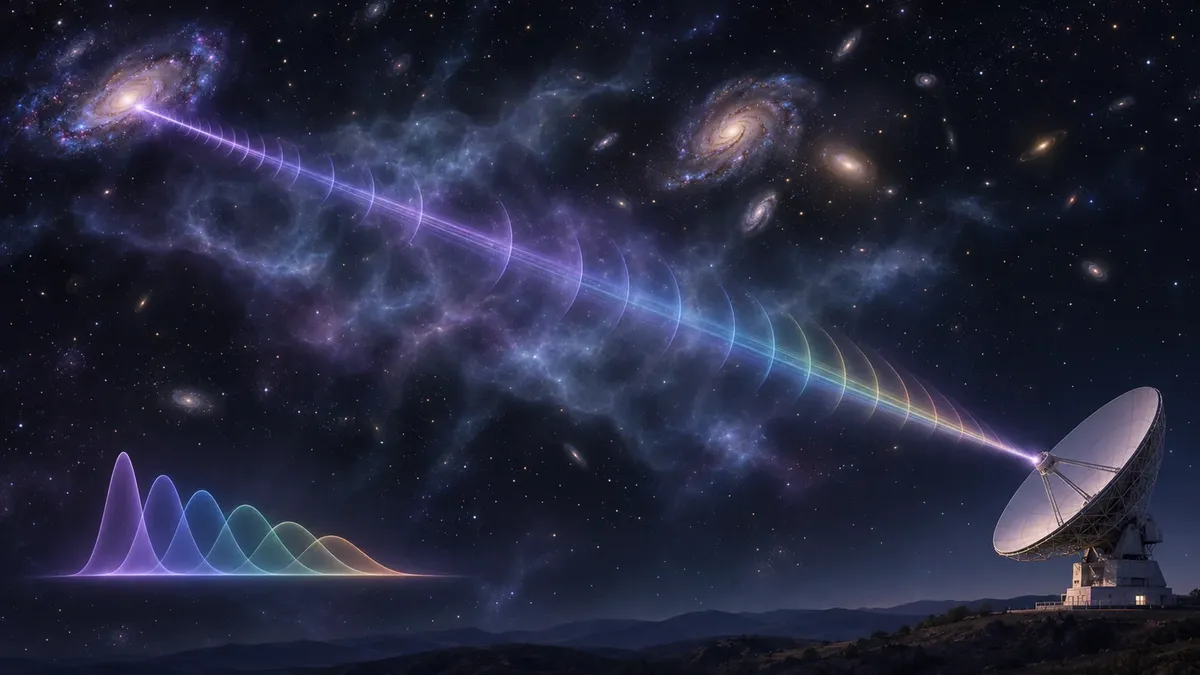
A fast radio burst’s radio waves are delayed by free electrons along their path. That makes the burst a probe of cosmic gas, but also leaves a puzzle: if one burst has an unusually large dispersion measure, did the extra electrons come from its own galaxy or from structures between us and the source? A new preprint proposes a probabilistic way to rank such sightlines while allowing for uncertainty in the host-galaxy contribution.
Fast radio bursts (FRBs) are brief radio flashes whose arrival times vary with frequency as they travel through ionized gas. The size of this delay, expressed as a dispersion measure (DM), reflects the number of free electrons accumulated along the path. For cosmological FRBs, that path includes the source’s host galaxy, the space between galaxies, intervening galaxy halos and our own Milky Way.
The challenge is that researchers cannot usually measure the host galaxy’s contribution directly. A large DM relative to the average expected at an FRB’s distance might therefore reflect gas near the source, an unusually electron-rich foreground, or both. The authors of a new arXiv preprint ask whether the uncertainty can be handled explicitly to help identify individual bursts worth investigating for possible foreground structures.
Modeling the uncertain host contribution
The team analyzed a sample of 92 localized FRBs—bursts whose positions and distances have been determined well enough to associate them with host galaxies. They treated each host’s DM as an unknown quantity, or latent variable, drawn from a shared lognormal population. In plain language, the model assumes a common, skewed distribution of host contributions rather than assigning every burst the same fixed value.
They used an expectation–maximization (EM) method to estimate the population distribution and each source’s likely host contribution together. The analysis also modeled scatter around the average cosmological DM–redshift relation with a redshift-dependent, skewed residual distribution. For each burst, the researchers then calculated a distribution of excess cosmological DM: the residual after subtracting the estimated Milky Way contribution, the average cosmological contribution at that redshift and the modeled host contribution.
From that distribution, they calculated the model-conditioned probability that the residual is positive. A positive residual means the measured DM remains above the model’s average expectation after those terms are accounted for. It can point to an unusually electron-rich path, but it does not identify the gas or establish where it lies.
A shortlist, not a detection list
The authors report that FRBs previously discussed as having possible foreground or intervening contributions tended to have higher values of this probability. Using a probability threshold of 0.7, they selected 18 additional localized FRBs as priorities for follow-up searches for possible intervening galaxies, groups, clusters or larger-scale structure.
That threshold is a ranking choice, not a physical detection threshold or a measure of statistical significance. The authors note that two sources with probabilities of about 0.7003 and 0.6998 fall on opposite sides despite being nearly indistinguishable by this measure. The 18 candidates should therefore be understood as targets to investigate—not as confirmed foreground systems or an exhaustive inventory.
The method’s central contribution is to carry uncertainty in the host DM into the source-by-source assessment, rather than treating the host contribution as known. It also preserves a probability and an uncertainty range for each sightline instead of reducing the result to a simple yes-or-no label. The paper reports a fitted mean host contribution of 154.5 pc cm⁻³, while emphasizing that the population model is an assumption shared across the sample.
What the probability cannot tell us
The probability is conditional on the choices in the model; it is not the probability that a particular foreground galaxy or cluster exists. A positive excess might arise from intervening structures, but also from host-galaxy gas or fluctuations in the intergalactic medium that the model does not fully capture. The paper says the ranking does not directly measure the amount of foreground DM.
Several uncertainties remain. The analysis adopts a fixed Milky Way halo contribution and uses one host-DM population, even though host environments may differ. The authors also flag systematic differences between Galactic electron-density models and scatter in intergalactic and halo gas. These effects are not fully included in the reported parameter-uncertainty analysis, and source-level probabilities—particularly for lower-redshift bursts—may be sensitive to them. The fitted residual skewness is weakly constrained by the sample, and the comparison trend based on nine previously reported foreground cases is described by the authors as a qualitative guide, not a formal prediction.
The study is available as an arXiv preprint, a research manuscript that may not have completed peer review. Its results are best read as a proposed way to prioritize observations, not as proof that the flagged bursts pass through specific foreground structures. Imaging, spectroscopy and improved constraints on each burst’s host and line of sight will be needed to test those possibilities.
- fast radio bursts
- dispersion measure
- cosmic baryons
- intervening galaxies
- host galaxies
- foreground structures
Related reading
Automatically matched by shared topic keywords. These links do not imply that the sources agree or establish a consensus.
Fast Radio Bursts Map the Clumping of Cosmic Electrons
Source published
Shared keywords: cosmic baryons, dispersion measure, fast radio bursts
Fast Radio Bursts Hint at Extra Gas Along Group Sight Lines
Source published
Shared keywords: cosmic baryons, dispersion measure, fast radio bursts
A radio burst’s crowded path reveals the challenge of tracing cosmic gas
Source published
Shared keywords: dispersion measure, fast radio bursts
What CHIME’s second catalog reveals about FRBs
Source published
Shared keywords: dispersion measure, fast radio bursts
A Cross-Signal Search for the Universe’s Missing Baryons
Source published
Shared keywords: fast radio bursts