TRANSMISSION // 2611.28054v1
Dark Matter and the Evolution of Strange Stars
Source published
A model of dark-matter-admixed strange quark stars finds lower mass limits but no delayed collapse during the early stages studied; stability is inferred, not tested with radial oscillations.
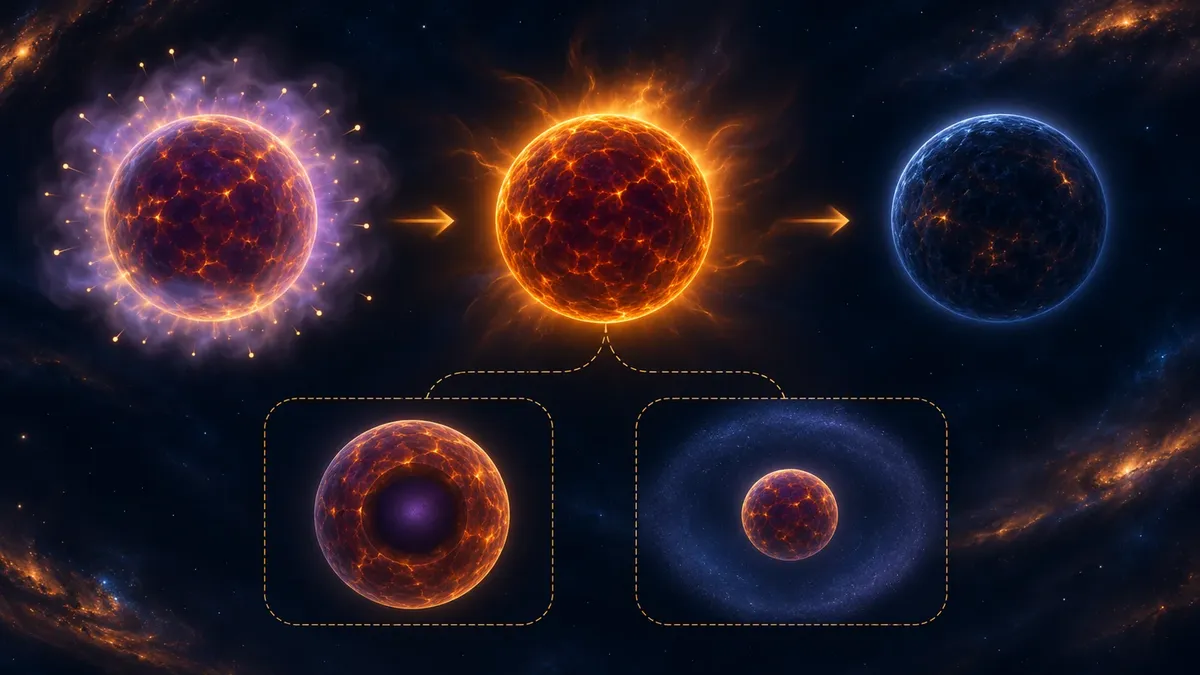
Could dark matter affect whether a newborn strange quark star remains stable as it evolves? A theoretical study models three stages—from neutrino-trapped birth through a heated, neutrino-free phase to a cold state—and finds no dark-matter-triggered delayed collapse in the cases examined.
Strange quark stars are hypothetical compact stars made mostly of deconfined quarks. In these models, matter is bound by the strong interaction, and the star can have a sharp surface. No observation has established that such stars exist. A new theoretical study asks what might happen if one contained fermionic dark matter as it changed from a neutrino-trapped newborn star to a heated stage after neutrinos escape, and then cooled to a cold state.
The question is whether that evolution could make a star unstable and lead to delayed collapse into a black hole. The researchers focus on strange quark stars, whose matter is modeled as already containing up, down and strange quarks throughout the sequence. That makes their model different from scenarios in which the loss of trapped neutrinos changes the star’s composition.
Modeling two components
Rajasmita Sahoo and Mrutunjaya Bhuyan describe the quark matter with a finite-temperature MIT bag model. It includes thermal gluons and a repulsive interaction among quarks, which stiffens the equation of state—the relation between pressure and density. They consider three quasistatic stages: a neutrino-trapped stage, a heated stage after deleptonization (the loss of lepton number as neutrinos escape), and a cold stage.
The dark matter is modeled as a separate, cold gas of asymmetric fermions, with particle masses of 0.3, 1 or 3 giga-electronvolts. The authors test cases with and without repulsive interactions among the dark particles. In the model, dark matter interacts with quark matter only through gravity: the two components do not exchange heat, and dark matter does not couple directly to neutrinos.
Using two-fluid Tolman–Oppenheimer–Volkoff equations, which describe the balance of pressure and gravity in a spherical star in general relativity, the researchers calculate stellar structure, maximum masses and tidal deformability. Tidal deformability measures how much a star is distorted by a companion’s gravity. They consider dark-matter fractions up to 5%. To follow an individual star through the stages, they keep its numbers of baryons and dark-matter particles fixed, rather than fixing its dark-matter fraction.
Effects depend on the model
In the cases studied, dark matter generally lowers the maximum mass and tidal deformability. For 1 GeV dark matter at a 5% mass fraction, the calculated maximum mass is about 8% lower, and the tidal deformability of a 1.4-solar-mass star about 26% lower, in each stage. Across the examined cases, the stage itself changes these quantities by only a few percent. These comparisons are model results, not general predictions for every possible star or dark-matter model.
The dark component’s distribution varies with its particle mass, the dark-matter fraction, the quark equation of state and the star’s mass. Heavy dark matter can form a compact core. Light dark matter can form an extended halo; 1 GeV dark matter can also extend slightly beyond the quark surface in some configurations. For the fractions considered, a halo does not increase the maximum mass. With 3 GeV dark matter and no self-interaction, the dark core can reach its own mass limit, setting the maximum mass of the combined star.
The main conclusion about evolution comes from tracking the largest baryon mass supported at fixed particle numbers. In every case considered, this limit rises from the neutrino-trapped stage toward the cold stage. Dark matter lowers the limit—for 1 GeV particles at fractions of 1–5%, by about 0.04 to 0.23 solar masses—but does not change that ordering. The authors therefore find no dark-matter-caused delayed collapse in their modeled scenarios.
This is an inference about stability, not a direct calculation of the star’s oscillation modes. The authors use a particle-number criterion to identify the stability limit, but do not solve the coupled radial-oscillation eigenvalue problem. They identify that calculation, particularly near the dark core’s own mass limit, as a useful next step.
Limits and implications
In this framework, matching pulsars with masses around twice the Sun’s requires a stiff quark equation of state. The dark-matter fraction is then limited to a few percent unless the particles are light. The authors’ comparison with gravitational-wave constraints does not exclude the dark-matter cases they test, but it is approximate: the observation constrains a binary system, not the tidal deformability of a single 1.4-solar-mass star.
The conclusions depend on substantial assumptions. The early evolution is represented by selected equilibrium stages, not a full simulation of neutrino transport. The model uses a bag-model equation of state without perturbative QCD corrections, assumes a bare star without a crust, and treats dark matter as cold and coupled to quark matter only through gravity. The dark-matter abundance is uncertain and is treated as a parameter.
The source is an arXiv preprint. The calculations offer a result within this particular model, not evidence that strange quark stars or dark matter inside them have been observed: dark matter lowers the modeled mass limit, but does not cause delayed collapse in the scenarios examined.
- strange quark stars
- fermionic dark matter
- compact stars
- stellar stability
- tidal deformability
- theoretical astrophysics
Reviewed cross-references
These connections were reviewed by a model, not independently fact-checked by a human. Similarity does not imply agreement; consult the original papers and the evidence below.
A dark-star model links a mass ceiling to gravitational-wave signatures
Supporting evidence: Both papers describe self-bound compact-star models with a finite-density surface: the origin paper attributes this to strange quark matter, while Lopes finds it in a scalar–vector dark-fermion model. This is a shared structural feature, not evidence that the models have the same microphysics or observable properties; the dark-star result depends on its chosen couplings and saturation assumptions.
Model review: · openai-codex/gpt-6-luna
Evidence and provenance
Selected excerpts, not complete papers. PDF extraction can omit figures or damage equations, tables and reading order; sources may be preprints.
2611.28054v1 — Original paper
Excerpt reference:
static/papers/2611.28054v1.md:68-120
Basis: Paper text
Source SHA-256:09a67a3467ca701b783569e21b31e581702935dc738e8fa1968d2f912ae46d0a2611.10662v1 — Original paper
Excerpt reference:
static/papers/2611.10662v1.md:1216-1387
Basis: Paper text
Source SHA-256:8ddfe7dacca4c286e923c7f16e5e23d4b3853b5c51388096788f8c1d7ef6f5b5
Related reading
Automatically matched by shared topic keywords. These links do not imply that the sources agree or establish a consensus.
Could dark matter explain unusually compact stars?
Source published
Shared keywords: fermionic dark matter
A spinning white dwarf’s tidal response depends on how the star changes shape
Source published
Shared keywords: theoretical astrophysics, tidal deformability
A dark-star model links a mass ceiling to gravitational-wave signatures
Source published
Shared keywords: tidal deformability
Neutron Star Tides Could Complicate Tests of Einstein’s Gravity
Source published
Shared keywords: tidal deformability
How Magnetism and Spin Shape Strange Quark Stars
Source published
Shared keywords: strange quark stars