TRANSMISSION // 2611.28052v1
How shock-driven plasma jets may spark magnetic reconnection
Source published
Two-dimensional particle simulations trace how high-speed jets behind a collisionless shock compress magnetic fields into reconnecting current sheets and contribute to electron energization.
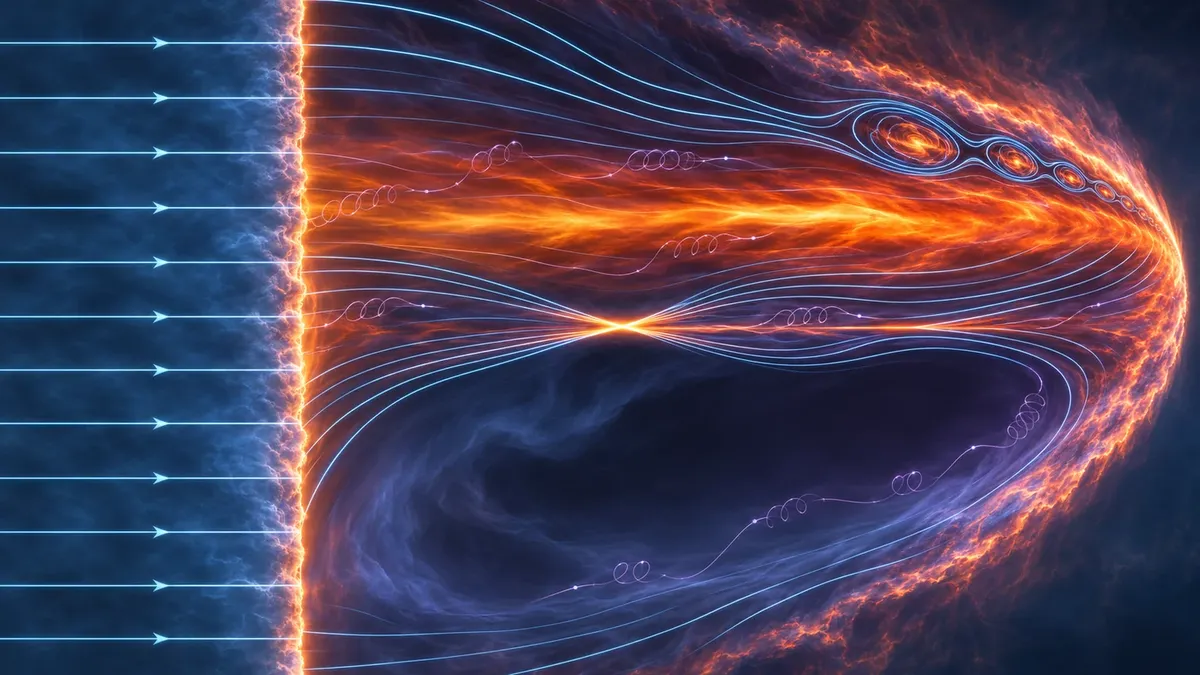
When plasma crosses a collisionless shock, fast-moving jets can form downstream. A new simulation study explores how those jets compress magnetic fields into thin sheets with signs of reconnection, and how electrons gain energy in the process.
A collisionless shock is a boundary where plasma changes rapidly without ordinary particle collisions driving the change. Such shocks occur in space, including where solar-wind plasma passes Earth’s bow shock. They can produce high-speed jets: localized flows with unusually high dynamic pressure. Magnetic reconnection—a rearrangement of magnetic fields that can transfer electromagnetic energy to particles—has also been observed downstream of shocks. How jets and reconnection are connected has remained an open question.
In an arXiv preprint, Wanxin Ouyang and colleagues investigate that connection using two-dimensional, full particle-in-cell (PIC) simulations of a parallel shock. PIC models track particles and electromagnetic fields together. The authors say their numerical resolution adequately captures most upstream fluctuations and the downstream reconnection region they examine; that is not a claim that every relevant process at every scale is resolved. The simulated shock front reforms over time, and the researchers compare runs with different ion-to-electron mass ratios.
The simulations suggest a sequence. Large, low-frequency waves ahead of the shock, called foreshock ULF waves, contain regions with different dynamic pressures. As the shock front reforms, high-pressure portions pass through it and form downstream jets; neighboring low-pressure portions become cavities. The jets carry bent magnetic-field structures. At a jet’s leading edge, compression produces a bow wave and squeezes magnetic fields pointing in opposing directions into a thin current sheet.
The simulated sheet shows several signs associated with reconnection: an X-point and magnetic-island patterns, enhanced energy-conversion diagnostics near the X-point, and outflows on both sides of it. Both electrons and ions flow outward in opposite directions from the X-point; the electron outflows are faster, while the ion outflows extend across a broader region. The authors interpret the combined signatures as ion-coupled reconnection. These are features in a simulation, not direct measurements of every step in an observed event.
The team also analyzes electron energization. Their diagnostic separates contributions associated with the electric field parallel to the magnetic field, betatron energization from changing magnetic-field strength, and Fermi energization linked to particle motion in curved structures. All three contribute in the modeled reconnection region. The betatron contribution is especially visible near the X-point, where the jet compresses the magnetic structure. The simulated electron-energy distribution has a high-energy tail above its thermal core; the paper says the tail is not a power law in this case.
The mass-ratio comparisons show that the simulated jets’ shapes depend on this parameter. At lower ratios, jets fragment more readily and are shorter-lived. At higher ratios, they become longer and wider, with clearer bow waves. The authors associate this trend with increasing ion inertia. Because the tested ratios are below the real proton-to-electron mass ratio, the trend does not establish exactly how jets would behave at the real value.
The setup also limits what can be concluded. The simulations are two-dimensional, whereas real plasmas are three-dimensional. The authors note that three-dimensional magnetic structures, instabilities, turbulence, and particle transport could change reconnection and energization. They model a particular parallel-shock configuration, not every shock geometry or space-plasma environment. The results therefore offer a proposed mechanism to investigate, not a universal explanation for shock-driven jets.
This work is an arXiv preprint and may not have completed peer review. The article is based on the supplied paper text and abstract; extracted equations and figures can lose formatting, and unrelated search results are not independent confirmation. Comparisons with spacecraft observations and future three-dimensional simulations could help establish how broadly the proposed link applies.
- collisionless shocks
- high-speed plasma jets
- magnetic reconnection
- particle-in-cell simulations
- electron energization
- space plasma
Reviewed cross-references
These connections were reviewed by a model, not independently fact-checked by a human. Similarity does not imply agreement; consult the original papers and the evidence below.
Two gamma-ray-producing regions emerge in black hole simulations
Shared method: Both studies use particle-in-cell simulations: Ouyang et al. use 2D full PIC for a parallel shock, while Kin et al. use 2D general-relativistic PIC for a black-hole magnetosphere. This is a shared simulation method, not evidence that their different plasma settings or findings directly corroborate one another.
Model review: · openai-codex/gpt-6-luna
Evidence and provenance
Selected excerpts, not complete papers. PDF extraction can omit figures or damage equations, tables and reading order; sources may be preprints.
2611.28052v1 — Original paper
Excerpt reference:
static/papers/2611.28052v1.md:13-68
Basis: Paper text
Source SHA-256:c18ba2f2dfcb188267747d98616abba3d8ea23bb81374cae6b34183bcdec1ea22611.10428v1 — Original paper
Excerpt reference:
static/papers/2611.10428v1.md:12-61
Basis: Paper text
Source SHA-256:86dee3a43bb6b6d376d8972be538bd2efe29c73033c9a3acea33c7becc4746db
Related reading
Automatically matched by shared topic keywords. These links do not imply that the sources agree or establish a consensus.
Two gamma-ray-producing regions emerge in black hole simulations
Source published
Shared keywords: magnetic reconnection, particle in cell simulations
A hidden magnetic field may steady pulsar current sheets
Source published
Shared keywords: magnetic reconnection, particle in cell simulations
How magnetic fields steer plasma waves and electron heating
Source published
Shared keywords: particle in cell simulations
Magnetic disturbances could reshape polarized light around black holes
Source published
Shared keywords: magnetic reconnection
Magnetic field geometry changes the pace of simulated reconnection
Source published
Shared keywords: magnetic reconnection