TRANSMISSION // 2611.28025v1
Why AI Teams Give Layout Instructions Differently
Source published
In a small study of webpage wireframes, people refined designs over many short turns, while most AI speakers described much of the layout at once. AI-AI teams scored higher on the study’s human-preference-based measure, especially for matching element proportions—but the result is exploratory.
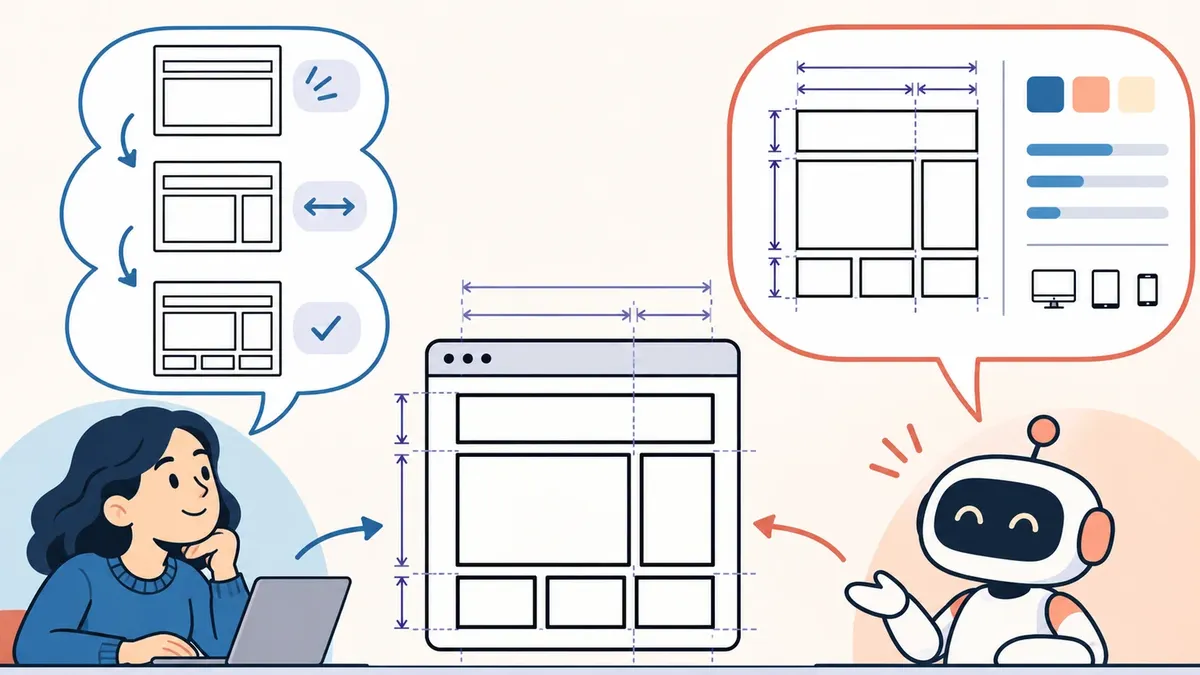
When a webpage is built through conversation, does it matter whether the instructions come from a person or another AI? A small study suggests the two kinds of teams work differently—and that a specific weakness in describing proportions may explain a gap in their scores.
A conversation about rectangles
Describing a complete webpage in one sentence is difficult. People often start with a rough idea, inspect what an AI produces, and ask for changes. To study this back-and-forth, researchers compared human-AI teams with AI-AI teams: in both, a “speaker” gave instructions to the same webpage-building model, which generated a wireframe.
The study focused on five simple, black-and-white webpage layouts made of labeled rectangles and nested containers. There was no text or color to reproduce. Instead, the task was to match features such as which elements appeared, their relative sizes and positions, their ordering, and how evenly elements were represented across containers.
How the comparison worked
Participants saw a target wireframe and could inspect each generated page before deciding what to request next. Their sessions had time limits. The AI-speaker condition used three different vision-language models to issue instructions to the same builder model used in the human condition.
Rather than asking another AI to judge the results, the researchers built a scoring function from human choices. Nineteen people compared pairs of generated layouts with their targets, producing 718 decisive pairwise judgments. A statistical model used these preferences to weight geometric features and create a similarity score. The researchers then applied that score to the human- and AI-led sessions.
Only six participants contributed sessions that met the study’s inclusion criteria for analysis. The paper reports 11 qualifying sessions and around 90 instructions overall. That small sample is important: the study offers an early look at a narrow task, not a reliable estimate of how people and AI teams will perform across design work generally.
Different rhythms, different strengths
Most AI speakers tried to specify much of the layout in their first instruction. The human participants tended to build it up in stages, using shorter messages. In the paper’s comparison of instruction length, humans wrote roughly a third as many characters per instruction as the flagship speaker model, Claude. Gemini also tended to front-load its instructions, while Qwen was more incremental.
On the study’s final similarity scores, human-AI teams scored below AI-AI teams. The researchers traced much of that difference to matching the shapes’ proportions—particularly aspect ratios, or how wide an element was compared with its height. Humans were nearly on par with the language models on other measured features, including the ordering of elements and their placement into nested structures.
This does not mean that people cannot give precise design instructions. In these sessions, they tended to describe size and position in broad, comparative terms rather than specify exact measurements. That may be harder for a builder model to translate into a close geometric match. The experiment examined wireframes under controlled conditions, not finished websites with content, color, usability requirements, or a designer’s broader goals.
The researchers also tested whether they could make Claude’s instructions more human-like. A limit on how many elements it could mention per turn made its progress more gradual, but its final score remained around 0.930, compared with 0.749 for humans. A short-instruction cap and a prompt containing examples of human instructions did not produce a significant shift in the reported trajectory or final score. These results suggest that changing an AI speaker’s style is not necessarily enough to reproduce human performance; they do not establish why the gap persists.
What the score can—and cannot—say
The preference-based score is a useful alternative to having an AI judge its own kind, but it has a key limitation. Its weights were fitted using human-generated candidates, and people did not provide preference judgments on the AI-generated pages. The authors note that some AI outputs, especially on aspect-ratio matching, extended beyond the range of candidates used to fit the scoring function. Because that feature matters to the central comparison, the human-versus-AI score gap deserves particular caution.
The work is an arXiv preprint, and the supplied source does not establish that it has undergone peer review. Its small participant sample, five simple targets, single builder model, and study-specific scoring approach limit how far the results can be generalized. The paper points to further comparisons—including human-human design teams—as useful next steps.
For now, the study’s clearest contribution may be methodological: testing multi-turn AI collaboration means looking not just at the finished artifact, but at how instructions unfold. People and AI speakers followed noticeably different conversational strategies, and a scoring method grounded in human preferences offered one way to examine what those differences mean.
- human-AI collaboration
- AI-AI teams
- multi-turn instruction following
- layout generation
- human-computer interaction
- large language models
Related reading
Automatically matched by shared topic keywords. These links do not imply that the sources agree or establish a consensus.
What Your Typing Can—and Can’t—Reveal When Prompting AI
Source published
Shared keywords: large language models
Pairing predictive AI with a medical reference chatbot to explain diabetes classifications
Source published
Shared keywords: human computer interaction, large language models
When a Virtual Person’s Words and Body Tell Different Stories
Source published
Shared keywords: human computer interaction, large language models
When Should an AI Advising Assistant Step Back?
Source published
Shared keywords: human ai collaboration, large language models
Can AI Make Scientific Reasoning Easier to Check?
Source published
Shared keywords: human ai collaboration, large language models