TRANSMISSION // 2611.28015v1
Teachers tested AI chatbots—but often not for misuse
Source published
A study of 214 educator-built chatbots finds that routine testing was common, while iterative refinement and tests of adversarial use were less so.
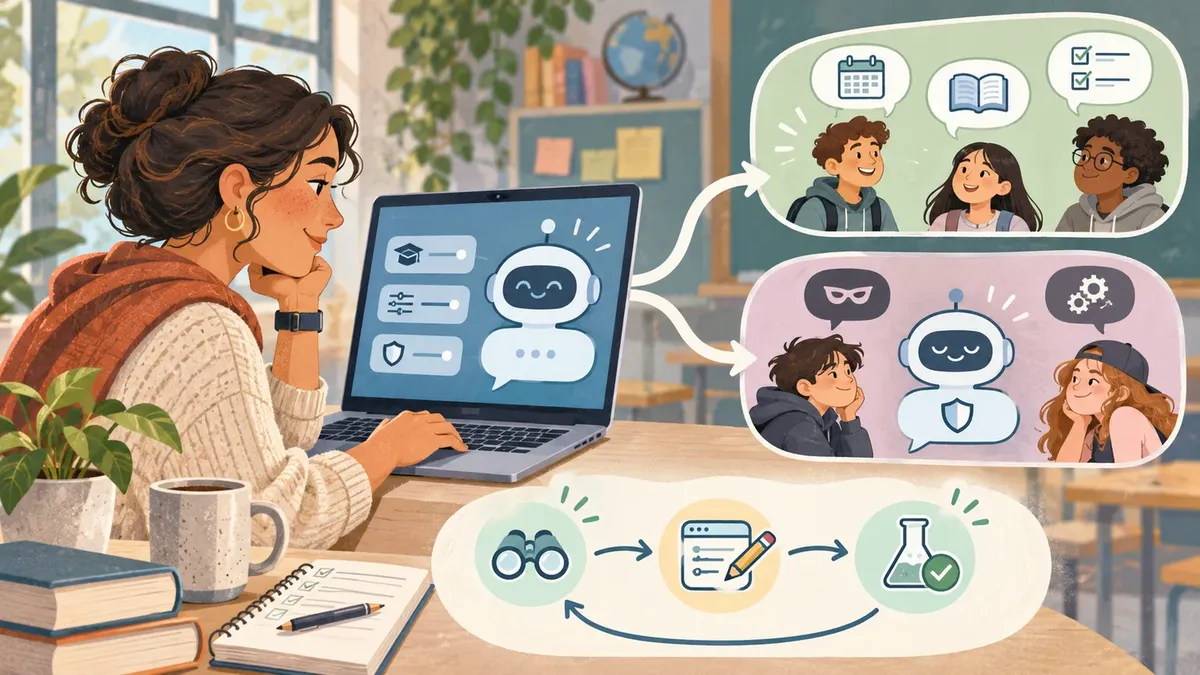
What does AI literacy training look like when educators put it into practice? Researchers examined chatbot prompts and conversations from an online course, finding a gap between how educators tested their bots and how some users later tried them.
A chatbot may work well when asked to do its intended job and still fail when someone tries to get around its rules. That gap matters in education, where a bot designed to tutor students might instead give away answers. A study of educators’ chatbot-building work asks what AI literacy training looks like beyond a quiz or a survey—and whether builders test for the ways other people may actually use their tools.
The researchers studied AI for Learning, an asynchronous online course for higher-education educators. Its participants learned about AI capabilities, limitations and ethics, prompt writing, and evaluating AI responses. As part of the course, they built chatbots on Playlab, a no-code platform, and were asked to test them. Deployment was optional.
The team examined 214 chatbots built by 87 educators and 1,740 conversations, containing 17,407 messages. The records covered conversations between builders and their own bots, course peers and bots, and end users and deployed bots. The data spanned 1.5 years. Researchers used a codebook to categorize prompt content and conversation behavior, with an AI model assisting in coding. Human annotators checked a sample; agreement between human and AI coding varied by category, with Cohen’s kappa from 0.71 to 0.89 for the reported comparisons. The researchers say the data were de-identified and the study received institutional review board approval.
What educators put into prompts
In the prompts educators wrote themselves, instructions about what a bot should do were more common than limits on what it should do. All authored prompts named at least one capability, such as tutoring or generating content. About 71% included at least one limitation, but only 40% addressed an ethical consideration. Confidentiality appeared in 1.6% of authored prompts, while 18.2% included neither a limitation nor an ethics code.
The course taught prompt components such as role, context, style, workflow and guardrails, and provided a starter template for those components. Role, context and workflow appeared in most prompts. By contrast, fewer prompts included the taught technique of providing worked examples, and only five prompts used chain-of-thought instructions. The researchers suggest that the template may have helped make components easier to use; the study does not establish that the template caused their higher uptake.
Testing and real-world use
Most bots had at least one recorded builder conversation, but systematic, repeated testing was uncommon. Researchers classified 14% of bots as showing iterative refinement—testing, changing the prompt and testing again. Another 29% received limited evaluation, while 19% showed no substantive testing. For 61% of tested bots, all builder conversations occurred on a single day before deployment.
Thirty-six bots, or 17%, were used by end users, generating 902 conversations; 63 bots, or 29%, were tried by course peers. In end-user conversations, 75% of bot responses were coded as consistent with the behavior described in the prompt. That measure does not mean the responses were correct, beneficial, or educationally effective.
The clearest mismatch involved adversarial use: attempts to use a bot in ways its designer did not intend, such as seeking answers or probing its boundaries. Builders’ tests covered 91% of the routine-use patterns later seen in deployment, but only 26% of the adversarial patterns. In other words, 74% of the adversarial bot-and-intent combinations observed after deployment had not appeared in builder tests. Some users got bots to provide answers despite prompts that told them not to. The researchers also found that the amount of testing was not associated with fewer failures among the 36 deployed bots; they caution that this small sample cannot show whether particular testing approaches prevent failures.
What the study can—and cannot—tell us
The work offers a way to observe training in practice: prompts and interaction records show what educators built and how others used it. The authors argue that training could more explicitly teach a repeatable cycle of observing, revising and retesting, and use prior users’ behavior to design adversarial test cases.
But the records do not show that the course changed educators’ skills. There was no pre-course authoring test, post-course test or self-report survey to compare with the logs. The study also involved higher-education educators using one platform; its findings may not generalize to other settings or tools. Because the platform did not retain accessible prompt-version histories, iteration could be difficult to measure, and anonymous links prevented researchers from knowing whether multiple conversations came from the same person.
This is a preprint version of an arXiv paper, not evidence of peer review or independent replication. Its coding approach and observed patterns are informative, but the results are descriptive rather than proof that a particular course design improves chatbot safety. The central practical question remains open: whether teaching educators to test against real-world failure patterns leads to more reliable bots.
- AI literacy
- teacher training
- educational chatbots
- prompt engineering
- AI evaluation
- red-teaming
Reviewed cross-references
These connections were reviewed by a model, not independently fact-checked by a human. Similarity does not imply agreement; consult the original papers and the evidence below.
Why AI-agent evaluations need more than a good answer
Supporting evidence: Both studies provide bounded examples of adversarial risks missed by routine testing: Xiao et al. report that educators’ probes covered 26% of end users’ adversarial-use patterns; Zhang et al. report zero overlap between functional testing and security red-teaming discoveries on two analytics agents. The settings, systems and study designs differ, so these findings are compatible examples, not a direct comparison.
Model review: · openai-codex/gpt-6-luna
Evidence and provenance
Selected excerpts, not complete papers. PDF extraction can omit figures or damage equations, tables and reading order; sources may be preprints.
2611.28015v1 — Original paper
Excerpt reference:
static/papers/2611.28015v1.md:693-749
Basis: Paper text
Source SHA-256:a5f34cbd123ba588067f8599631dd156ac1d8e72796ad6487c85d7283d2472f52611.14493v1 — Original paper
Excerpt reference:
static/papers/2611.14493v1.md:13-128
Basis: Paper text
Source SHA-256:8d6cd2b149d7f8c72d7a03014fd6211cbe526d50f25b0fbb41e819c3da1cbf64
Related reading
Automatically matched by shared topic keywords. These links do not imply that the sources agree or establish a consensus.
Can one medical-image detector learn across X-rays and mammograms?
Source published
Shared keywords: ai evaluation
An AI’s step-by-step answer is not necessarily an explanation
Source published
Shared keywords: ai literacy
A map of prompt patterns for software engineering
Source published
Shared keywords: prompt engineering
Why more AI attacks don’t always make agents safer
Source published
Shared keywords: red teaming
What Counts as a Successful AI Red-Team Attack?
Source published
Shared keywords: red teaming