TRANSMISSION // 2611.27983v1
Regression When Noise Has No Finite Variance
Source published
A theoretical method adapts linear regression to heavy-tailed noise by pruning large residuals, without knowing the noise’s moment parameters in advance.
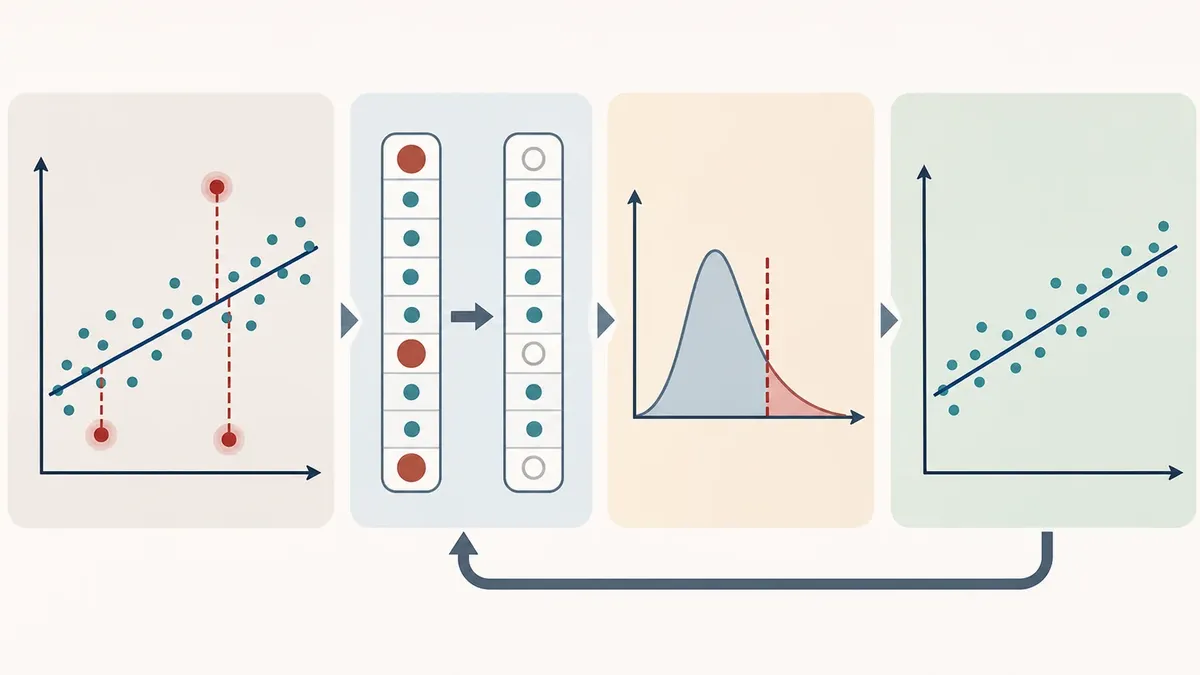
Regression methods often rely on errors having a finite variance. But some noise distributions have a finite moment of order between 1 and 2 while their variance is infinite. This paper develops a way to adapt certain finite-variance regression procedures to that harder setting—and spells out the assumptions the guarantees require.
Linear regression estimates how inputs relate to an outcome. Many familiar statistical guarantees work best when unusually large errors are sufficiently controlled, for example when the noise has a finite variance. But a distribution can have a finite moment of order α between 1 and 2 while its variance is infinite. How well can regression work in that setting, particularly when the tail properties are unknown?
Artin Tajdini, Jasper C. H. Lee, Jonathan Scarlett and Kevin Jamieson study this question theoretically. Their main result assumes that the regression noise has a finite conditional α-moment, for an unknown α between 1 and 2, and that the covariates satisfy a finite fourth-moment condition. The proposed method does not need to know the moment order or its scale in advance.
Prune residuals, then correct
The authors propose a “black-box reduction”: a way to use a regression procedure designed for finite-variance noise as a subroutine when the noise has weaker moment control. The method starts with a rough estimate and uses residuals—the differences between observed and predicted outcomes—to improve it.
At each stage, one block of samples is used to choose a threshold based on observed residuals. On a separate, independent block, residuals above that threshold are set to zero in a transformed response. A finite-variance regression subroutine then estimates a correction to the current model. Repeating the steps progressively refines the estimate. In the analysis, pruning controls the variance of the transformed problem while threshold selection limits the bias it introduces.
Using separate blocks matters: the stated argument relies on independence between threshold selection and the data passed to the subroutine. Reusing the same observations would require a guarantee that accounts for the resulting dependence. Because the thresholds are estimated from data, the method does not require advance knowledge of α, the noise scale, the covariance matrix or the design’s fourth-moment bound.
What the guarantees establish
Under the stated assumptions, and when the sample size exceeds a specified threshold, the authors prove a high-probability bound on estimation error. The rate improves with more samples and depends on α: values closer to 1, which allow heavier tails, produce slower rates. Error is measured in a covariance-weighted norm. Here, that norm corresponds to root mean-square prediction difference over the centered covariate distribution; it is not a blanket guarantee for every prediction setting.
The authors also prove a matching minimax lower bound under the specified model conditions. This means that, within that class of problems, the upper-bound rate cannot generally be improved beyond constant factors. The main lower-bound theorem gives a dimension-dependent result; the paper discusses confidence dependence separately, rather than deriving it in that theorem.
A related result addresses prediction with arbitrary covariate distributions. It assumes a bounded conditional α-moment for the response itself, a stronger condition than a moment bound on regression noise alone. Under the paper’s assumptions, a noise-only moment bound does not suffice for this distribution-free prediction guarantee. Its bound also inherits an additional logarithmic factor from the finite-variance prediction method used as a building block. The paper describes a related adaptation for mean estimation as well.
What remains uncertain
These are theoretical results, not evidence that the method performs better on real-world data. The estimation guarantee requires positive-definite covariance, finite fourth moments for covariates, a suitable finite-variance subroutine with the required rate, and enough samples. The sample-size threshold depends on quantities that include the design’s fourth-moment bound and the subroutine’s sample-size requirements. The overall method is computationally efficient whenever the selected subroutine is, but a subroutine with the needed statistical guarantee is not necessarily computationally efficient.
The paper includes a proof-of-concept simulation comparing empirical pruning with pruning based on known moments. It uses 2,000 samples, eight covariates and 200 repetitions in one particular simulated setting. The authors report lower estimation errors for empirical pruning than for the tested alternatives in that experiment. This illustration does not establish performance across other settings or datasets.
The authors leave open whether the fourth-moment condition on covariates can be weakened while retaining the estimation rate, and whether the extra logarithmic factor in distribution-free prediction can be removed. The source is an arXiv preprint, and the available material does not establish its peer-review status. Its results are best read as the authors’ theoretical claims, not as settled consensus or a guarantee for every application.
- robust regression
- heavy-tailed noise
- linear regression
- residual pruning
- statistical learning
- mean estimation
Related reading
Automatically matched by shared topic keywords. These links do not imply that the sources agree or establish a consensus.