TRANSMISSION // 2611.27979v1
Webb finds a nearly pristine pocket in an early galaxy
Source published
JWST observations of the lensed galaxy AMORE6 reveal strong helium emission and very little oxygen, pointing to an unusually hard radiation source in chemically primitive gas—but not proving that Population III stars are responsible.
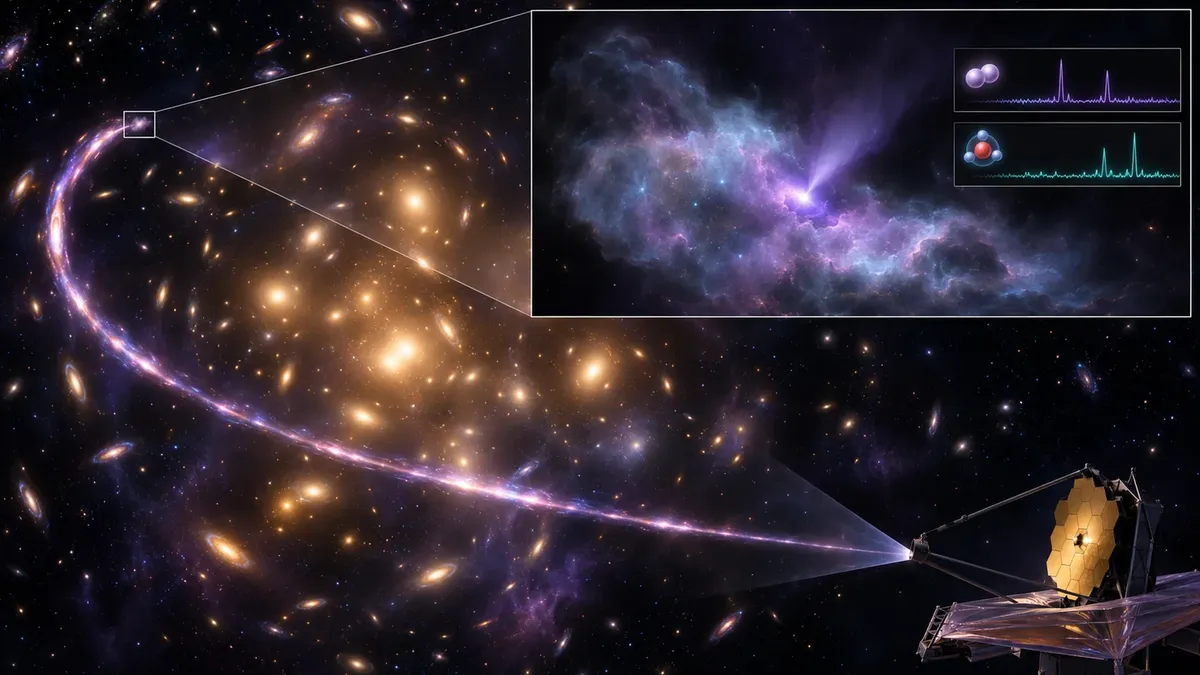
About a billion years after the Big Bang, some gas may still have been nearly untouched by earlier generations of stars. A JWST study of the strongly magnified galaxy AMORE6 finds evidence for such a chemically primitive environment and an intense source of high-energy radiation. The signals fit predictions for the Universe’s first stars, but another possible power source remains on the table.
The first stars formed from gas made mostly of hydrogen and helium, with almost none of the heavier elements that later stars and stellar explosions spread through space. Astronomers call this proposed first generation Population III, or Pop III. Finding them directly is difficult: their light is blended with that of other sources, and their most distinctive signals may be brief.
A team led by Takahiro Morishita used the James Webb Space Telescope (JWST) to examine AMORE6, a faint galaxy seen when the Universe was about one billion years old. The galaxy lies behind the Abell 2744 galaxy cluster, whose gravity magnifies its light. The researchers took deep spectra of one magnified image with JWST’s NIRSpec instrument, covering ultraviolet and optical wavelengths in the galaxy’s rest frame. They measured emission lines—light at specific wavelengths from energized gas—and compared the line strengths with models of the gas and its radiation source.
Two clues: helium and scarce oxygen
The spectra show two emission lines from doubly ionized helium, detected at reported significances of 16.7 and 4.0 sigma. Producing this helium emission requires very energetic light. Very hot, massive stars in extremely metal-poor gas could supply it, making the lines a useful clue to a possible Pop III population. The measured helium-to-hydrogen line ratios are consistent with predictions for such stars, but are not unique to them.
The team also finds weak oxygen emission. Using the oxygen-to-hydrogen line ratio and photoionization models, the paper estimates an oxygen abundance of about 0.076 percent of the Sun’s. This is an exceptionally low inferred abundance, consistent with gas that has undergone little chemical enrichment. The authors report that reasonable changes to some model assumptions would raise the estimate only modestly; their broader interpretation also draws on limits for other metal lines.
Together, the helium and oxygen results suggest a region with both unusually hard ionizing radiation and very little oxygen. The authors argue that such conditions could occur if massive first-generation stars are forming in gas that remains mostly pristine. The gas need not be entirely metal-free: the study detects evidence of oxygen and carbon, and the authors note that massive stars could enrich their surroundings even during a short-lived episode of star formation.
A promising case, not a definitive identification
The central uncertainty is what produces the hard radiation. An accreting black hole could also be responsible, either instead of or alongside hot stars. The spectra do not provide a definitive test of that possibility. Earlier observations found a narrow, symmetric Lyα line profile, without an evident broad component associated with a dominant accreting source. But Lyα is affected by resonant radiation transfer, which complicates its interpretation; the paper says this observation does not rule out a black hole.
The oxygen estimate also depends on how the emitting gas is modeled. In particular, dense gas can weaken some oxygen lines, potentially making enriched gas look more metal-poor. The researchers compare several line constraints and conclude that low metallicity is favored over this alternative, while acknowledging that abundance estimates are model-dependent. The source’s strong gravitational magnification makes detailed study possible, but the lensing estimate itself has uncertainty.
This is evidence about one small, distant galaxy, not a census of how common such environments are. And although the observations are consistent with the conditions expected for Pop III stars, they do not establish that those stars have been directly identified. The work is an arXiv preprint; its claims should be read as a reported analysis rather than as a settled scientific consensus. Follow-up observations and independent scrutiny will help clarify what powers AMORE6 and how much of its gas is truly primitive.
- James Webb Space Telescope
- Population III stars
- early galaxies
- AMORE6
- oxygen abundance
- gravitational lensing
Reviewed cross-references
These connections were reviewed by a model, not independently fact-checked by a human. Similarity does not imply agreement; consult the original papers and the evidence below.
Webb spots a faint oxygen line in a distant galaxy’s core
Supporting evidence: Both studies report very low inferred oxygen abundance in strongly lensed, faint galaxies observed with JWST spectroscopy: Morishita et al. estimate AMORE6 at 0.076% of solar oxygen abundance, while Messa et al. place LAP2’s integrated abundance at no more than about 0.5% solar and detect a more oxygen-rich core. This supports the bounded point that extremely oxygen-poor gas is reported in more than one early galaxy; the systems differ in redshift and measurement approach, and neither result alone establishes Population III stars.
Model review: · openai-codex/gpt-6-luna
Evidence and provenance
Selected excerpts, not complete papers. PDF extraction can omit figures or damage equations, tables and reading order; sources may be preprints.
2611.27979v1 — Original paper
Excerpt reference:
static/papers/2611.27979v1.md:170-211
Basis: Paper text
Source SHA-256:4dfd46f23cd2455894d2f8d2cfdac117fd3efd4a771c9c9d8975a4cb3db4cf312611.05487v1 — Original paper
Excerpt reference:
static/papers/2611.05487v1.md:55-110
Basis: Paper text
Source SHA-256:fd5569f3209881d0d9705c9524386ea28790d3fce29573ccef792ef94450eb002611.05487v1 — Original paper
Excerpt reference:
static/papers/2611.05487v1.md:706-761
Basis: Paper text
Source SHA-256:fd5569f3209881d0d9705c9524386ea28790d3fce29573ccef792ef94450eb00
Related reading
Automatically matched by shared topic keywords. These links do not imply that the sources agree or establish a consensus.
Webb spots a faint oxygen line in a distant galaxy’s core
Source published
Shared keywords: gravitational lensing, james webb space telescope, oxygen abundance, population iii stars
JWST probes the chemistry of tiny early galaxies—and a nitrogen puzzle
Source published
Shared keywords: early galaxies, gravitational lensing, james webb space telescope
Five observations that could sharpen our picture of early galaxies
Source published
Shared keywords: james webb space telescope, population iii stars
Reconstructing galaxy histories offers clues to the scarcity of the earliest galaxies
Source published
Shared keywords: early galaxies, james webb space telescope
Early Galaxies Narrow a Search for Neutrino Interactions
Source published
Shared keywords: early galaxies, james webb space telescope