TRANSMISSION // 2611.27975v1
A thermodynamic-limit energy bound for lattice QED
Source published
A mathematical analysis bounds the ground-state energy of lattice QED in a specified approximation. Its key comparison holds in the infinite-volume limit, not on every finite lattice.
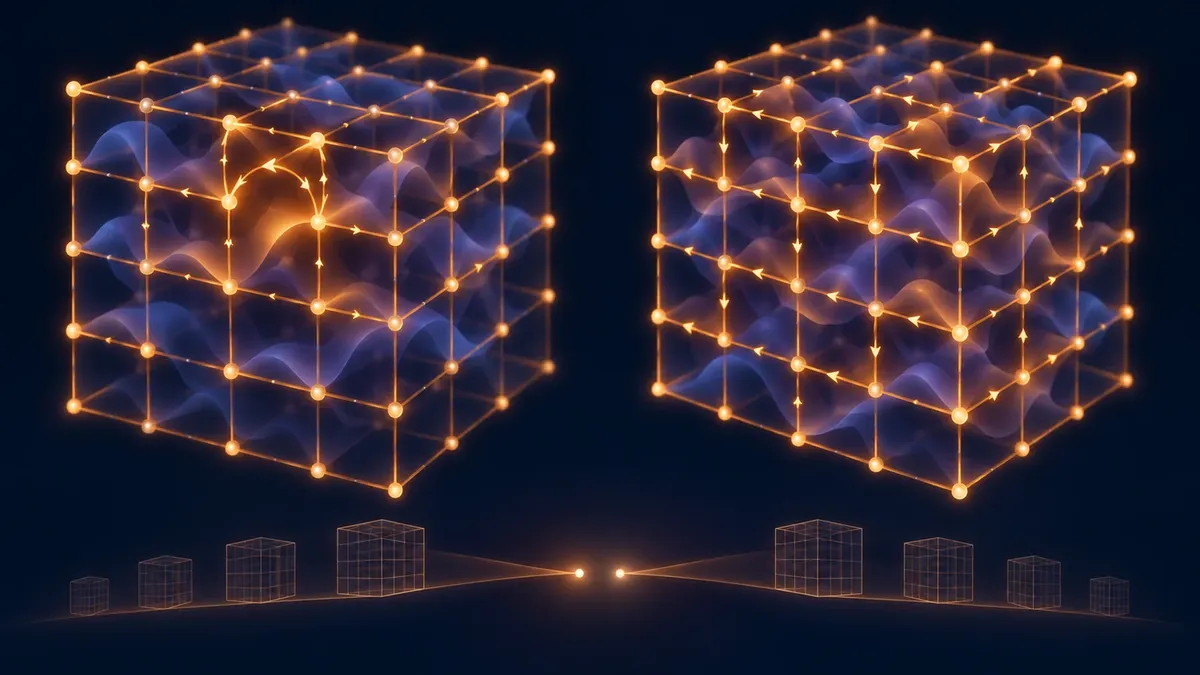
How low can the ground-state energy of lattice quantum electrodynamics be, relative to a chosen vacuum reference? Paweł Zin and Andrzej Veitia derive a lower bound for a particular lattice model and show why the argument depends on taking the thermodynamic limit.
Why bound the ground-state energy?
Quantum electrodynamics (QED) is usually studied through perturbation theory, which builds predictions from successive corrections around a reference state. But a perturbative expansion by itself does not prove that the underlying theory has a ground state or that its energy is bounded below. Zin and Veitia investigate this issue in a discrete, finite-spacing version of QED, where the ground-state energy can be studied using nonperturbative mathematical tools.
Their result is not a general bound for all versions of QED. It concerns lattice QED with naive fermions, in Coulomb gauge, and within a Gaussian photon approximation. The analysis is restricted to the charge-neutral sector, as required by Gauss’s law with periodic boundary conditions. The authors set the Fock-vacuum energy to zero, so all quoted energies are relative to that reference—not absolute vacuum energies in an unrestricted physical setting.
Comparing gauge configurations
The central step concerns the fermionic part of the energy when the links—the lattice variables that encode the gauge field—are held fixed. The authors prove that, in the thermodynamic limit, the minimum fermionic energy per lattice site across link configurations agrees with the value for the trivial configuration, in which every link variable is one.
To establish this comparison, they express the fermionic ground-state energy using a logarithm of a determinant. They then derive an inequality that reduces the problem one spatial dimension at a time. In three dimensions, the gauge-dependent part of the resulting bound contributes only a correction that vanishes per site as the lattice grows. This lets them compare the limiting energy density with the trivial-link case. The proof does not rely on reflection positivity and, according to the paper, works for either even or odd lattice sizes.
This is an asymptotic statement about energy density. It does not say that the trivial gauge configuration minimizes the fermionic energy on every finite lattice. Indeed, the paper gives finite-lattice counterexamples where a nontrivial configuration has lower fermionic energy. Those examples make the limit important: the theorem’s conclusion cannot simply be applied to small systems.
From comparison to a bound
The authors combine the comparison with the nonnegativity of the Coulomb Hamiltonian and the fact that the electromagnetic Hamiltonian is bounded below by its vacuum energy. The variational principle also gives an upper bound: because the reference Fock vacuum has zero energy in the chosen convention, the ground-state energy cannot be higher than zero.
In the limit of vanishing dimensionless fermion mass, the paper reports that the ground-state energy per site, relative to the Fock vacuum, lies between approximately −0.2659 q²/a and zero. Here q is the charge parameter and a the lattice spacing. This is a model- and approximation-specific bound, not a measured energy and not a prediction for physical vacuum energy without further interpretation. The numerical coefficient comes from evaluated lattice sums; the supplement describes a numerical convergence procedure for one of those sums.
The authors also note that the bound vanishes in the weak-coupling limit at fixed lattice spacing, consistent with their choice of the Fock vacuum as reference. That consistency check does not establish convergence of the QED perturbation series or resolve the broader mathematical questions that motivate the work.
What remains uncertain
The findings apply to one fermion discretization and one photon treatment. The paper identifies extensions to other lattice fermions, such as Wilson or staggered fermions, as a direction for future research. Its finite-size examples also warn against treating a thermodynamic-limit result as a guarantee for simulations on modest lattices.
This article is based on the first arXiv version of the paper, a preprint. The supplied source gives no indication that it has undergone peer review. The proof and supporting calculations are presented in the manuscript and supplement, but an independent assessment of their correctness is outside the evidence available here. The result is best read as a rigorous claim within the authors’ stated framework, rather than a resolution of QED’s foundations or a bound that automatically transfers to other formulations.
- lattice QED
- ground-state energy
- nonperturbative bounds
- Coulomb gauge
- Gaussian photon approximation
- thermodynamic limit