TRANSMISSION // 2611.27963v1
A Safety Check for Video World Models at Walls
Source published
NoPeWorld reads hidden states in frozen video generators to flag risky movements, reducing—but not eliminating—wall-crossing in the authors’ tests.
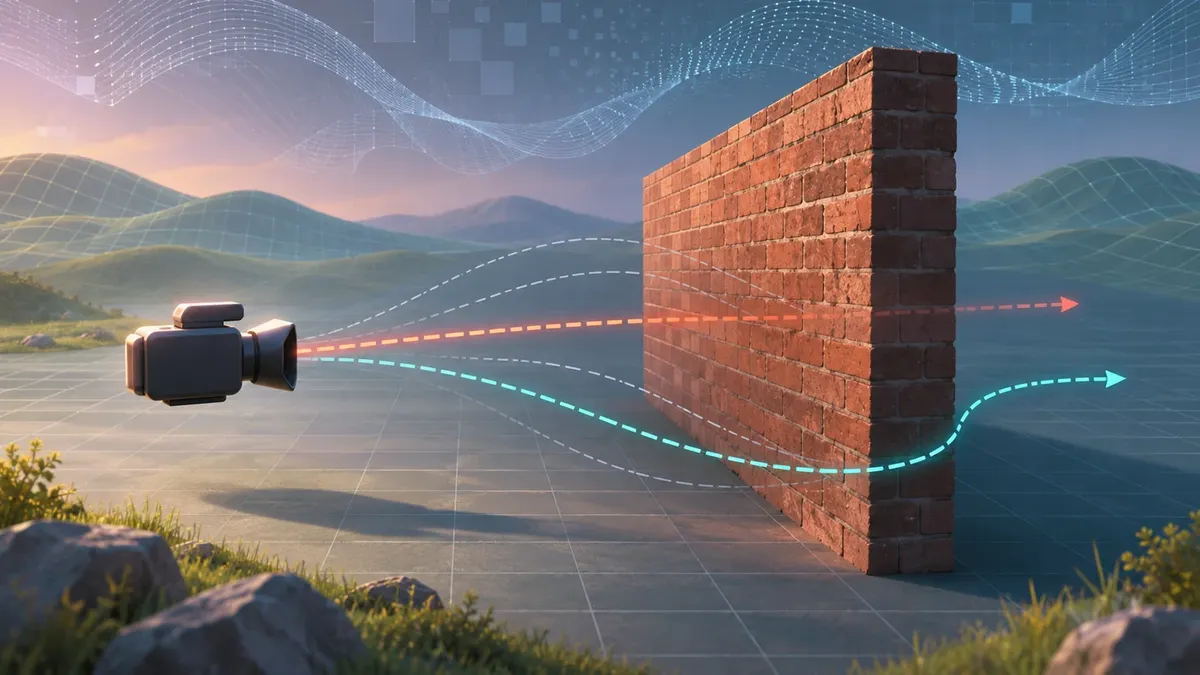
Interactive video world models can generate what happens after a command, but sometimes depict a camera passing through a wall. An arXiv preprint introduces a benchmark for testing this failure and a small safety head designed to flag risky movements before video frames are generated.
A video world model responds to commands—move forward, turn, or follow a route—by generating what happens next. But a plausible-looking video is not necessarily physically faithful. When a command leads toward a wall, some models may show the camera passing through it or the obstacle disappearing.
In Non-penetrating World Models, researchers introduce NoPeBench, a benchmark for testing how interactive video generators handle obstacles, and NoPeWorld, a method that uses information inside a generator to assess candidate movements. The generator itself remains frozen; the team trains a small prediction head to identify unsafe options and select alternatives intended to preserve the command’s direction.
Three ways to test obstacle handling
The benchmark evaluates six open-source video models in three settings. Task 1 tests movement decisions using teacher-forced histories rendered in Unreal Engine: the model is given the correct scene history, limiting the effects of errors accumulating during generation. Task 2 runs the models in closed loop, generating video as commands lead toward obstacles. Researchers compare the depicted camera paths with the scenes’ 3D geometry.
Task 3 tests transfer from a single open-domain image, without 3D ground truth. It includes 81 static-obstacle images from the WBench benchmark and 50 images with moving obstacles, generated from scene descriptions. The images cover first- and third-person viewpoints. Vision-language models (VLMs) judge whether generated videos show violations; the paper compares these judgments with human labels.
For training, the researchers used simulated Unreal Engine scenes, separate from the benchmark scenes. They labelled candidate movements using swept clearance from obstacles and how well each option matched the simulator’s collide-and-slide response to the original command. A small head reads intermediate states from a diffusion transformer (DiT), the video generator’s internal network, while the generator’s weights stay fixed. It scores a finite set of possible movements; if the input appears unsafe, NoPeWorld can replace it with a safer candidate, such as a stop or a wall slide.
What the authors report
Averaged across six generators, the reported physical-violation rate fell from 74% to 16%. The method did not eliminate failures: results varied by model, and some violations remained. Its choice of alternative also matters. In Task 2, NoPeWorld achieved stronger safe-intent scores than the comparison methods on five pose-driven generators, but the paper reports exceptions and trade-offs. For WorldPlay2, for example, NoPeWorld reduced violations while scoring below the raw model on the safe-intent measure.
The authors also find that hidden states can help predict whether a candidate movement will lead to contact, including before the next video chunk is generated. In a validation analysis of LingBot-World 2.0, readouts using DiT states performed better than comparable probes using video-model latents or decoded pixels. This result is specific to that analysis; it does not establish the same comparison for every model.
The trained heads were evaluated without retraining on open-domain images, third-person views, and moving obstacles, with reported violation reductions varying across generators and settings. These results are based on VLM judgments, not 3D geometric ground truth for those images. On 50 unobstructed control routes, the paper reports that, depending on the model and mode, 92–100% of videos neither stopped early nor retreated.
What remains uncertain
NoPeBench deliberately tests obstacle encounters, so its results do not measure world models’ overall physical reliability. The simulated tasks cover a defined set of scenes and routes, while the open-domain task uses selected benchmark images and generated scenes rather than a broad, naturally sampled survey of real-world situations. VLM judgments can be wrong: the authors compare them with human labels, but that does not make every judgment definitive. Geometric-evaluator agreement is reported for Task 2 videos, where geometry is available, not as ground truth for Task 3.
The method can also change safe commands, and avoiding a collision is not the same as preserving every aspect of a user’s intended movement. The paper reports some unnecessary changes and meaningful differences between generators.
This is an arXiv preprint, a publicly available manuscript whose record does not establish peer review. The authors provide public links to code, benchmark data, and model weights. The findings support a focused conclusion: in the tested settings, a small head reading a frozen generator’s internal states reduced many obstacle-penetration failures, but did not remove them or establish general physical reliability.
- video world models
- artificial intelligence
- diffusion transformers
- collision detection
- AI benchmarks
- physical simulation
Reviewed cross-references
These connections were reviewed by a model, not independently fact-checked by a human. Similarity does not imply agreement; consult the original papers and the evidence below.
Teaching robot video models to focus on what moves
Supporting evidence: NoPeWorld’s authors report reduced penetration after using frozen DiT states to detect unsafe actions and replace them with safer alternatives; MoReWorld’s authors report improved interaction-dynamics scores with motion-region guidance on WorldSimProbe. These findings support the bounded proposition that targeted guidance can improve measured action-consequence fidelity in the respective tested settings, but the different methods and benchmarks do not establish a direct comparison.
Model review: · openai-codex/gpt-6-luna
Evidence and provenance
Selected excerpts, not complete papers. PDF extraction can omit figures or damage equations, tables and reading order; sources may be preprints.
2611.27963v1 — Original paper
Excerpt reference:
static/papers/2611.27963v1.md:13-111
Basis: Paper text
Source SHA-256:3a0fecbd9708dabdc0ab803ebd3de20119ba64cdcb13ed02d25f13b550dcb6432611.27344v1 — Original paper
Excerpt reference:
static/papers/2611.27344v1.md:78-164
Basis: Paper text
Source SHA-256:15519900f5bbf63f29419fea3708e0d6a4212b324271c72091d55f5a3b021b432611.27344v1 — Original paper
Excerpt reference:
static/papers/2611.27344v1.md:950-1051
Basis: Paper text
Source SHA-256:15519900f5bbf63f29419fea3708e0d6a4212b324271c72091d55f5a3b021b43
Related reading
Automatically matched by shared topic keywords. These links do not imply that the sources agree or establish a consensus.
When AI benchmarks give the wrong grade
Source published
Shared keywords: ai benchmarks
IdealCache plans when image and video AI should reuse its calculations
Source published
Shared keywords: diffusion transformers
How AI may reshape the market for legal work
Source published
Shared keywords: artificial intelligence
TouchéWorld brings camera and hand controls together in generated video
Source published
Shared keywords: video world models
Can AI benchmarks renew themselves? VeRA’s answer
Source published
Shared keywords: ai benchmarks