TRANSMISSION // 2611.27942v1
A clearer way to judge Rydberg-atom receivers
Source published
A proposed microwave-photonics framework translates a Rydberg-atom receiver’s response into familiar radio-frequency link-budget measures—and highlights a noise limitation.
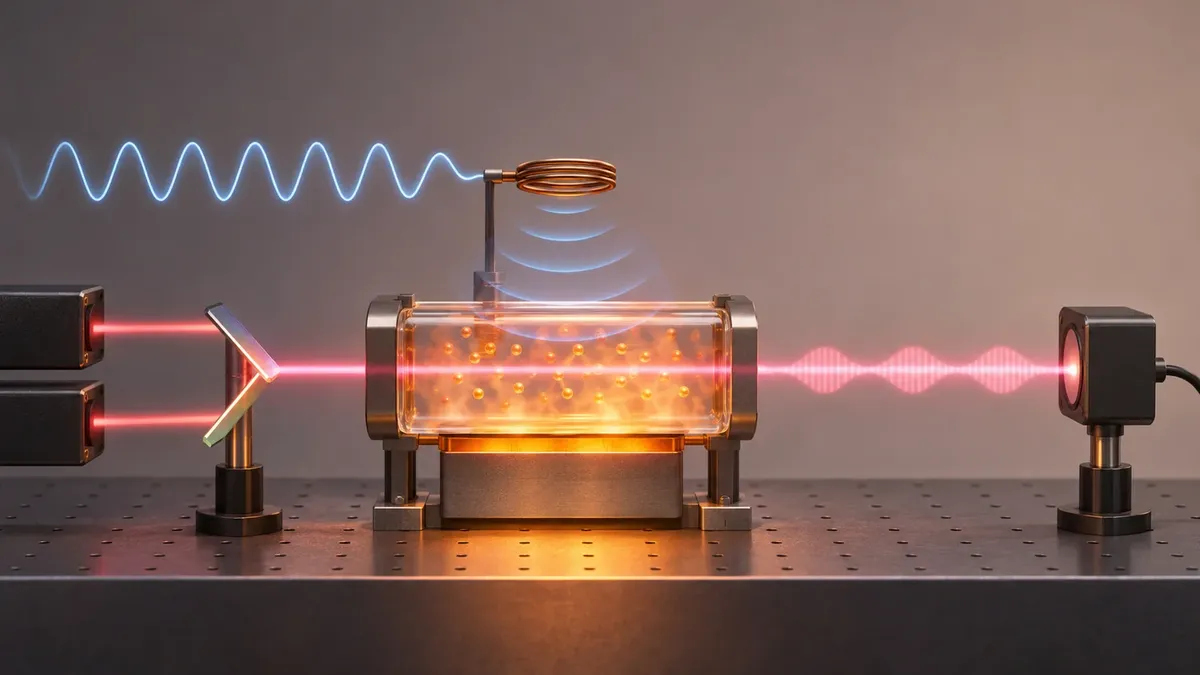
Rydberg atoms can respond strongly to radio waves, but sensitivity alone does not tell engineers how a receiver performs in a communications system. This preprint recasts a warm-vapor Rydberg receiver as an optical link and derives several familiar performance measures from its atomic response.
Rydberg-atom receivers use laser-controlled atoms to turn an incoming radio-frequency (RF) field into a change in light that can be measured. Their unusual sensitivity is appealing, but assessing a receiver also means asking how much signal it delivers, how noise accumulates, and over what range it operates usefully. David Rosser’s preprint proposes a way to answer those questions using concepts from microwave photonics and RF engineering.
Treating the vapor as a link
The paper frames the receiver as an intensity-modulated, direct-detection optical link. In plain language, the RF signal changes the response of a laser-driven atomic vapor; that change modulates the probe light, and a detector reads out its intensity. The vapor cell is therefore treated not simply as a sensitive sensor, but as the link’s modulating element.
To model the cell, the author derives a closed-form expression for transmission by averaging the response of a four-level atomic system over the atoms’ different velocities. This matters because atoms in a warm vapor move at different speeds, affecting how they interact with the laser light. The paper then uses this single response function to derive conversion gain, noise figure, bandwidth, intercept points and spurious-free dynamic range—measures used to describe signal conversion, added noise and distortion.
What the analysis reports
For a weak probe, the model predicts that the receiver’s instantaneous bandwidth is half the width of the transparency window when expressed in two-photon detuning. The paper also analyzes how a local oscillator—a reference RF field used in receiver schemes—affects distortion: it places the second-order intercept near twice the local-oscillator field, making the oscillator the limiting factor for even-order linearity in the described setup.
For a rubidium transition at 17.04 GHz, the closed-form results are compared with a velocity-resolved density-matrix model. The abstract reports agreement within 1% for slope and intercepts and within 10% for bandwidth. It also reports that the closed forms underestimate group delay by about a third. These are comparisons between models, not a demonstration that a physical receiver achieved those performance figures in an experiment.
The framework connects the response to atomic constants, and the abstract says the sensing volume escapes the Chu limit, a bound relevant to conventional electrically small antennas. But the author’s conclusion is not that atomic receivers are ready to replace conventional hardware: the modeled noise figure of a warm vapor is said to rule out a general replacement for an antenna and low-noise amplifier.
What remains uncertain
This is a theoretical formulation, and the evidence available here is the paper’s abstract rather than its full text. The reported agreement is with another model, so it does not by itself establish performance in a laboratory receiver or in an operational system. The abstract also does not provide the numerical noise figure or enough detail to assess its assumptions and scope. The results therefore offer a structured way to evaluate receiver trade-offs, not a universal verdict on every Rydberg-atom design.
The work is a preprint on arXiv and may not have undergone peer review. Its conclusions should be read as the author’s analysis, pending scrutiny and further validation.
- Rydberg atoms
- microwave photonics
- RF receivers
- atomic vapor
- receiver noise
- preprint
Reviewed cross-references
These connections were reviewed by a model, not independently fact-checked by a human. Similarity does not imply agreement; consult the original papers and the evidence below.
Cesium atoms turn a 10 MHz electric field into an optical signal
Shared method: Both papers describe using a local-oscillator electric field with a signal field to produce a lower-frequency beat that is read out optically: Rosser describes vapor mixing a weak RF signal to an intermediate frequency, while Han et al. report a 10.1 MHz LO and 10 MHz signal producing a 100 kHz beat. This is a shared heterodyne approach, not evidence of equivalent performance: the papers concern different frequency bands and sensing mechanisms, and the supplied excerpts do not establish a direct quantitative comparison.
Model review: · openai-codex/gpt-6-luna
Evidence and provenance
Selected excerpts, not complete papers. PDF extraction can omit figures or damage equations, tables and reading order; sources may be preprints.
2611.27942v1 — Original paper
Excerpt reference:
static/papers/2611.27942v1.md:39-115
Basis: Paper text
Source SHA-256:0bb8a7fd7284827f09b8b1e61f691abbc37190269f7c510def8198c26c8021a12611.11430v1 — Original paper
Excerpt reference:
static/papers/2611.11430v1.md:13-112
Basis: Paper text
Source SHA-256:b8db29da86cd7fdd17b049509a88aa97ecd6b7cdc47d13c0bd7d6d2b20c07344
Related reading
Automatically matched by shared topic keywords. These links do not imply that the sources agree or establish a consensus.
Could Rydberg atoms detect atmospheric signals at 4.7 THz?
Source published
Shared keywords: rydberg atoms
A laser-made charge source reduces stray fields around Rydberg atoms
Source published
Shared keywords: rydberg atoms
Cesium atoms turn a 10 MHz electric field into an optical signal
Source published
Shared keywords: rydberg atoms
A promising quantum optimization strategy loses its edge when noise enters
Source published
Shared keywords: rydberg atoms
A tunable interaction could broaden neutral-atom quantum gates
Source published
Shared keywords: rydberg atoms