TRANSMISSION // 2611.27924v1
BioEmu2 aims to make molecular motion easier to model
Source published
A generative model samples biomolecular structures and emulates some dynamics much faster than molecular dynamics, but its slow-kinetics predictions remain unvalidated.
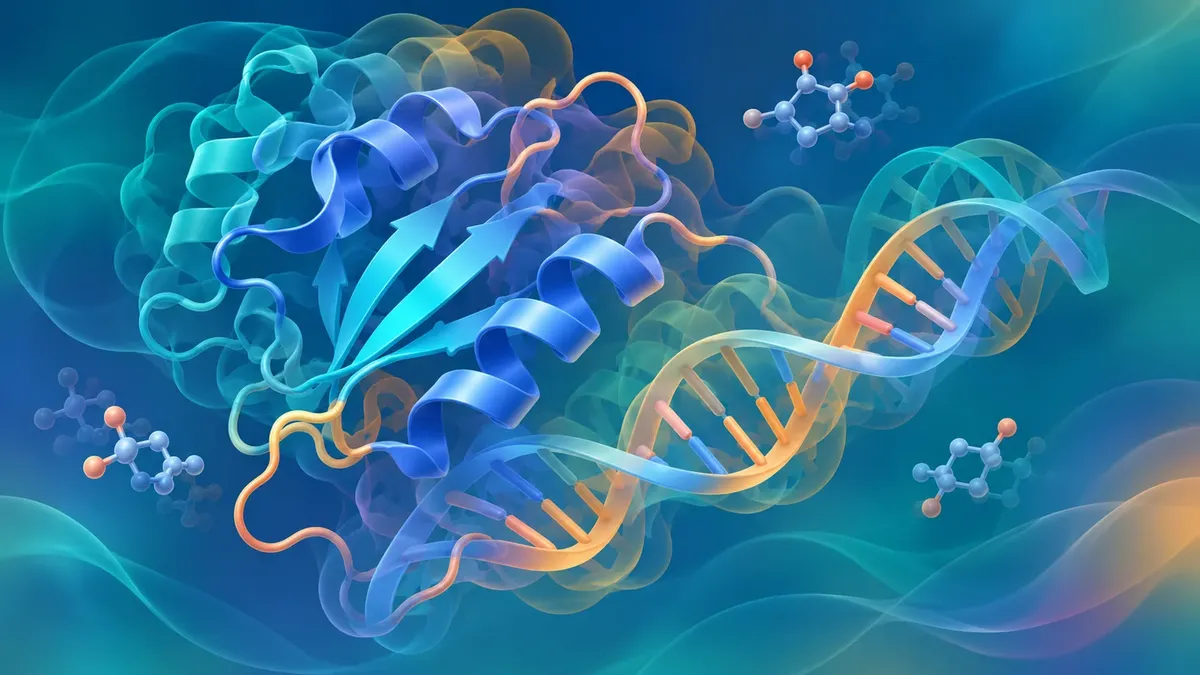
A protein’s structure is only part of its story: its function can depend on how it changes shape, binds partners and moves between states. BioEmu2 is designed to model those ensembles and motions at atomic detail, while making clear that some of its most ambitious predictions still need testing.
A protein structure is often shown as a fixed set of atoms. In living systems, however, proteins and other biomolecules flex, change shape and bind or release partners. Those motions can be central to function. The challenge is to model not just a plausible structure, but also the range of structures a molecule visits and how it moves between them.
The authors of BioEmu2 present a generative model intended to do all three: predict a static structure, sample an equilibrium ensemble of structures, and propagate a starting structure forward in time. Their paper reports that the model can perform sampling tasks orders of magnitude faster than molecular dynamics (MD), a computational method that simulates atomic motion step by step.
One model, three ways to sample
BioEmu2 is trained on experimental and synthetic structures as well as extensive MD data. The paper describes systems that can include proteins, DNA and RNA, modified residues, ligands and ions. Its system representation also supports small molecules and lipids. These capabilities depend on the model’s specified representations and the coverage of its training data; for example, branched components can be represented but were absent from the training data.
The model generates biomolecular coordinates without explicit solvent. Instead, solvent and simulation-volume degrees of freedom are marginalized out of the MD training data, so their effects are learned implicitly.
In equilibrium mode, BioEmu2 draws structures from a learned approximation of the distribution expected at room temperature and atmospheric pressure. In time-propagation mode, it takes a starting structure and a chosen time lag, then predicts a possible future endpoint. It does not calculate every intervening motion as MD does. Repeated predictions can be joined into a trajectory, with the model’s sequence representation reused between steps.
The researchers tested these capabilities against several kinds of reference. For static structure prediction, they compared BioEmu2 with selected co-folding models on FoldBench and Runs N’ Poses. For equilibrium sampling, they compared the model’s conformational distributions with MD reference simulations, assessing whether it found relevant states and reproduced their relative populations. They also compared time-dependent behavior with MD on 78 systems, using measures of how quickly slow structural motions lose memory of their earlier state.
What the tests found
On the structure-prediction benchmarks, the authors report accuracy competitive with the evaluated models. The comparison was not exhaustive: AlphaFold 3 was excluded for licensing reasons, and Boltz-2 was excluded because its training cutoff was later than the selected comparison set’s.
For equilibrium sampling, BioEmu2 found about half of the states sampled by MD for proteins and protein complexes, and more states than an equally sized MD sample for protein–ligand systems. For metastable states in the tested systems and categories, the reported free-energy errors ranged from 0.7 to 1.2 kilocalories per mole. These results describe comparisons with the paper’s MD references, not proof that the model reproduces exact biological populations for every molecule.
The authors also show examples of time propagation, including an adenylate kinase trajectory in which ligands bind as protein domains close. In their broader comparison, BioEmu2’s dynamics were close to MD for many systems, but sometimes relaxed too quickly. More importantly, the authors say that quantitative accuracy for slow processes such as binding, dissociation, folding and unfolding has not been established. Most dynamics training data came from MD simulations of up to one microsecond, so predictions of slower events should be treated as qualitative hypotheses, not measured rates or confirmed pathways.
BioEmu2 can also be steered during generation. Users can encourage specified residue contacts or apply bias potentials to favor selected structural features or rarely sampled states. In one example, enhanced sampling helped explore phosphoglycerate kinase conformations near a known closed structure. Such steering changes what the model samples; reweighting can estimate statistics of its original learned distribution, but cannot correct errors already present in that distribution.
A promising emulator, with boundaries
The paper describes a broad modeling framework, not a replacement for experiments or a guarantee of accurate kinetics. Its equilibrium target is learned from MD data and is an approximation; the authors explicitly note that matching equilibrium distributions does not by itself ensure realistic dynamics. Slow-motion predictions need independent validation against suitable experimental data, and the paper identifies larger high-quality experimental datasets as an important need.
The cited source is an arXiv posting, and the available source material does not establish its peer-review status. The results should therefore be read as the authors’ reported findings, not as independently confirmed conclusions. The work’s central contribution is a unified way to generate structures, ensembles and time-separated configurations across more kinds of molecular systems. Whether that approach can reliably capture biologically important slow events remains an open question.
- BioEmu2
- biomolecular dynamics
- protein structure
- molecular dynamics
- generative models
- conformational ensembles
Related reading
Automatically matched by shared topic keywords. These links do not imply that the sources agree or establish a consensus.
CoMoFlow Gives Protein Shape Generation a Set of Motion Controls
Source published
Shared keywords: molecular dynamics
ChatAtom aims to simplify molecular-dynamics workflows
Source published
Shared keywords: molecular dynamics
Quantum-assisted simulation follows a proton between two water molecules
Source published
Shared keywords: molecular dynamics
Tessera scales molecular AI to 30.7 million atoms across 512 GPUs
Source published
Shared keywords: molecular dynamics
Can a quantum circuit be learned as a flowing probability cloud?
Source published
Shared keywords: generative models