TRANSMISSION // 2611.27915v1
StereoVLM: Teaching AI to See in 3D with Two Cameras
Source published
StereoVLM uses calibrated stereo images to help a vision-language model estimate metric depth and reason about objects in 3D. Its authors report stronger results with disparity supervision, while noting the limits of benchmark and simulated-robot tests.
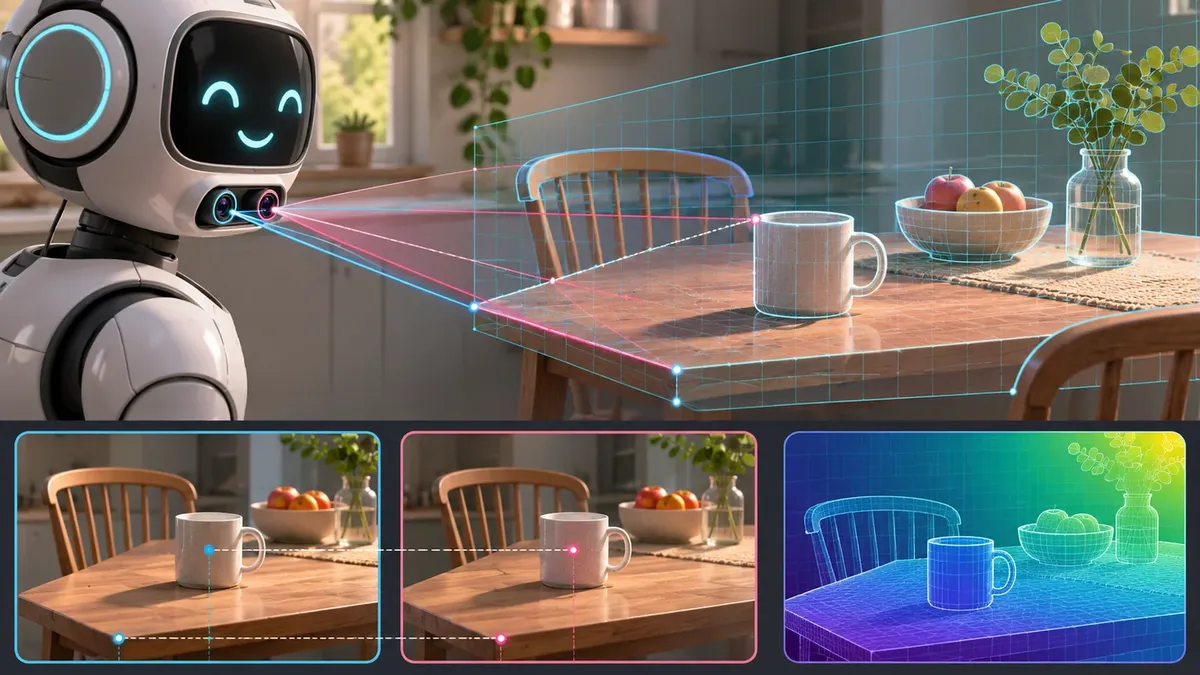
A single image can show what is in a scene without revealing how far away things are. StereoVLM explores whether two calibrated camera views can help a vision-language model connect visual clues to measurable 3D geometry—and whether that learning helps beyond depth estimation.
A picture can tell an AI model that a scene contains a mug, a table and a robot arm. But recognizing objects is not the same as knowing their distances or positions in physical space. From one image, an object’s apparent size can be ambiguous: a small image might show a nearby small object or a distant large one.
Stereo cameras offer another clue. Because the cameras are separated by a known distance, the same point in a scene appears in slightly different positions in each image. That shift—called disparity—can be related to depth when the cameras’ geometry is calibrated. The question in this study is whether a vision-language model (VLM), trained to process images and text, can learn to use those binocular cues for metric 3D reasoning, rather than relying mainly on familiar scene patterns.
From matching pixels to locating objects
The authors introduce StereoVLM, built on Qwen3-VL. It receives a rectified left–right image pair and a text question. When needed, the question includes camera calibration information, such as focal length and the distance between cameras. The model is trained on a hierarchy of tasks: matching points across images, estimating their disparity, converting that geometry into metric depth, and locating named or task-relevant objects in 3D.
The researchers also created Stereo3D-Bench to test these abilities at three levels: point geometry, object geometry and object-level spatial reasoning. Its main split draws on four sources—DROID, Xperience-10M, FSD and RoboCasa—and contains 94,546 question-answer instances. An independently collected out-of-domain (OOD) split tests point-level geometry on unseen scenes. The paper describes held-out data and leakage controls; benchmark answers use source-native geometry rather than simply repeating the stereo estimator’s training targets. Some object annotations were generated with automated tools, and benchmark questions received manual review.
To check whether the model actually uses the second view, the team compared correct stereo input with controls: a missing or blank right image, a duplicate of the left image, and an unrelated right image. These tests matter because good scores alone would not show that binocular geometry drives the predictions.
Disparity helped on unseen scenes
A central finding is that the choice of training target mattered. In a controlled comparison, the researchers trained models to predict depth directly from a single image, depth directly from stereo, or disparity from stereo. On the OOD split, the disparity-trained model achieved a depth δ₁ score of 74.92%, compared with 45.89% for the model trained to predict binocular depth directly. Here, δ₁ measures the share of predictions within a specified accuracy threshold; it is not a general measure of all spatial reasoning. The result suggests that learning the image shift first, then using calibration to derive depth, transferred better to these unseen scenes than directly learning depth.
On the main benchmark, StereoVLM-8B reached 95.17% on point-level depth δ₁ and an average object-level score of 66.98%. In the input-control experiment, the 2B model did better with the correctly paired right view than with a left-only image: its depth δ₁ rose from 80.82% to 94.51%, and its object-level average from 40.26% to 64.43%. Blank or unpaired views did not reproduce the correct-stereo results. Together, these interventions support the claim that valid cross-view evidence contributes to performance, though they do not establish that every prediction is grounded in geometry.
The authors also tested whether stereo training helped other tasks. Against a matched model trained without stereo instructions, the model gained an average of 3.54 percentage points across five spatial benchmarks. In simulated RoboCasa manipulation tasks, success rose by 4.3 percentage points over general instruction tuning alone. These are results in specified benchmark and simulation settings, not evidence of improved performance in real-world robot deployments.
What the results do—and don’t—show
The work’s evidence is strongest for calibrated, synchronized stereo inputs and the tasks represented in its evaluations. The authors identify reliance on camera calibration, controlled benchmarks and simulated kitchen tasks as limitations, and point to the simulation-to-real gap, challenging visual conditions and varied robot platforms as open issues. Benchmark construction also involves estimated references and automated annotation steps, even though the paper describes filtering and quality checks.
The paper is an arXiv preprint, so its claims should be treated as research findings rather than settled conclusions. Comparisons depend on the chosen benchmarks, models and evaluation protocols; the results do not show that stereo is always better than other approaches, or that the method will work reliably in every environment. The study does, however, offer a concrete test of a useful idea: teaching a language-capable model how two calibrated views relate may help connect visual understanding to measurable space.
- StereoVLM
- stereo vision
- vision-language models
- 3D spatial reasoning
- metric depth
- robotics
Related reading
Automatically matched by shared topic keywords. These links do not imply that the sources agree or establish a consensus.
PhysMoE gives robot vision-language models a more direct way to point
Source published
Shared keywords: vision language models
Robots Can Plan Around What They Can’t See
Source published
Shared keywords: vision language models
A Robot Learns From Its Own Attempts
Source published
Shared keywords: vision language models
Giving Wearable AI a Measurable 3D View
Source published
Shared keywords: 3d spatial reasoning
Can a large vision model use a smaller model’s visual memory?
Source published
Shared keywords: vision language models