TRANSMISSION // 2611.27914v1
What does a typical quantum subspace look like?
Source published
A mathematical study derives exact moment formulas for reduced states from random quantum subspaces and a Marchenko–Pastur spectral limit in a specified large-dimension regime.
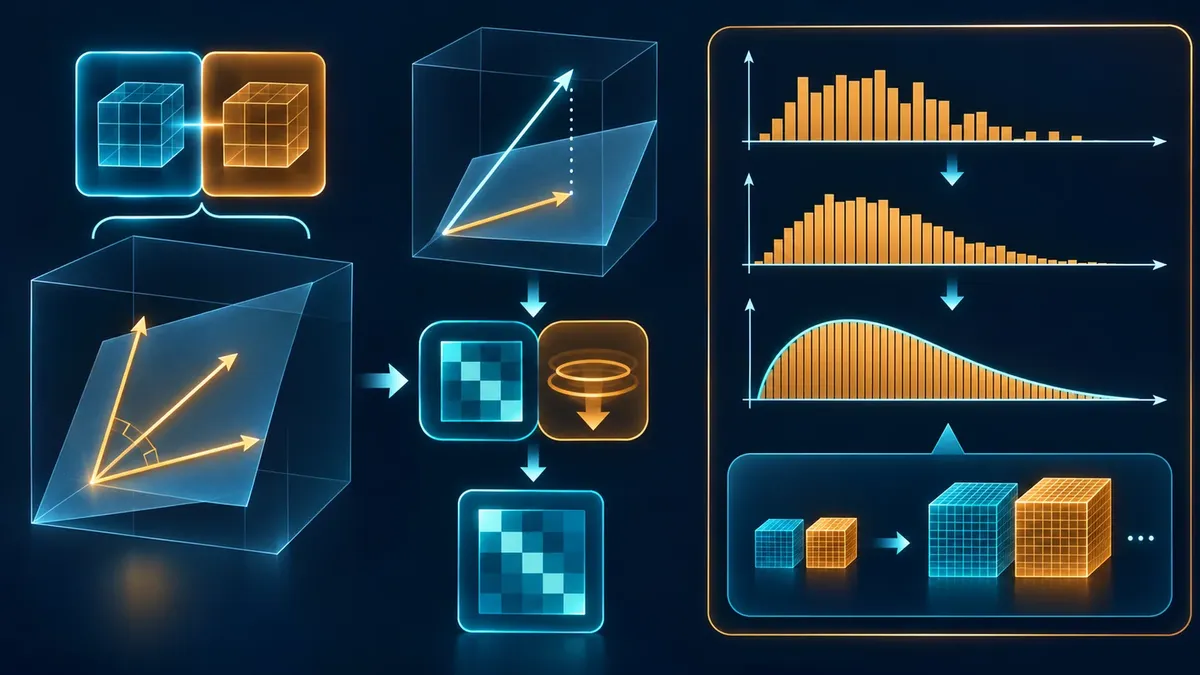
When we observe only part of a quantum system, what does that part’s state typically look like? This paper studies reduced states built from randomly chosen subspaces, deriving exact formulas for their eigenvalue moments and analyzing their behavior as system dimensions grow.
A quantum state can look different depending on which part of a larger system we observe. Its density matrix encodes measurable properties, and its eigenvalues describe the spectrum of that state. This paper asks what that spectrum typically looks like when the larger system is represented not by one random state, but by a randomly chosen subspace.
A subspace is a collection of mutually orthogonal directions in the combined system. The authors choose a subspace, form the projection onto it, and take the partial trace over subsystem B to describe subsystem A. Dividing by the subspace dimension normalizes the result into a density matrix. The distribution produced by this construction is called the Grassmannian ensemble. When the subspace has dimension one, it reduces to the familiar ensemble formed by tracing out part of a random pure state.
Calculating moments
The authors use Weingarten calculus, a technique for calculating averages involving entries of uniformly random unitary matrices. A random subspace can be generated by applying such a unitary to a fixed reference subspace, so the method turns questions about reduced density matrices into unitary averages.
The paper derives explicit formulas for tracial moments—quantities such as the trace of a density matrix raised to a power. These moments reveal information about the eigenvalue distribution. The authors also calculate mixed moments involving multiple reduced density matrices. For numerical illustrations, they generate random subspaces from Gaussian matrices using QR decomposition, then examine the resulting spectra and entropies.
A limiting spectrum under specified conditions
The main spectral result concerns a particular large-system regime: both subsystem dimensions grow, while their ratio approaches a fixed positive value. Theorem 6 states that the empirical distribution of appropriately rescaled eigenvalues converges in probability to a rescaled Marchenko–Pastur law. The law’s parameter depends on the dimension ratio and the chosen subspace dimension.
In accessible terms, the theorem says that, in this scaling regime, the overall eigenvalue distribution becomes increasingly well described by a specific random-matrix distribution. It does not say that individual eigenvalues become fixed, or that the same distribution describes every quantum state or every way of choosing a subspace.
There is a wording difference worth noting: the paper’s abstract describes the empirical distribution as converging almost surely, whereas Theorem 6 states convergence in probability. These are distinct mathematical modes of convergence. The stated theorem supports the in-probability formulation; because the abstract and theorem do not use the same wording, this account does not present the stronger almost-sure claim as unambiguous.
The authors give an alternative route to the limiting spectral result using asymptotic freeness. This is a notion of independence for noncommuting matrices, not ordinary independence in every sense. In the large-dimension limit, the reduced states associated with orthogonal directions have the relevant freeness property, which lets the authors recover the spectral law using free probability.
The paper also calculates an asymptotic expansion for the average von Neumann entropy. Entropy summarizes the spectrum in a single measure of a state’s mixedness; for a reduced state of a bipartite pure state, it also measures entanglement between the two parts. The result is tied to the parameters and limiting assumptions of the ensemble.
Scope and uncertainty
These are mathematical results about an idealized random model, not measurements of a quantum device. The limiting theorem applies under its specified dimension scaling; it should not be assumed to describe small systems accurately or subspaces selected by a particular physical process. The simulations illustrate finite-size cases but do not establish that real systems follow this model.
The work is an arXiv preprint, which may not have completed peer review. Its conclusions are therefore best understood as the authors’ reported findings, not as settled consensus. The source manuscript’s extracted equations and formatting can also be difficult to interpret, so the account above relies on claims stated clearly in the abstract and main results.
Overall, the study extends random-matrix methods from individual random quantum states to random quantum subspaces. It provides explicit moment formulas, analyzes asymptotic freeness, and derives a large-dimension spectral limit and entropy result, with conclusions bounded by the model and its scaling conditions.
- quantum physics
- random matrix theory
- quantum states
- Grassmannian ensemble
- Marchenko–Pastur law
- entanglement entropy
Related reading
Automatically matched by shared topic keywords. These links do not imply that the sources agree or establish a consensus.
Linked quantum states retain an arithmetic fingerprint
Source published
Shared keywords: entanglement entropy
A Rényi Route to Quantum Energy Bounds
Source published
Shared keywords: entanglement entropy
A classical route to bounding uncertainty in quantum predictions
Source published
Shared keywords: quantum physics, quantum states
Quantum states that spread out—but remain uneven
Source published
Shared keywords: quantum physics
Why causal order may not behave like a quantum observable
Source published
Shared keywords: quantum physics