TRANSMISSION // 2611.27913v1
A segmentation score that can tell splits from merges
Source published
StarPQ is an evaluation metric designed to distinguish when image-segmentation predictions split one object into pieces or merge several objects together. Its authors say it can also help account for specified biases or disagreements in instance labels.
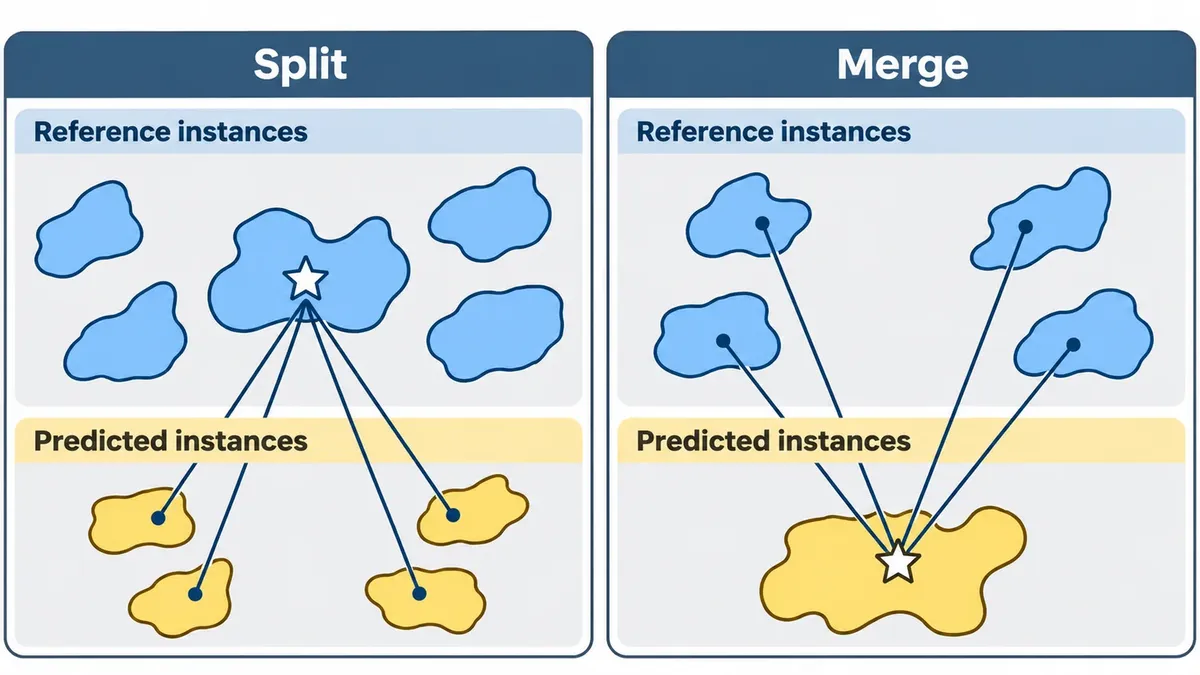
A segmentation score can hide an important distinction: did a model break one object into fragments, or treat several objects as one? Star Panoptic Quality, or StarPQ, is designed to identify those errors separately—and let evaluators decide how strongly to penalize them.
Why one score may miss the kind of mistake
Image-segmentation systems label regions in pictures or scans. In instance segmentation, they must also identify individual objects: not just “these pixels are sheep,” for example, but which pixels belong to each sheep.
Individual-object labels can be costly to create, so researchers sometimes approximate them from semantic maps, which label object types but not separate instances. A common technique, connected components, treats each unbroken patch of pixels as one object. Touching objects can then be joined into one, while an object obscured by another may be broken into pieces. Even expert annotators can disagree about where one instance ends and another begins.
Panoptic Quality (PQ), a widely used metric discussed in the paper, compares predicted instances with reference instances through one-to-one matches. That offers a single score for segmentation and detection quality, but it can penalize a prediction for disagreeing with a reference even when the reference reflects a split or merge bias. The authors propose Star Panoptic Quality (StarPQ) to show these cases separately.
How StarPQ matches objects
The method represents predicted and reference instances as two sets of nodes in a bipartite graph. An edge connects instances that overlap. Instead of requiring every match to pair one prediction with one reference, StarPQ groups matches into “stars.” A clean star has one prediction and one reference. A split star has one reference at its center matched to multiple predicted instances as leaves. A merge star has one prediction at its center matched to multiple reference instances as leaves.
The matching rule asks whether more than half of a segment’s area lies within another segment. The authors apply this rule in both directions, allowing them to identify both splits and merges. A star’s overlap is calculated by treating all its reference segments as one region and all its predictions as another.
StarPQ has two settings that control whether extra segments from splits and merges count as errors. Evaluators can penalize both, forgive one type, or forgive both. The appropriate choice depends on how the data were collected, how reference instances were assembled, and what a downstream task needs; the paper does not prescribe one setting for every situation.
What the paper tested
The authors first use a controlled example in which they shift a prediction map across a reference map to increase their overlap. In this constructed case, StarPQ registers split and merge groupings that a one-to-one match does not capture in the same way.
They then examine recovering instances from semantic maps in COCO, including connected components and connected components followed by a distance-transform watershed method. Their examples illustrate how the recovery method’s assumptions matter: connected components can merge touching sheep or donuts, while watershed can help separate some compact shapes but may create extra splits for elongated objects such as skis. These results demonstrate how StarPQ can diagnose and accommodate particular failure patterns—not that one recovery method works best for every class.
The paper also explores disagreement among expert annotations using an illustrative MRI metastasis example. When experts split or merge particular instances, StarPQ can be configured to forgive those specified disagreements. Finally, the authors compare models on the COCO and Cityscapes benchmarks, reporting separate split and merge summaries. In those evaluations, merges were more frequent than splits, and the authors report that the difference was greater in Cityscapes. These findings describe the datasets and models examined, not all segmentation systems.
What remains uncertain
A key limitation is that the star-forest construction uses a heuristic. It is not guaranteed to find the arrangement that maximizes total star overlap, although the authors say disagreements between the heuristic and exact optimization were rare in their experiments. They favor the simpler, faster procedure, but that trade-off matters when interpreting results.
More broadly, StarPQ does not decide whether a split or merge should count as acceptable. That judgment depends on the application and the reliability of the reference labels. Configurable scoring can make assumptions about specified biases or delineation disagreements explicit; it does not resolve uncertainty in general or remove the need to choose those assumptions carefully.
This article is based on an arXiv preprint, not an independently verified account of peer-reviewed findings. The reported experiments support the proposed metric’s behavior in the tested settings; they do not establish that StarPQ is preferable for every task. Readers should consult the paper for its full methods and evaluation details.
- image segmentation
- instance segmentation
- evaluation metrics
- Panoptic Quality
- StarPQ
- computer vision
Reviewed cross-references
These connections were reviewed by a model, not independently fact-checked by a human. Similarity does not imply agreement; consult the original papers and the evidence below.
When segmentation scores depend on how objects are matched
Shared method: Both papers represent reference and predicted segments as a bipartite overlap graph and use graph-based matching to account for segmentation instances. Their matching rules differ: StarPQ builds clean, split, and merge stars using Intersection over Leaf, while the second paper studies degree-constrained strategies using IoU thresholds; this is a shared framework element, not evidence that their metrics or results are interchangeable.
Model review: · openai-codex/gpt-6-luna
Evidence and provenance
Selected excerpts, not complete papers. PDF extraction can omit figures or damage equations, tables and reading order; sources may be preprints.
2611.27913v1 — Original paper
Excerpt reference:
static/papers/2611.27913v1.md:159-248
Basis: Paper text
Source SHA-256:e2bce25b64e9a93c16c2bc255f8ed07059070917d63e12c03b75ccfe89eaa9e12605.31094v2 — Original paper
Excerpt reference:
static/papers/2605.31094v2.md:70-108
Basis: Paper text
Source SHA-256:e9c5a35904d1e17b5ff43809f028dd33aa98f4c193d9818bdf621426acf09391
Related reading
Automatically matched by shared topic keywords. These links do not imply that the sources agree or establish a consensus.
When segmentation scores depend on how objects are matched
Source published
Shared keywords: evaluation metrics, image segmentation, panoptic quality
Beyond spotting windows: A LiDAR benchmark asks what building features do
Source published
Shared keywords: computer vision, instance segmentation
Animal Identification Scores Can Hide Other Clues to a Match
Source published
Shared keywords: computer vision, image segmentation
How SAM-3 Finds Its Own Paths to Better Segmentation
Source published
Shared keywords: computer vision, image segmentation
A vision-inspired network that is less confidently wrong
Source published
Shared keywords: computer vision