TRANSMISSION // 2611.27898v1
A Sagittarius flyby may have left a lasting mark on the Milky Way’s disc
Source published
Four simulations suggest that a single early Sagittarius-like passage could leave pre-existing disc stars vertically thicker and hotter. The result is suggestive, not a reconstruction of the Milky Way’s full history.
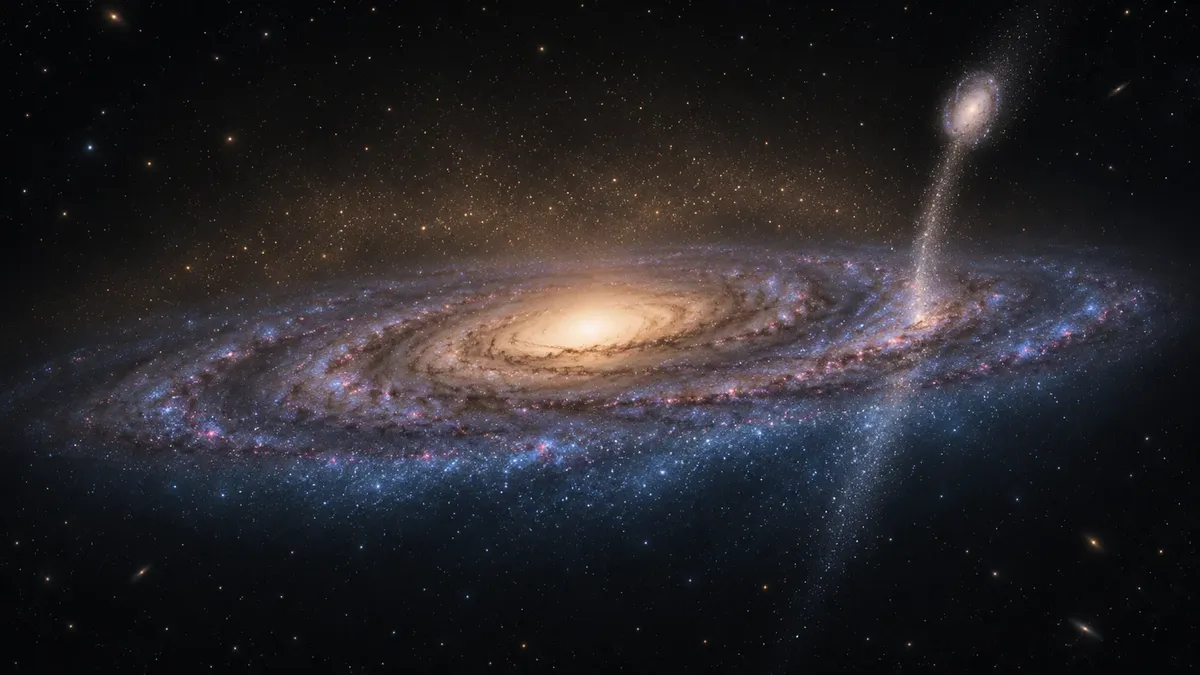
Could the Milky Way’s stars preserve a record of an encounter with the Sagittarius dwarf galaxy billions of years ago? Controlled simulations find that one fast passage can leave an age-dependent imprint in the disc’s vertical structure. The authors say the pattern resembles a reported observation, while stressing that their model is deliberately simplified.
A galaxy’s disc is not a perfectly flat, motionless collection of stars. Gravitational encounters can disturb it, and some effects may persist in how stars move above and below the galactic plane. Payel Das and Jason A. S. Hunt ask whether a single early passage by a Sagittarius-like dwarf galaxy could leave such a long-lived trace in a Milky Way-like disc.
The question is motivated by evidence interpreted as pointing to an encounter around 5–7 billion years ago. One clue is a reported increase in the vertical velocity dispersion of older stars in the Milky Way’s outer, low-alpha disc. Velocity dispersion describes how varied a group’s motions are; greater vertical dispersion means more varied motion perpendicular to the disc. The simulations test whether a satellite crossing could produce a similar age-related feature. They do not establish that Sagittarius caused the reported observation.
Four controlled galaxy simulations
The researchers used four N-body-plus-hydrodynamics simulations: one isolated Milky Way-like galaxy as a control, and three with a Sagittarius-like satellite. In each satellite run, the dwarf made one fast, nearly polar passage through the host’s outer disc, then departed on an unbound path. The simulations isolate this crossing rather than reproduce the Milky Way’s complete formation history.
The baseline satellite had a total mass of about 70 billion Suns. One variation made it 1.5 times more massive; another increased its crossing speed. The simulated passages came closest to the galaxy’s centre at roughly 15–18 kiloparsecs, at speeds of 466–634 kilometres per second. The team compared the present-day structure of newly formed thin-disc stars across the runs, grouping them by age and location. They measured vertical thickness and vertical velocity dispersion, among other properties.
The clearest imprint is in stars already present
In the simulations, stars old enough to have existed at the time of the passage were vertically thicker and more dynamically heated than comparable stars in the isolated control. The size varied with the satellite model and with the measure: the paper reports up to about a 37% increase in mass-enclosed height and an excess of up to roughly 5 kilometres per second in vertical velocity dispersion. Stars formed after the passage, by contrast, were reported to be indistinguishable from the control in these comparisons.
The age boundary is central to the proposed “fossil” signature: the difference appears around the age corresponding to the encounter, about 7.1 billion years ago. For the reported vertical-structure measures among stars old enough to predate the passage, the more massive satellite produced the largest departures from the control, and the faster-passage run the smallest. The simulations show this pattern, but do not settle whether the heating comes directly from the satellite’s gravity or partly through the host galaxy’s collective response.
The authors also compared the simulated age–dispersion pattern with a smooth heating relation fitted to the isolated control. The satellite runs showed extra vertical heating among stars old enough to predate the passage. The baseline simulation’s excess of about 4 kilometres per second is close to the roughly 4-kilometre-per-second jump reported in an earlier study of the Milky Way’s outer low-alpha disc. The authors present this resemblance as support for plausibility, not a unique identification. Inferring satellite mass from the jump is uncertain: the estimate is good only to about a factor of 1.5, and mass and crossing speed are partly degenerate.
What the simulations cannot settle
The simulated disc is substantially dynamically colder than the real Milky Way before the encounter. Matching the size of a dispersion jump therefore does not mean the model reproduces the Galaxy’s full conditions. The experiment also omits the Milky Way’s cosmological environment, later accretion and mergers, the Large Magellanic Cloud, and Sagittarius’s repeated later passages. Such events could alter or blur an old signature.
The analysis focuses on newly formed thin-disc stars. Earlier stellar populations in the model were assigned approximate ages and chemical properties rather than grown self-consistently, so the results do not establish how those pre-existing populations would respond. The authors also note that uncertainties in real stellar ages—potentially around 30%—could wash out a sharp age boundary. They leave unresolved whether the heating is direct or mediated by the host halo’s response.
This is an arXiv preprint, and the supplied manuscript includes a placeholder for its acceptance status; the evidence here does not establish peer review. Its controlled simulations show that one idealized passage can produce a lasting, age-dependent vertical imprint. Whether the Milky Way preserves a readable version of that record—and whether Sagittarius made it—requires further modeling and observational tests.
- Sagittarius dwarf galaxy
- Milky Way
- galactic disc
- stellar dynamics
- galaxy simulations
- galactic archaeology
Related reading
Automatically matched by shared topic keywords. These links do not imply that the sources agree or establish a consensus.
Milky Way Star Patterns May Share a Dynamical Story
Source published
Shared keywords: galactic archaeology, milky way, stellar dynamics
A Proposed Infrared Instrument Could Trace the Milky Way’s History
Source published
Shared keywords: galactic archaeology, milky way
Galactic dust offers a tentative clue to dark matter—not a verdict
Source published
Shared keywords: galaxy simulations
Red giants’ individual vibrations sharpen estimates of their ages
Source published
Shared keywords: galactic archaeology
CosmicGrain follows dust histories through a simulated galaxy
Source published
Shared keywords: galaxy simulations