TRANSMISSION // 2611.27891v1
DICE reports faster AI decoding in tested setups
Source published
DICE combines draft-model predictions with pre-sampled, synchronized randomness to guide speculative decoding. The paper reports throughput gains in its tested settings.
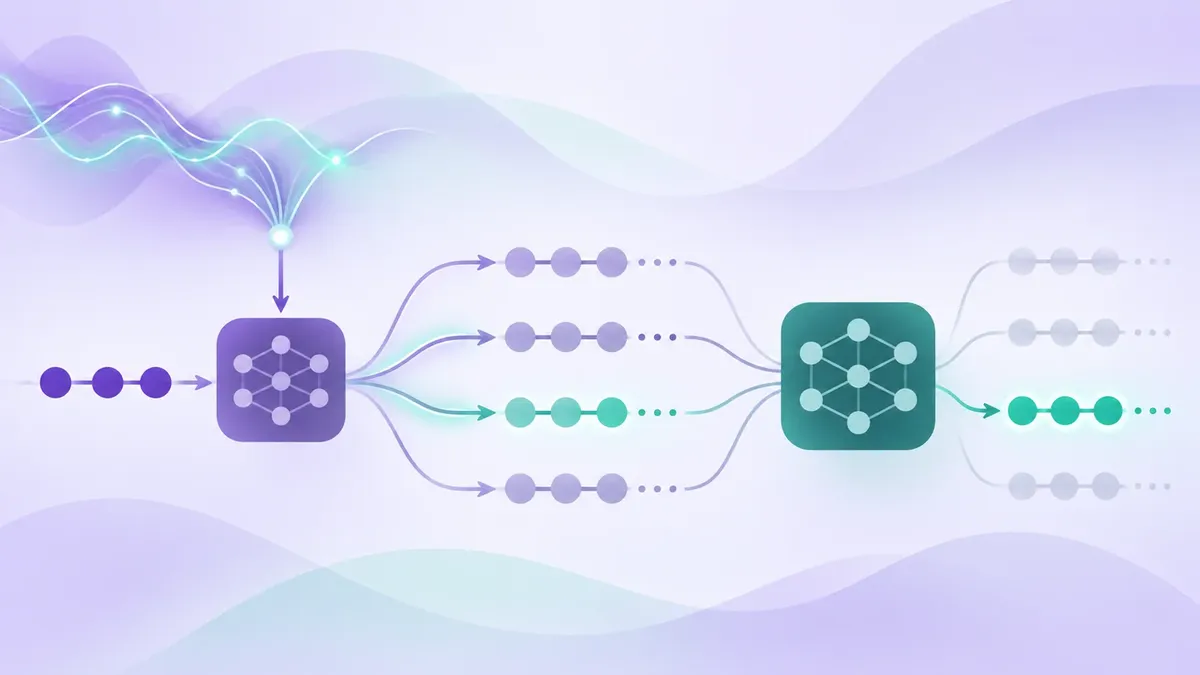
Language models generate text token by token, which can make responses slow. Speculative decoding lets a drafter propose candidate continuations for a target model to verify. Guanning Zeng and Andrea Zanette’s DICE method uses draft predictions together with synchronized sampling randomness to help decide which candidates to prepare.
Large language models generate text sequentially: each new token depends on what came before. Speculative decoding tries to reduce the cost of this process. A drafter proposes possible continuations, and the target model evaluates candidates in a forward pass. Verification accepts a matching prefix; if a proposal fails, the target supplies a correction token. The target still does the verification work, but several candidate tokens can be considered together.
The challenge is choosing which continuations to prepare when drafting computation is limited. Zeng and Zanette’s paper asks whether a decoding system can use not only a drafter’s predictions, but also the random draws that will be used during sampling.
Using draws to guide candidate selection
In sampling-based generation, the target’s next-token choice depends on its predicted probabilities and random draws. The target probabilities are unavailable until the target model runs. The draws, however, can be generated before drafting begins. DICE (Draw-Informed Candidate Selection) pre-samples and synchronizes the verification randomness used by its drafting policy and the target verifier.
The drafter combines its own predictions with those draws to estimate which candidates are more likely to be used in that particular run. DICE uses these estimates to allocate a fixed drafting budget: in tree-based decoding, they guide which candidate nodes to propose, expand and retain for verification. In asynchronous prefetching, possible next-round drafts are prepared while the current round is being verified, and DICE prioritizes which outcomes to cache.
The method is intended to work with existing drafters, without additional drafter training or changes to the target sampling distribution. The paper gives a correctness argument for its tree method and for prefetching under the stated assumptions. The prefetching estimates, in particular, use a model of draft-to-target probability ratios that assumes draft probabilities are calibrated. DICE changes which candidates are prepared; it does not make the target’s eventual predictions known in advance.
What the evaluations report
For draft-tree decoding, the authors tested 16 target–drafter pairs across reference implementations and optimized SGLang and vLLM backends. The benchmarks were Spec-Bench and SPEED-Bench. In the reported comparisons against each method’s corresponding baseline, throughput gains ranged from 4.3% to 21.5% on Spec-Bench and from 5.6% to 24.6% on SPEED-Bench.
For asynchronous prefetching, the evaluation used Alpaca, GSM8K, HumanEval and UltraFeedback, with four target–drafter pairs. Against vanilla speculative speculative decoding (SSD), the paper reports throughput gains of 4.0% to 13.7%, alongside higher cache-hit rates in all four pairs.
The authors also report tree-decoding results across sampling temperatures and concurrency levels. In their EAGLE-4 comparison, DICE and the baseline ran at the same speed at temperature zero; DICE’s advantage grew as temperature increased. In a separate tree-decoding concurrency sweep, DICE remained faster than autoregressive decoding at concurrency 64 in the tested setups. For prefetching, the temperature results concern cache-hit rates; the paper does not report the same concurrency sweep for that application.
These measurements are specific to the tested models, hardware, software backends, workloads and configurations. They do not establish that DICE will produce the same gains in every deployment. The paper’s ablations suggest that using the actual synchronized draws helped more than the particular probability-estimation variants they tested. That is evidence from those experiments, not a general finding about all possible estimates or settings.
Limits and source status
DICE still relies on drafter predictions, and prefetching depends on estimates of possible verification outcomes. Performance comparisons also depend on the baseline and implementation. Although the evaluation includes optimized backends as well as reference implementations, it cannot cover every model family or production workload.
This article is based on the arXiv version of the paper, a preprint that may not have undergone peer review. Its mathematical argument and reported benchmarks provide evidence for the proposal, but independent replication and testing in additional settings would help clarify how broadly the results apply. The central idea is specific: randomness that can be pre-sampled and synchronized may help a system choose what to compute ahead of verification.
- speculative decoding
- DICE
- language models
- AI inference
- sampling randomness
- LLM throughput
Reviewed cross-references
These connections were reviewed by a model, not independently fact-checked by a human. Similarity does not imply agreement; consult the original papers and the evidence below.
ForeSpark schedules both AI guesses and checks
Supporting evidence: Both papers report throughput gains from adapting speculative-decoding decisions in their tested setups: DICE uses pre-sampled verification randomness to guide draft-tree selection and reports gains over its evaluated baselines, while ForeSpark jointly schedules per-request draft and verification budgets and reports gains over its evaluated baselines. This supports the bounded point that adapting speculative computation can improve throughput in evaluated settings, not that the methods are directly comparable or that either is universally faster; their workloads and approaches differ.
Model review: · openai-codex/gpt-6-luna
Evidence and provenance
Selected excerpts, not complete papers. PDF extraction can omit figures or damage equations, tables and reading order; sources may be preprints.
2611.27891v1 — Original paper
Excerpt reference:
static/papers/2611.27891v1.md:836-1004
Basis: Paper text
Source SHA-256:0119e2e16aa0eeadb2c81e72587bfb52bb2366e32198871facae2cc85aefd78f2611.13442v1 — Original paper
Excerpt reference:
static/papers/2611.13442v1.md:1246-1322
Basis: Paper text
Source SHA-256:8c75b74b0abff761e1b212e9e683922db639cfac7bd65f46416e98ea239a07f2
Related reading
Automatically matched by shared topic keywords. These links do not imply that the sources agree or establish a consensus.
ForeSpark schedules both AI guesses and checks
Source published
Shared keywords: ai inference, speculative decoding
A text watermark designed for draft-and-check AI generation
Source published
Shared keywords: speculative decoding
RECAP speeds up vision-language models by recycling predictions in context
Source published
Shared keywords: speculative decoding
A language-model drafter that works while its guesses are checked
Source published
Shared keywords: language models, speculative decoding
HybridSpec speeds hybrid language models by checking fewer draft tokens
Source published
Shared keywords: language models, speculative decoding