TRANSMISSION // 2611.27890v1
TESS catches flickers from black-hole candidates
Source published
A TESS survey finds optical variability in 20 intermediate-mass black-hole candidates, while instrumental noise and short observing windows limit what the signals can reveal.
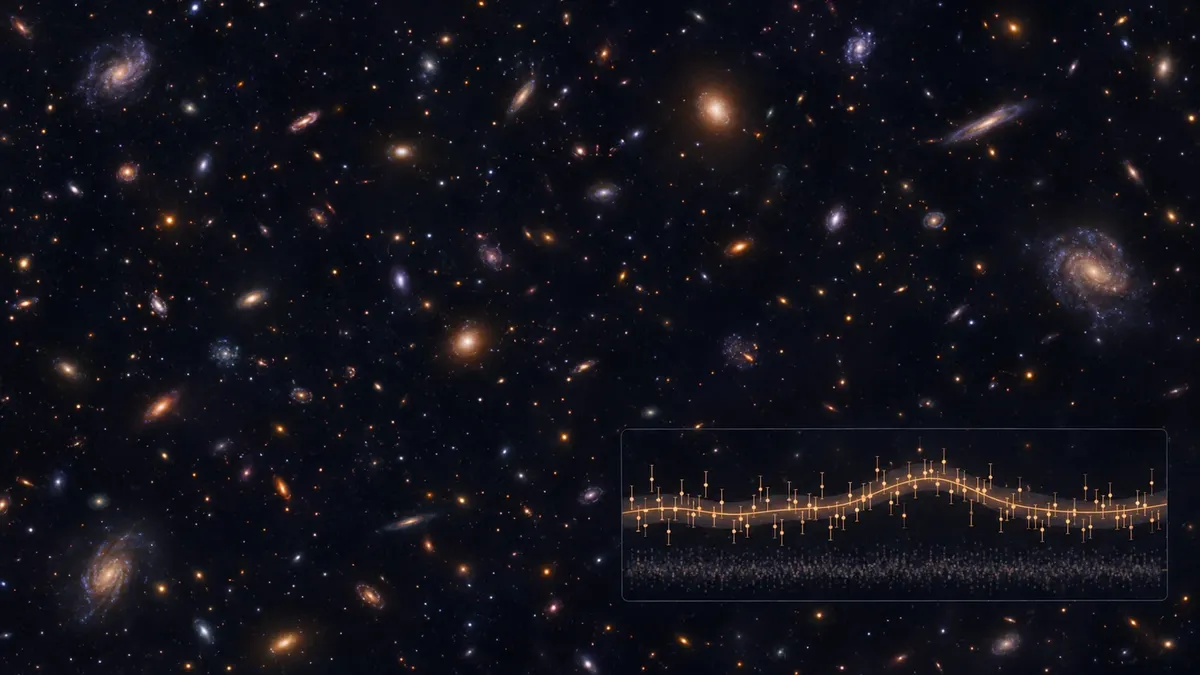
Could brief changes in a galaxy’s light help reveal a hard-to-find black hole? Researchers sifted through TESS observations of hundreds of candidates, looking for flickers that stand out from instrumental noise and nearby sources. They found promising signals, but evidence for a link between black-hole mass and variability timescale remains tentative.
Intermediate-mass black holes are thought to sit between stellar-mass black holes and the supermassive black holes found in many galactic centres. Finding them is difficult: they can be faint, their light can be mixed with that of their host galaxies, and estimates of their masses are uncertain. One possible clue is variability. As gas falls toward a black hole, the light from the surrounding active galactic nucleus can change over time.
Jinghuai Yao, Wenwen Zuo, Hengxiao Guo and Ashutosh Tripathi asked whether the Transiting Exoplanet Survey Satellite (TESS) could detect such changes in candidate systems. TESS repeatedly measures the brightness of broad areas of sky. Its observations can be taken every few minutes, offering a way to track changes over hours or days—timescales that may matter for lower-mass black holes.
Separating flickers from noise
The researchers assembled 410 active-galaxy candidates with estimated black-hole masses below one million times the Sun’s mass and brightness suitable for TESS. They examined data from TESS’s primary and extended missions, spanning about eight years and using observing sectors of roughly 28 days. Revisiting some targets in multiple sectors made it possible to look for variability at different times.
TESS was designed primarily to find planets, not faint galactic nuclei. Its pixels cover a relatively broad patch of sky, so light from neighbouring objects can blend together. Instrumental effects can also imitate a change in brightness. To reduce these problems, the team used the Quaver pipeline, adapted to process many targets, and compared each source’s apparent variability with that of surrounding background pixels. Their metrics considered both whether the source varied more than its surroundings and whether its pixels changed together. They also flagged sectors affected by likely instrumental artifacts and visually inspected candidates for contamination from nearby sources.
The team then fitted selected light curves with a damped random walk (DRW) model. In simple terms, this describes irregular brightness changes that gradually lose memory of their earlier state. The researchers also used observations from the Zwicky Transient Facility (ZTF), a ground-based survey, to assess longer-term variability.
A shortlist, not a census
The researchers classified three sources as high-confidence variable candidates and 17 as medium-confidence candidates. All three high-confidence sources—UGC 6728, NGC 4051 and NGC 4395—already had independent evidence of optical variability. Most medium-confidence sources did not have published confirmations of optical variability, making them potential targets for follow-up rather than established detections.
The ZTF data showed fractional variability of 1.8–7.4% in the three high-confidence sources. Most medium-confidence sources had measured variability below 1%; the authors caution that these small changes should not be treated as reliable evidence of long-term variability. The study also examined 155 nearby dwarf-galaxy nuclei not catalogued as active galaxies, but did not independently identify high-confidence variability candidates among them.
A possible relationship between black-hole mass and DRW timescale appeared only after the researchers selected a small subset of sectors with stronger, more coherent signals. That subset included 17 sectors from eight sources. The trend was sensitive to the selection thresholds and was not present across the broader dataset. The authors therefore describe it as tentative, not as evidence establishing a general mass–timescale relation.
What the data cannot settle
Each TESS sector covers only about 28 days. The paper’s injection–recovery tests found that longer input DRW timescales were increasingly underestimated under observing conditions like these. A fitted timescale close to or beyond the observing window can therefore be difficult to interpret as a physical property of the black hole. The authors also note that the DRW model may not capture all features of active-galaxy variability, and that their light-curve reduction may affect comparisons with earlier measurements.
Sensitivity is another constraint. In TESS’s relatively shallow observations, a host galaxy’s starlight can dilute changes from a faint nucleus. The team found that stronger candidate signals were more common among brighter sources. Failure to detect variability therefore does not show that a candidate lacks a black hole or an active nucleus.
The findings illustrate a useful role for TESS’s frequent, repeated observations, while showing why candidate signals need careful checks and follow-up. The source is an arXiv preprint. In particular, the small, selection-dependent timescale sample cannot yet provide a firm test of how variability depends on black-hole mass.
- TESS
- intermediate-mass black holes
- active galactic nuclei
- optical variability
- Quaver
- damped random walk
- astronomy preprint
Related reading
Automatically matched by shared topic keywords. These links do not imply that the sources agree or establish a consensus.
When Quasar Variability Hides in the Noise
Source published
Shared keywords: active galactic nuclei
Infrared echoes trace dust around lower-mass black holes
Source published
Shared keywords: active galactic nuclei
LISA could find elusive black holes long before their companions fall in
Source published
Shared keywords: intermediate mass black holes
Gas disks could steer stars into growing black holes
Source published
Shared keywords: intermediate mass black holes
JWST’s proposed time-lapse of the Milky Way’s center
Source published
Shared keywords: intermediate mass black holes