TRANSMISSION // 2611.27871v1
A world model reads quantum dynamics to infer hidden interactions
Source published
A self-supervised neural network inferred Hamiltonian parameters from noisy simulated measurements, including in a 100-site chain. The results are promising, but the study does not yet demonstrate the method on quantum hardware.
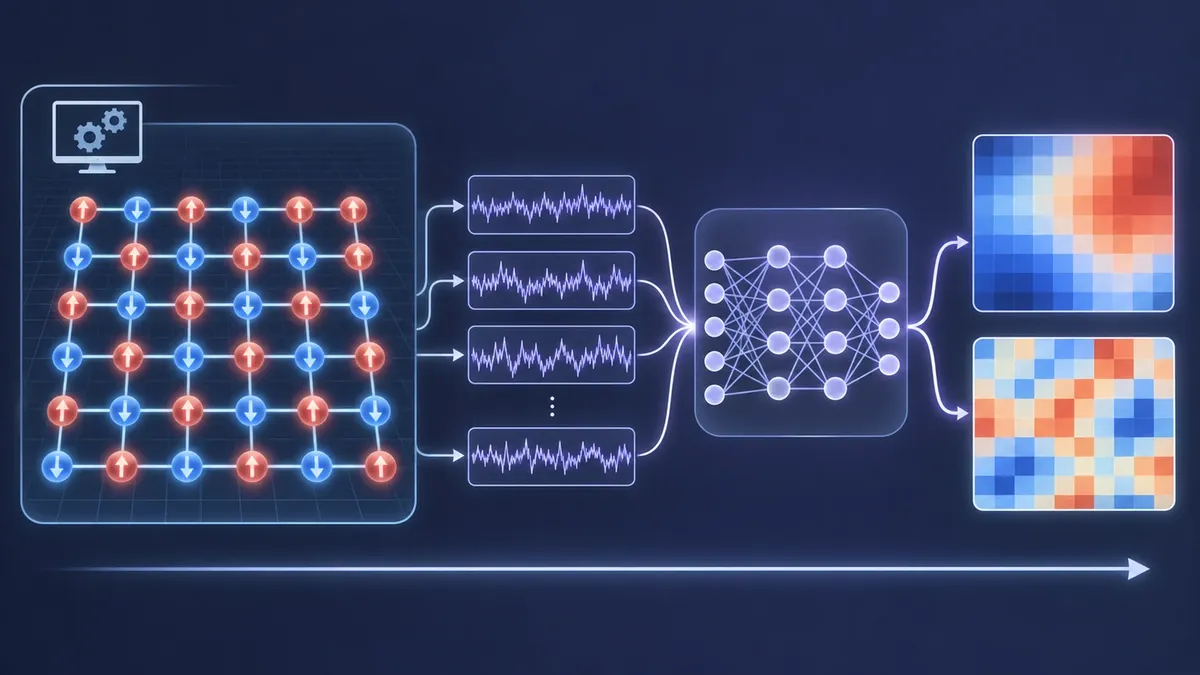
A quantum system’s interactions are not always exactly what its control settings say they should be. Can a neural network work backward from noisy measurements of how a system changes over time to identify the Hamiltonian—the rule governing that evolution? A new preprint tests a self-supervised approach on simulated spin systems.
A quantum device may be programmed with particular fields and interactions, yet imperfections such as spatial variation, cross-talk or drift can make its actual behaviour differ from the intended design. Figuring out which Hamiltonian—a mathematical description of the system’s energy and dynamics—produced observed measurements is one way to characterize a device.
Yuan Wang and Oleksandr Kyriienko propose using a “world model” for this inverse problem. Here, a world model is a neural network that learns how observations change over time. The question is whether it can use those changes to infer underlying physical parameters, rather than simply predict another set of measurements.
Learning from the next measurement window
The researchers tested a joint-embedding predictive architecture, or JEPA. It encodes short windows of measurements into compact representations, then trains a predictor to forecast the representation of the immediately following window. The network is not asked to reconstruct every measurement value; it learns which features of one window help predict the next.
That distinction matters because quantum measurements are noisy. Repeated measurements, or “shots,” can produce different results even when the underlying system is unchanged. The authors’ reasoning is that the Hamiltonian persists across windows, while each window contains fresh shot noise. Predicting across windows may therefore encourage the model to retain repeatable dynamics and discard random fluctuations.
The team first trained the encoder and predictor without Hamiltonian labels. They then froze the encoder and trained a small regression head using labelled examples to read out physical parameters from its representation. The paper’s approximate 2.7 million trainable-weight figure refers to the encoder and JEPA predictor together, not the entire downstream system: the paper reports 373,504 parameters for the encoder and 2,303,360 for the predictor, before adding the regression head. Comparisons included a masked autoencoder trained to reconstruct hidden measurements, the same encoder without pretraining, and regression using observables directly, either over time or averaged across it.
Tests on two simulated spin systems
The main benchmark was a 12-qubit, two-dimensional transverse-field Ising lattice. The researchers used exact numerical simulation to generate its dynamics and noisy measurement records. Across different tasks, the network recovered spatial maps of local fields and interactions. They tested real-time evolution and imaginary-time relaxation, a different kind of evolution used in methods for finding low-energy states.
The second benchmark was a disordered, one-dimensional Heisenberg chain with 100 sites. Its dynamics were generated using a tensor-network method rather than exact full-state simulation. The model’s task was to recover the site-by-site disorder map from noisy observables.
In the four reported settings, latent prediction had lower parameter-recovery error than the masked autoencoder. The authors report improvements of about 1.3 to 1.7 times over that reconstruction approach, depending on the task. The learned representation also outperformed regression on time-averaged measurements, with reported gains ranging from 4.4 to 30 times. But a random, untrained encoder that preserved time information also did better than time averaging. Temporal information itself therefore accounted for much of the improvement; pretraining added a further benefit rather than explaining the whole gap.
A practical check asked whether inferred parameters could reproduce the simulated dynamics. In the Ising-lattice test, parameters inferred from the first eight of 32 frames were used to simulate the remaining evolution. The authors compared the resulting occupations with those generated using the true Hamiltonian and report errors close to the shot-noise level. This suggests the recovered maps capture useful features of the simulated system, but it is not a forecast of measurements from an experiment or validation of an unknown hardware Hamiltonian.
What remains uncertain
The results have a specific scope: the study uses simulated data, not measurements collected in a quantum-device experiment, and tests two model families with particular parameter distributions and noise models. The simulations include finite-shot noise and a model of detection flips. Whether the approach transfers to other noise conditions, real device drift, or hardware systems remains to be tested. The authors specifically identify transfer from classically tractable systems to larger hardware as a next question.
The paper is a preprint, so its claims have not necessarily undergone peer review. Its comparisons apply to the models, data and tuning procedures tested; they do not establish that JEPA is best for every Hamiltonian-learning problem. For now, the work demonstrates a promising way to extract physical parameters from noisy simulated dynamics—not a proven method for calibrating quantum hardware.
- quantum dynamics
- Hamiltonian learning
- quantum many-body physics
- self-supervised learning
- joint-embedding predictive architecture
- quantum simulation
Reviewed cross-references
These connections were reviewed by a model, not independently fact-checked by a human. Similarity does not imply agreement; consult the original papers and the evidence below.
A smaller physics model helps a neural network learn 50-qubit spin chains
Supporting evidence: Both papers report recovering Hamiltonian parameters from dynamical measurements in their tested settings: Wang and Kyriienko use latent prediction on simulated Ising and Heisenberg systems, while de Lima uses a Jordan–Wigner-reduced PINNverse on synthetic spin-chain data. This supports the bounded point that distinct learning approaches can infer Hamiltonian parameters from dynamics; it is not a direct comparison or independent validation under matched conditions.
Model review: · openai-codex/gpt-6-luna
Evidence and provenance
Selected excerpts, not complete papers. PDF extraction can omit figures or damage equations, tables and reading order; sources may be preprints.
2611.27871v1 — Original paper
Excerpt reference:
static/papers/2611.27871v1.md:12-62
Basis: Paper text
Source SHA-256:2ce507bc2b77d1d1a66b5fbd83e10355bc7048b1da484b102acb0f8b7003a0862611.14023v1 — Original paper
Excerpt reference:
static/papers/2611.14023v1.md:12-74
Basis: Paper text
Source SHA-256:6e58196fafaf53f4a192dc3418dc5cbe8b269234810323b9af4ecdbf7f08cd78
Related reading
Automatically matched by shared topic keywords. These links do not imply that the sources agree or establish a consensus.
A market-wide clue helps a stock-learning AI separate shared shocks from individual signals
Source published
Shared keywords: self supervised learning
When can interacting quantum dynamics look free?
Source published
Shared keywords: quantum dynamics
LEF-JEPA targets object structure without preserving every visual detail
Source published
Shared keywords: self supervised learning
Simulating quantum noise by enlarging the quantum system
Source published
Shared keywords: quantum simulation
When Do Eighth-Order Quantum Simulation Formulas Help?
Source published
Shared keywords: quantum simulation