TRANSMISSION // 2611.27865v1
Teaching AI teams to react to adversaries with logic
Source published
SLICR combines formal logic and multi-agent reinforcement learning to help agents adapt to opponents in partially observed simulations.
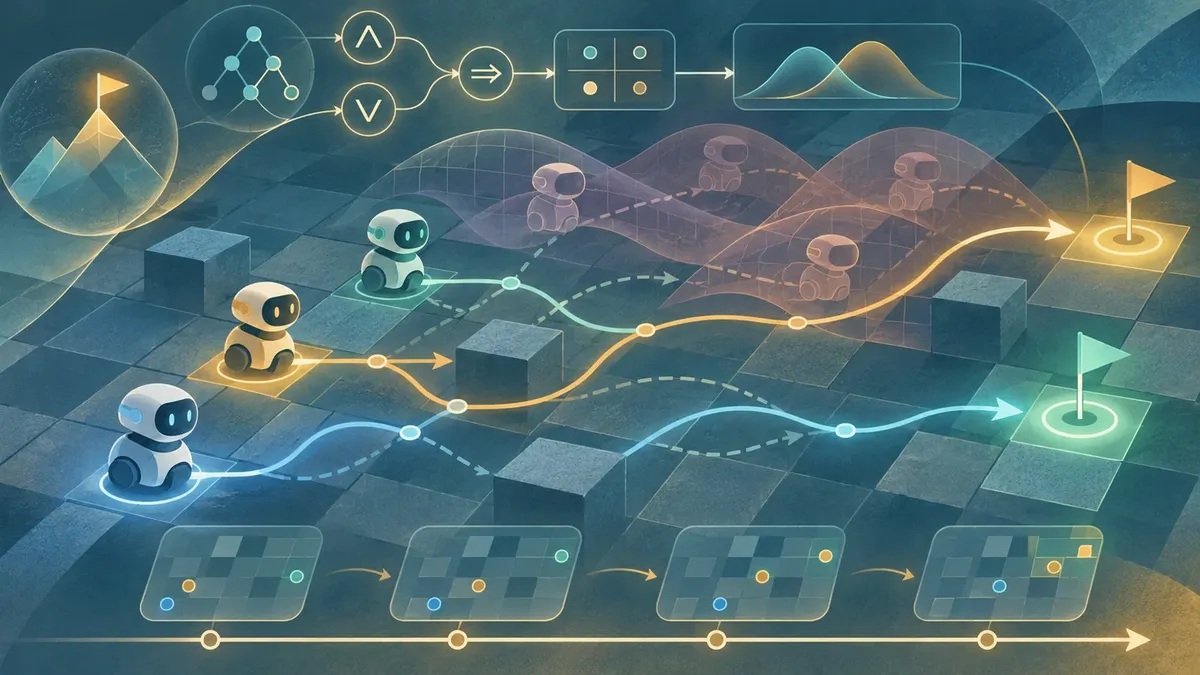
A team of learning agents may need to succeed against opponents whose tactics change—and whose actions are only partly visible. SLICR uses formal logic to describe what agents should achieve and how their strategies may depend on opponents’ behavior. In simulations, it outperformed an opponent-modeling baseline on several tasks, though the results do not establish how it would perform outside those settings.
The challenge: objectives that depend on opponents
Reinforcement learning trains an agent through repeated interaction, using rewards to encourage useful behavior. In multi-agent settings, however, an opponent’s strategy can change what counts as a good move. A policy that works against one opponent may fail against another, especially when agents can see only part of the environment.
The paper introduces SLICR, a method for combining reinforcement learning with Strategy Logic and linear temporal logic. These formalisms let researchers specify goals over time—for example, eventually reaching a destination while always avoiding interception—and describe whether an agent’s strategy should work against every opponent strategy or adapt to the particular strategy it faces.
The authors’ central question is whether such specifications can guide agents to respond effectively to adversaries under partial observability, including opponents that do not behave in a predictable or rational way.
How SLICR learns
SLICR turns a logical objective into a learning signal. Instead of treating success as simply achieved or not achieved, it assigns a graded “robustness” value to how well a sequence of states satisfies the temporal objective. The agents use these values as rewards while learning response strategies.
Because an agent cannot directly inspect an opponent’s full policy, SLICR builds a compact representation of opponent behavior from observed actions and observations. An encoder produces this representation; decoder networks are trained to reconstruct opponents’ actions and observations and predict some of their future actions. The agent uses the representation alongside its own local history when choosing what to do.
A separate “shield” is intended to identify experience involving uniformly random opponents. The method can then exclude that experience from learning, rather than allowing behavior the authors classify as irrational to distort the response policy. Training uses centralized information to help learn policies, while the intended execution is decentralized: agents act using their local information.
The study evaluates SLICR in three simulated benchmark families: Predator–Prey, Google Research Football, and an extension of SMAC-HARD, a StarCraft-based multi-agent environment. The authors compare it mainly with LIAM, an opponent-modeling baseline, and test both seen opponents used in training and unseen opponents held out for evaluation. Results are reported across ten independent runs with different random seeds.
What the experiments suggest
Across the tested settings, SLICR often performed better than LIAM, including against held-out strategies. The paper reports improvements of up to 90% over that baseline in some results; this is a maximum, not a typical gain across all tasks. In one SMAC-HARD map, for example, the authors report that SLICR reached a 90% win rate against unseen opponents while LIAM rarely won. Results varied by benchmark and setup, so the headline figure should not be read as a general performance guarantee.
The experiments also suggest that the logical specification and shield can matter, but not uniformly. In some comparisons, adding the inner temporal-logic guidance improved results; in others, shaped rewards did better for part of training. The more adaptive specification form—which lets a response depend on opponent strategies—performed better on some Predator–Prey and football tasks, while the two forms were more similar across the SMAC-HARD results. That adaptive form also used more model parameters.
Important limits
The work covers only specifications with at most one alternation between “for all” and “there exists” strategy choices. Its theoretical link between the learned reward objective and the probability of satisfying a specification depends on assumptions, including that the opponent-strategy representation preserves all relevant information. The authors note that this may be difficult under partial observability; their learned embedding can only approximate it when different strategies look indistinguishable from an agent’s observations.
The benchmarks are simulations with constructed sets of opponent policies. Strong results there do not show that SLICR will transfer to physical systems or real-world adversaries. The reported comparisons are specific to the chosen environments, baselines, training budgets, and evaluation procedures.
This account is based on the full text of the arXiv version 1 preprint, SLICR: Strategy Logic-Guided Multi-Agent Reinforcement Learning. An arXiv preprint is not, by itself, evidence of peer review. As with any paper extraction, formatting problems can also make details in equations or figures harder to verify; numerical claims here are limited to results clearly described in the text.
- multi-agent reinforcement learning
- Strategy Logic
- formal methods
- opponent modeling
- partial observability
- AI simulations
Related reading
Automatically matched by shared topic keywords. These links do not imply that the sources agree or establish a consensus.
When Observations Limit an AI Safety Guarantee
Source published
Shared keywords: partial observability
When Can We Prove a Neural Network Will Behave?
Source published
Shared keywords: formal methods
A classifier translates robot instructions into temporal logic
Source published
Shared keywords: formal methods
A value gap may reveal when AI teammates are out of sync
Source published
Shared keywords: multi agent reinforcement learning
CARGO trains simulated vehicles to distinguish helpful cooperation from avoidable risk
Source published
Shared keywords: multi agent reinforcement learning