TRANSMISSION // 2611.27836v1
How stars may shape the Neptunian desert
Source published
Planet boundaries shift around different stars in ways consistent with atmospheric escape, though current data cannot rule out a role for tidal migration.
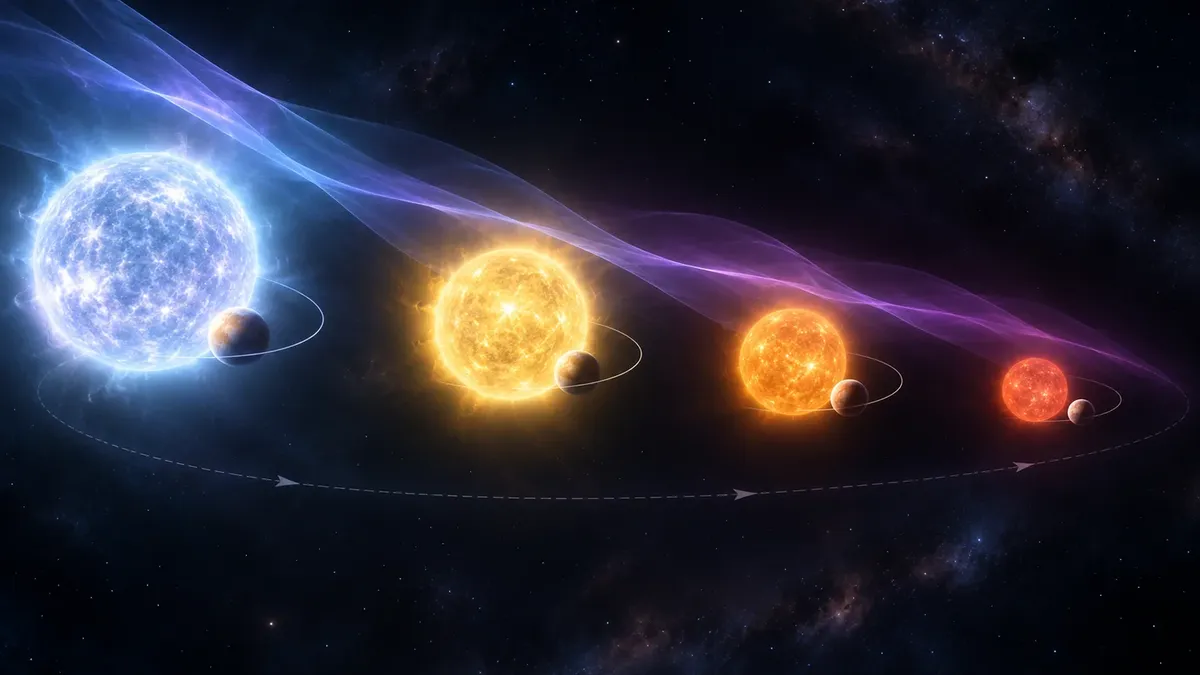
Why are intermediate-sized planets scarce on the tightest orbits? Comparing the desert around F-, G-, K- and M-type stars, researchers find patterns consistent with atmospheric loss driven by high-energy radiation. The evidence is suggestive, not decisive—especially for planets around small, cool stars, which remain sparsely sampled.
Astronomers have found a shortage of intermediate-sized planets on very tight orbits. This feature, known as the Neptunian desert, is not completely empty, but planets roughly 2–10 times Earth’s radius are uncommon at the shortest orbital periods. Two leading explanations involve different processes: high-energy radiation from a star can heat a planet’s upper atmosphere and drive gas into space, while tidal circularisation after high-eccentricity migration—and a tidal-disruption limit for planets arriving on such paths—may help define the desert’s edges.
A study by George W. King and colleagues tests these explanations by asking whether the desert’s boundaries change with host-star type in ways the mechanisms predict. The work is an arXiv preprint, so its conclusions should be regarded as provisional rather than settled consensus.
Comparing planets around different stars
The researchers used a catalogue of confirmed and known planets from Kepler and TESS, with stellar properties drawn from a published catalogue. They grouped host stars into F, G, K and M types, then traced the desert’s boundary against four quantities: orbital period, orbital distance, ordinary starlight received by a planet (bolometric instellation), and estimated lifetime exposure to X-rays and ultraviolet radiation (XUV).
To account for differences in detectability, the analysis used inverse detection-efficiency weights: planets less likely to be detected received greater weight. The researchers also incorporated measurement uncertainties by repeatedly drawing possible values for planet radii, orbital properties, stellar masses and ages. They defined the desert’s “opening” using planets between 2.2 and 7.5 Earth radii, a range where the competing explanations are particularly difficult to separate.
Lifetime XUV exposure cannot be measured directly for these planets. The team estimated it using Mors, a model of how stars’ high-energy output changes with mass, age and initial rotation. These doses are therefore model-based estimates, not direct measurements of the radiation each planet received.
The boundary moves with stellar type
From F stars toward smaller M stars, the desert boundary in the 2.2–7.5-Earth-radius range shifts toward shorter orbital periods and smaller orbital distances. It also shifts to substantially lower bolometric instellation. In the sample after cuts on planet radius, orbital period and transit signal-to-noise, the opening in period moves from about 3.8 days for F-star hosts to about 2.2 days for M-star hosts. That sample includes 119 M-hosted planets, compared with hundreds in each of the F, G and K groups.
The researchers compared these shifts with their estimates of cumulative XUV exposure. At a fixed orbital distance, period or bolometric instellation, the XUV dose varies with stellar mass. The direction of that variation matches the observed movement of the desert boundary. This correspondence supports a role for radiation-driven atmospheric escape: planets around different stars may need to occupy different orbits to receive comparable accumulated XUV exposure.
A further test plots the boundary against lifetime XUV itself. For planets up to 7.5 Earth radii, the estimated boundaries overlap substantially across stellar types. Similar boundaries at similar accumulated doses are consistent with atmospheric escape helping shape the population.
Why tides are not ruled out
The evidence does not settle the debate. Under the high-eccentricity migration and tidal explanation, the boundary in orbital-period space is expected to be largely unchanged across stellar types. The observed period shifts therefore lean toward an XUV-driven contribution. But when the researchers compared the lifetime-XUV boundaries with a predicted tidal shift, uncertainties were too large to exclude it: the M-star boundary was statistically compatible with both the FGK boundary and the tidal prediction.
The authors interpret their results as favoring photoevaporation—the loss of atmospheric gas driven by stellar radiation—in the lower part of the desert, with a possible role up to sub-Saturn sizes. Above about 7.5 Earth radii, boundaries diverge in lifetime-XUV space in a way consistent with tides and high-eccentricity migration playing a larger part. The study does not establish one mechanism as the cause of the entire desert.
Several limitations matter. There are few M-star systems hosting Neptune-sized planets, and the sample of larger planets around M stars is also small. Stellar ages can be uncertain, and estimated lifetime XUV doses depend on the stellar-evolution model and assumptions about planetary histories. The analysis assumes planets stayed at their current orbital distances throughout their lives; planets that migrated later could have received less radiation than estimated. The comparison also assumes that planets of the same radius have broadly similar compositions across stellar types.
More well-characterised planets around M stars, and reliable planet masses where available, could help distinguish atmospheric escape from tidal processes. For now, the results offer a useful clue, not a final verdict on how the Neptunian desert formed.
- exoplanets
- Neptunian desert
- photoevaporation
- stellar mass
- XUV irradiation
- high-eccentricity migration
Related reading
Automatically matched by shared topic keywords. These links do not imply that the sources agree or establish a consensus.