TRANSMISSION // 2611.27826v1
A diffusion model that listens to the graph
Source published
A graph-aware diffusion method shapes noise around relationships among nodes. Its authors report gains on recommendation and traffic tasks, but the available evidence is only an abstract.
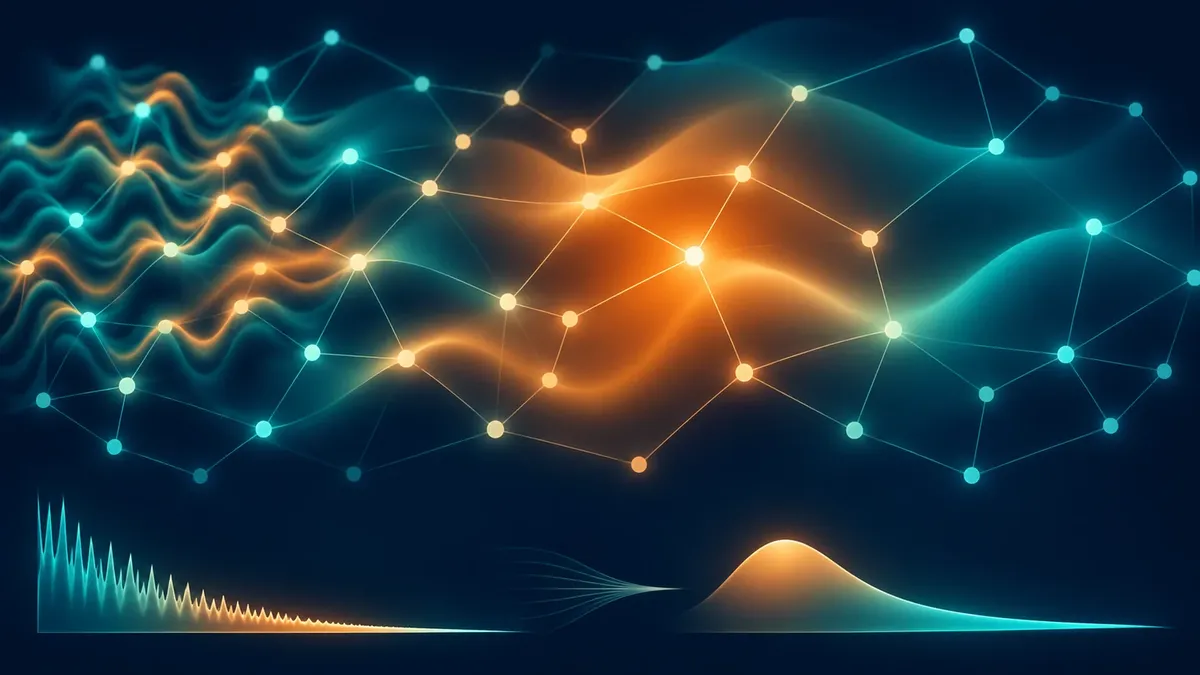
Many datasets place signals on graph nodes: traffic readings at road sensors or purchases of related products, for example. A graph-aware generative method aims to use those connections when learning patterns in partly observed data. Its reported results are promising, but the evidence available here is limited to the paper’s abstract.
Why make diffusion graph-aware?
Traffic readings from road sensors can be related through the road network. Other examples include purchases of related products. Representing connections as a graph lets researchers study signals attached to its nodes. When some values are missing, or future values are needed, a model of the signal’s distribution can help produce plausible estimates.
Diffusion models learn distributions by gradually adding noise to data, then learning how to reverse that corruption. The authors of Graph Signal Generation via Graph-Aware Diffusion Models identify a mismatch in standard approaches: their forward noise is independent across nodes and does not depend on the graph. They propose graph-aware diffusion (GAD), which incorporates the graph into the noise process.
Noise shaped by relationships
In GAD, the forward process is heat diffusion on the graph, driven by Gaussian noise. Heat diffusion describes how a quantity spreads through connected nodes. The authors also express the process in the graph Fourier basis, a way to separate a signal into patterns at different graph frequencies. This is loosely analogous to ordinary Fourier analysis, which separates a sound into frequencies.
With one shared diffusion rate, GAD attenuates high graph frequencies faster than low ones. The authors’ alternative, Mode-Adaptive SNR Scheduling (MASS), assigns a separate diffusion rate to each frequency to keep their signal-to-noise ratios (SNRs) equal. SNR describes how much signal remains relative to noise.
The abstract reports two theoretical results. For graph-stationary signals—a class with a particular regularity relative to the graph—MASS equalizes the normalized error of the optimal linear denoiser across frequencies. The authors also analyze stiffness in the reverse stochastic differential equation (SDE), which describes the process used to undo the noise. They report a logarithmic upper bound for MASS and a linear lower bound for shared rates, in terms of the condition number of a shifted graph Laplacian. These are mathematical results under the paper’s setup; they do not by themselves guarantee faster runtime in every practical application.
Reported task results
The abstract reports that GAD with MASS improved recommendation accuracy by 5–19%. For traffic imputation, it reduced root mean squared error (RMSE) by up to 7.8% while using half as many reverse steps. The authors also report improved mean absolute error (MAE) and RMSE for forecasting using only three reverse steps.
These results suggest that adapting the noise schedule to graph structure may be useful across the reported tasks. However, the abstract does not name the datasets or baselines, describe the evaluation conditions, or explain the percentage ranges in detail. It cannot establish how the results compare across settings or whether similar gains would appear elsewhere. “Up to” refers to the largest reported reduction, not necessarily a typical result.
What remains uncertain
This account is based on the abstract alone. The full paper’s methods, experiments, tables, and limitations were not available in the supplied evidence. We therefore cannot assess dataset sizes, variability, statistical tests, implementation details, or how results differ among benchmarks. The findings here are the authors’ abstract-level summary, not an independent verification.
The work is an arXiv preprint, a research manuscript posted publicly. The supplied record does not establish whether it has been peer reviewed. Reading the full paper and seeing independent replication would help clarify how robust the theoretical claims and task results are, and where graph-aware noise is most useful.
- graph diffusion
- graph signals
- generative models
- traffic imputation
- recommendation systems
- machine learning
Related reading
Automatically matched by shared topic keywords. These links do not imply that the sources agree or establish a consensus.
One Energy Lens for Many Kinds of Machine Learning
Source published
Shared keywords: generative models, machine learning
Quantum-derived inputs reshape a malware detector, with no clear final detection edge over a dimension-matched Gaussian model
Source published
Shared keywords: generative models
Teaching graph generators which hidden dimensions matter
Source published
Shared keywords: machine learning
Can synthetic speech features help AI distinguish memory-clinic groups?
Source published
Shared keywords: machine learning
Could referral networks help target HIV resources without mapping every contact?
Source published
Shared keywords: graph diffusion