TRANSMISSION // 2611.27820v1
What shapes black holes from the first stars?
Source published
A large StarTrack simulation grid tests how uncertain starting binaries and stellar-evolution choices shape Population III black-hole binaries—and how merger selection changes the picture.
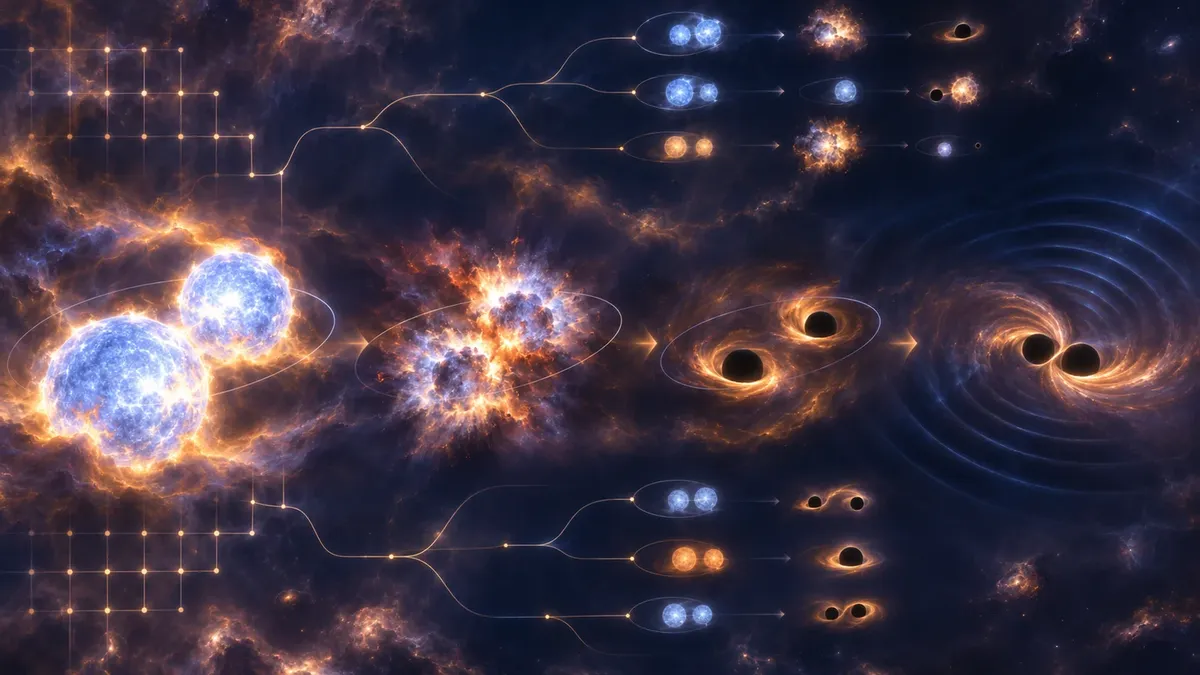
The first stars may have left behind black-hole pairs that could eventually merge and send gravitational waves across the universe. But predictions for these binaries depend on uncertain assumptions about how the stars began and evolved. Neha Singh and Tomasz Bulik test eight such assumptions across 1,152 simulated model configurations, comparing all black-hole binaries with those that merge within an adopted cosmic-age limit.
Population III stars were the universe’s first generation, born from primordial gas. Their black-hole remnants could form pairs that later merge, making gravitational waves a possible way to investigate the first stars. Yet a predicted merger population depends on many uncertain ingredients: the initial masses and orbits of binaries, how stars transfer mass, and how much a newborn black hole is kicked when it forms.
Neha Singh and Tomasz Bulik ask which of these assumptions most influence the properties of simulated Population III black-hole binaries—and whether the answer changes when attention is restricted to systems that merge. Their study is a computer-based population synthesis, not an analysis of newly detected gravitational-wave events.
A grid of possible histories
The researchers used StarTrack, a rapid code that follows stellar and binary evolution through parameterized prescriptions. They evolved two million starting binaries for each of 1,152 configurations, varying eight model evolutionary parameters. These included the initial binary-property distributions, common-envelope efficiency, angular momentum lost during mass transfer, black-hole remnant prescriptions, and the size and direction of natal kicks. Altogether, the grid represents about 2.3 billion simulated binaries.
The team compared two populations: every binary black hole (BBH) produced in a model, and the subset whose total time from the initial binary’s formation to merger was no longer than the adopted Hubble-time threshold. This is a time-after-formation criterion, not a prediction that all selected mergers occur at the same cosmic epoch.
To rank the assumptions, the authors used variance-based sensitivity analysis. In plain terms, they measured how much each varied input, including its interactions with other inputs, contributed to differences in a summary statistic across model configurations. Every configuration received equal weight. The analysis therefore describes variation across the tested grid, not how likely each model is in the universe.
No single assumption controls everything
For the full BBH population, the starting binary distributions had the largest measured influence on mass-ratio, chirp-mass and birth-orbit summaries. Natal-kick magnitude led for delay times and the spin summaries examined. The rankings shifted for the merger-selected population: the initial distributions remained central to mass variation, while common-envelope efficiency also contributed substantially to mass ratios, birth orbits and delays. Among merger-selected spin summaries, the leading parameter depended on which spin measure or part of its distribution was considered.
The ranges across model medians show how widely the predictions can vary within this grid. Median total mass ranged from 34.3 to 171.0 solar masses for all-BBH populations, and from 23.1 to 94.8 solar masses for merger-selected populations in the main comparison. Median birth eccentricity ranged from 0.075 to 0.639 for all BBHs and 0.039 to 0.983 for merging BBHs. These are ranges of medians across models, not the mass or eccentricity range of every individual binary.
Merger selection also reshaped populations and relationships between properties. Among the 992 models with at least ten merging BBHs, selection lowered median total mass in 792 and raised median mass ratio in 940. Birth eccentricity did not shift in one uniform direction: some model groups produced merger-selected populations with high median eccentricities, while others produced lower ones. Correlations between properties changed too, including the association between aligned and precessing spin. Such patterns varied across the grid rather than providing one universal signature.
What the results do—and do not—show
The study maps sensitivity within a specific set of assumptions: isolated binary evolution, the tested parameter values and prescriptions, and the adopted spin treatment, including an initial black-hole spin of 0.05. The authors note that finite simulated samples limit precision; some merger samples are particularly small. Sensitivity scores measure variation across model summaries, not causal effects in real stars, statistical significance, or the direction of a parameter’s influence.
The models also do not yet predict the population astronomers would detect. They omit cosmic star-formation weighting and detector selection effects, and do not include further encounters in higher-order systems. Those factors, measurement uncertainty, and other formation channels could affect which binaries are observed and how their properties are distributed. The authors say a future study will address star-formation histories and detectable populations.
The work is presented as an Astronomy & Astrophysics manuscript, and the supplied source is a preprint manuscript rather than evidence here of peer-reviewed publication. Its broad parameter grid offers a structured comparison of assumptions, but its conclusions should be read as conditional on that grid and modeling framework—not as proof that any observed merger came from Population III stars.
- Population III stars
- binary black holes
- gravitational waves
- population synthesis
- StarTrack
- natal kicks
- common-envelope evolution
Reviewed cross-references
These connections were reviewed by a model, not independently fact-checked by a human. Similarity does not imply agreement; consult the original papers and the evidence below.
Even powerful birth kicks struggle to reverse black hole binary orbits
Supporting evidence: Both studies connect natal kicks with black-hole binary spin or orbital-orientation predictions: Singh and Bulik find kick magnitude is the leading varied parameter for median precession spin among merging Population III binaries, while Santiago-Leandro and colleagues find that even kicks near 1,000 km/s do not consistently reverse orbital orientation in their simulated systems. These are compatible but not a direct test of the same claim: the first is a population-synthesis sensitivity result, and the second uses hydrodynamic simulations of selected stellar models and binary setups.
Model review: · openai-codex/gpt-6-luna
Evidence and provenance
Selected excerpts, not complete papers. PDF extraction can omit figures or damage equations, tables and reading order; sources may be preprints.
2611.27820v1 — Original paper
Excerpt reference:
static/papers/2611.27820v1.md:16-61
Basis: Paper text
Source SHA-256:90759e8151787a6dd5453a2582d0628b181e08184999aebf080f2fcd8aceb78f2611.08604v1 — Original paper
Excerpt reference:
static/papers/2611.08604v1.md:1264-1328
Basis: Paper text
Source SHA-256:ae4b5bfb8b16b667a6a452f3a680fd5809c070f5d3a8480ed5911c59d718f64f
Related reading
Automatically matched by shared topic keywords. These links do not imply that the sources agree or establish a consensus.
Leftover Gas Disks May Divert Neutron Star Mergers into Fast Blue Transients
Source published
Shared keywords: common envelope evolution
Dying stars’ pulses may explain unexpectedly wide white dwarf binaries
Source published
Shared keywords: common envelope evolution, population synthesis
Even powerful birth kicks struggle to reverse black hole binary orbits
Source published
Shared keywords: gravitational waves, natal kicks
How a star feeds a black-hole binary
Source published
Shared keywords: binary black holes, gravitational waves
Eccentric black-hole signals may reveal the environments around them
Source published
Shared keywords: binary black holes, gravitational waves