TRANSMISSION // 2611.27815v1
Can quantum machine learning train without measurements?
Source published
A proposed framework moves quantum machine-learning optimization inside the quantum system, potentially avoiding repeated measurements and classical feedback during training. The evidence here is limited to the paper’s abstract.
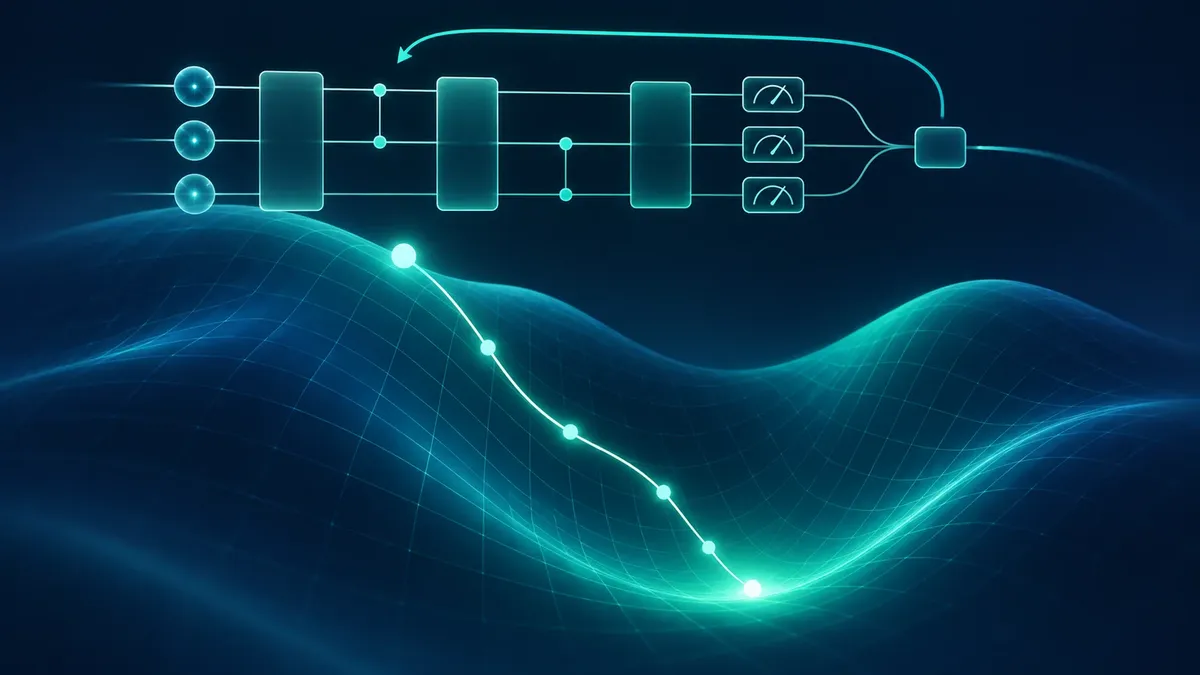
Training many quantum machine-learning models requires measuring a quantum system and using the results to update a classical optimizer. A new theoretical framework asks whether that loop can instead run autonomously within the quantum domain.
The measurement bottleneck
Quantum machine-learning models often train through a repeated handoff: a quantum circuit processes data, measurements produce classical results, and a classical computer uses those results to adjust the circuit. This process can be a scalability bottleneck because information must repeatedly pass from the quantum system to classical hardware.
In the preprint Autonomous quantum machine learning via Riemannian gradient-based optimization, Kasidit Srimahajariyapong and colleagues propose a way to carry out training without that measurement-and-feedback loop. The central question is whether a model can follow an optimization path entirely within the quantum domain—and, if so, under what conditions it will learn effectively.
Optimizing within the quantum domain
The authors build their approach around Riemannian gradient optimization. In broad terms, this is a method for taking optimization steps while respecting the geometry and constraints of the space where a model’s states or operations live. Rather than measuring the system, sending results to a classical optimizer, and returning updated settings, the proposed framework uses quantum-domain update rules.
The abstract says the researchers derive such rules for a broad class of learning tasks and identify sufficient conditions for realizing the training dynamics autonomously. These are conditions under which the proposed process can operate without quantum measurements or classical feedback during optimization—not a claim that every quantum-learning task can be trained this way.
What the authors report
Within the stated regime, the paper establishes a theoretical guarantee: for sufficiently small step sizes, the training dynamics converge exponentially in the number of training iterations. The authors also analyze training cost in relation to circuit-depth growth. The abstract does not give the detailed assumptions, rate constants, or circuit-depth results, so the guarantee should not be read as a general promise of fast or resource-efficient training on hardware.
Another proposed capability is automatic discovery of symmetries hidden in training data, without specifying those symmetries in advance. Symmetry here means a structure in the data that remains unchanged under certain transformations. The abstract presents this as a result of the framework, but does not provide enough detail to assess how broadly it applies or how discovery is demonstrated.
The authors also report numerical studies of two canonical examples: quantum phase classification and unitary learning with a hidden symmetry. In these examples, they say learning appears achievable with low circuit depths and only a few distinct training examples. The abstract gives no numerical measurements, benchmark comparisons, hardware tests, or information about how representative these examples are. These findings therefore support a proof-of-concept claim, not a conclusion that the method is already practical at scale.
What remains uncertain
The potential appeal is clear: avoiding repeated measurement and classical optimization could remove a major source of overhead in some quantum-learning workflows. But autonomous operation does not by itself establish an overall advantage. The abstract does not show whether the approach reduces total resources, how noise affects it, or how it compares with standard training methods on real quantum devices. Nor does it establish that the required conditions hold for common applications.
This account is based on the preprint’s abstract, not a full-text assessment. The abstract summarizes the authors’ claims but does not expose the derivations, experimental setup, limitations, or evidence needed to evaluate them in depth. The work is identified as an arXiv preprint; no peer-review status is provided in the supplied material. Its convergence and symmetry claims should therefore be understood as claims reported by the authors, pending scrutiny of the full paper and independent evaluation.
- quantum machine learning
- autonomous learning
- Riemannian optimization
- quantum circuits
- quantum computing
Reviewed cross-references
These connections were reviewed by a model, not independently fact-checked by a human. Similarity does not imply agreement; consult the original papers and the evidence below.
Why quantum machine-learning models can lose sensitivity
Supporting evidence: Both papers describe challenges in extracting useful information from measured quantum outputs: the origin paper identifies repeated measurement and classical feedback as a training bottleneck, while Mondragon-Sampedro and Alvarez-Estevez report that observable concentration can reduce input sensitivity and increase measurement demands. These are compatible but distinct mechanisms; their empirical comparison covers selected kernel and extreme-learning models, not the origin paper’s autonomous method.
Model review: · openai-codex/gpt-6-luna
Evidence and provenance
Selected excerpts, not complete papers. PDF extraction can omit figures or damage equations, tables and reading order; sources may be preprints.
2611.27815v1 — Original paper
Excerpt reference:
static/papers/2611.27815v1.md:58-113
Basis: Paper text
Source SHA-256:5e233bba7e08ae7652f1f80e3e3fe1f33acc0827d6cb76ee408f3e271e967c8b2611.27486v1 — Original paper
Excerpt reference:
static/papers/2611.27486v1.md:15-95
Basis: Paper text
Source SHA-256:35a8e8c8ba0e00bfe2fededff7ee70a453425d735589b1ed7cb2e2bc91cfb34e2611.27486v1 — Original paper
Excerpt reference:
static/papers/2611.27486v1.md:96-147
Basis: Paper text
Source SHA-256:35a8e8c8ba0e00bfe2fededff7ee70a453425d735589b1ed7cb2e2bc91cfb34e
Related reading
Automatically matched by shared topic keywords. These links do not imply that the sources agree or establish a consensus.
Learning when quantum error mitigation is worth the cost
Source published
Shared keywords: quantum computing, quantum machine learning
Selecting training examples for quantum machine learning
Source published
Shared keywords: quantum circuits, quantum machine learning
Why quantum machine-learning models can lose sensitivity
Source published
Shared keywords: quantum circuits, quantum machine learning
A lean new layer could help quantum neural networks learn more
Source published
Shared keywords: quantum circuits, quantum machine learning
A feature-aware search for quantum data encodings
Source published
Shared keywords: quantum circuits, quantum machine learning