TRANSMISSION // 2611.27810v1
Can an AI explain what it hears in a clinical voice?
Source published
A benchmark tests whether audio AI models’ descriptions of clinical speech match clinician ratings—and whether those descriptions stay consistent.
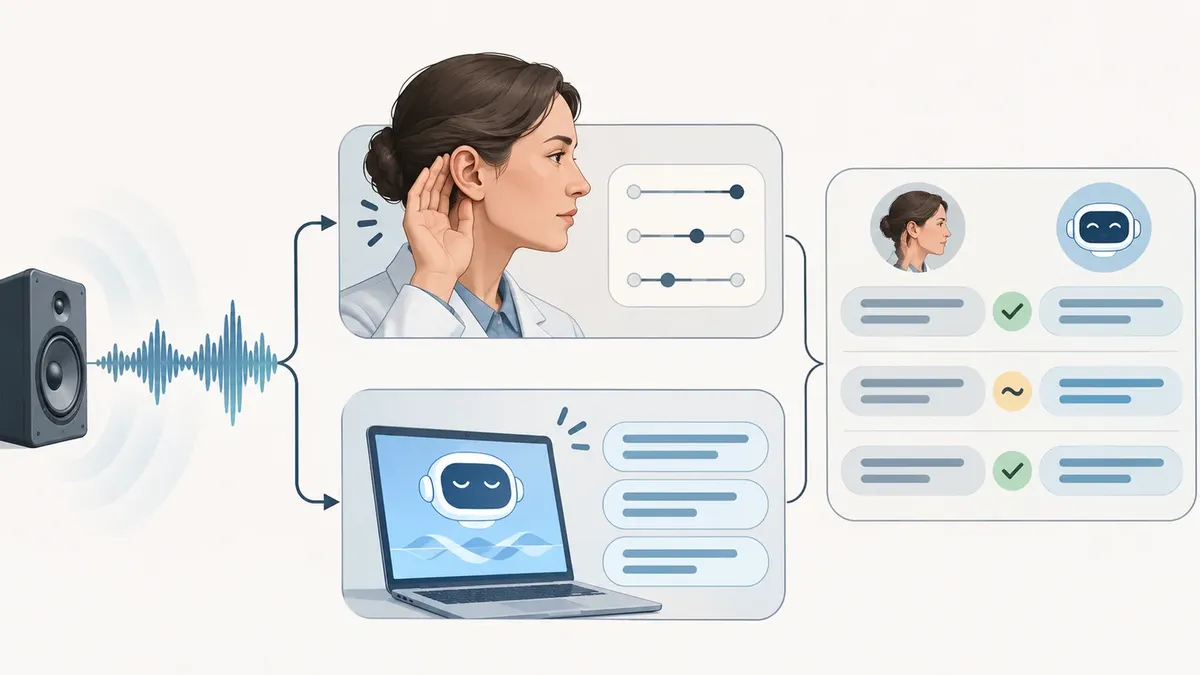
Audio AI can offer a diagnosis alongside a description of a person’s voice. But do those descriptions accurately reflect the recording, and do they stay the same when a question is reworded? A new benchmark puts those claims to the test.
An audio AI model might answer a clinical question by first describing a voice as breathy, unusually quiet or monotonous. Such details can sound like an explanation for its answer. Yet a fluent account is not necessarily an accurate one—and, as the researchers note, a model’s written reasoning need not reveal how it actually reached its prediction.
A study called SLP-Bench asks a more specific question: do the acoustic claims in these models’ responses agree with clinicians’ judgments of the same speech recording, and are the claims stable across repeated or differently worded prompts?
Checking claims against clinician ratings
The researchers assembled five datasets containing recordings, clinician-rated speech characteristics and clinical information about speakers. The test set included 794 clips from 260 patients, spanning English and Spanish recordings. Across the datasets, the benchmark covers 25 perceptual dimensions, including breathiness, pitch, loudness and imprecise consonants. These are features clinicians assess by listening; they are not, by themselves, diagnoses.
Ten open-weight audio language models were tested without task-specific training, using prompts about speech characteristics, clinical endpoints or general descriptions of a voice. The team also evaluated a fine-tuned 7-billion-parameter model. In all, the benchmark included 3,452 prompts.
To score a model’s description, a separate language model extracted claims about voice characteristics from its reasoning text. Researchers compared those claims with the clinician ratings for each recording. They measured factuality using balanced accuracy, a score that accounts for both present and absent labels; a score of 0.5 corresponds to chance under this metric. They also measured whether claims agreed across two sampled responses, a paraphrased prompt or questions about different clinical targets.
This process has an important wrinkle: claims were identified by an automated extractor, not by a clinician rating every sentence. In a check on 63 test chains annotated by language models, the extractor achieved an F1 score of 0.69. That leaves room for missed or incorrectly interpreted claims, and means the evaluation is not a direct, human-verified audit of every statement.
Claims were only slightly above chance
Across the ten zero-shot models, claim balanced accuracy ranged from 0.52 to 0.58. Their claims also changed with resampling and rewording. The models that were most consistent were not the most factually accurate: repeating a description reliably did not guarantee that it matched the clinician’s rating.
Performance varied by speech feature. Models were more accurate on articulation than on respiratory characteristics such as loudness and phrase length; those respiratory claims remained near chance, including after fine-tuning. Claims were also generally less factual when the prompt asked about a diagnosis than when it asked directly about a speech feature. Results differed across datasets, and models were near chance on endpoint answers for Bridge2AI.
The team then trained a 7B model with a reinforcement-learning reward for claims that agreed with clinician ratings. Its claim balanced accuracy rose from 0.54 to 0.60, while its average agreement score, kappa, rose from 0.39 to 0.61. The researchers report that it preserved answer accuracy on questions about individual speech dimensions. By contrast, rewarding the answer alone led the model to answer “no” to almost every clinical endpoint question, illustrating how a scoring rule can encourage an unhelpful shortcut.
These findings do not show that the models can reliably diagnose disorders, or that more accurate descriptions improve diagnosis. The study evaluates particular models on particular datasets and rating scales; its authors say a dedicated study is still needed to test whether more factual claims improve clinical predictions. Some datasets are small, one is test-only, and respiratory dimensions remain difficult for all the evaluated models. The authors also identify future work on clinician-annotated claim references and more equal training budgets across reward strategies.
SLP-Bench shifts attention from an AI’s final answer to the details it says it heard. That is useful for testing whether model-generated descriptions are grounded in clinician ratings, but the benchmark is not a clinical validation study. The paper is an arXiv preprint, so its findings should be treated as preliminary rather than as established evidence. The benchmark is available upon request, subject to approval by the dataset providers.
- audio language models
- clinical speech
- speech-language pathology
- AI evaluation
- perceptual voice assessment
Related reading
Automatically matched by shared topic keywords. These links do not imply that the sources agree or establish a consensus.
How an Audio Codec Could Help AI Tell Where Sounds Come From
Source published
Shared keywords: audio language models
Windchime turns spoken prompts into music and moving images
Source published
Shared keywords: audio language models
Estimating AI Reliability With Fewer Repeated Trials
Source published
Shared keywords: ai evaluation
An AI can answer correctly and still act outside its authority
Source published
Shared keywords: ai evaluation
Expert Feedback Raises Average Ratings for AI Finance Briefs
Source published
Shared keywords: ai evaluation