TRANSMISSION // 2611.27784v1
How Well Does ARCAS 290M Detect AI-Generated Speech?
Source published
ARCAS 290M was tested on ten public audio benchmarks without benchmark-specific tuning. It performed strongly on fully synthetic speech, but struggled more with short edits, replayed audio and some real-world recordings.
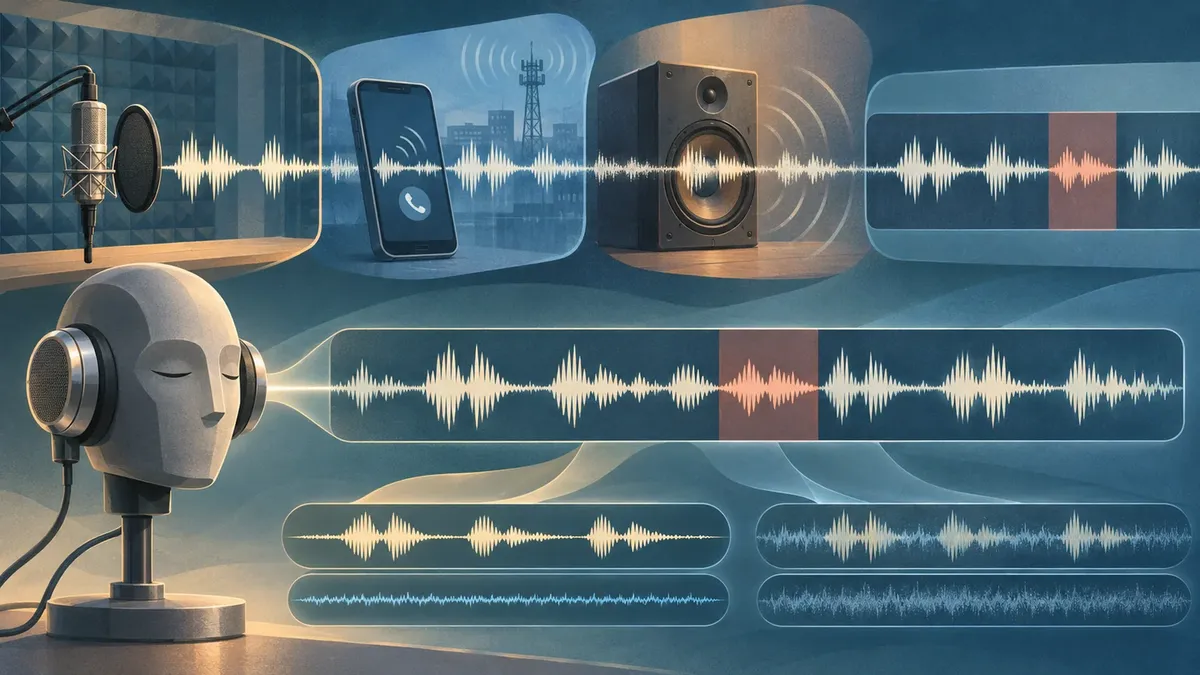
AI voice cloning can produce convincing speech from just a short recording. A detector that works on one generator or clean dataset may behave differently after audio is compressed, replayed through a speaker, or edited only in part. Researchers at Neural Defend tested whether their ARCAS 290M model could handle that variety without being adjusted for each benchmark.
A convincing synthetic voice can be used to impersonate someone, but spotting it is not straightforward. Audio generators change, recordings pass through different devices and platforms, and a fake may alter only a few words in otherwise genuine speech. The question in this study was whether one deployed detector could work across those changing conditions without being retrained for each test set.
The researchers evaluated ARCAS 290M, a commercial model made by Neural Defend. They sent recordings from the complete official test releases of ten public benchmarks to the model’s production endpoint. In total, they report scoring 5.64 million recordings, unchanged and at their released sample rates. The model was frozen: the team did not fine-tune it, recalibrate it, or make benchmark-specific adjustments. Each file received a single verdict, so a recording with any synthetic segment counted as fake under the relevant dataset’s rules.
The benchmarks cover several kinds of challenge: text-to-speech and voice-conversion systems, codec-generated speech, telephone and Bluetooth conditions, multiple languages, recordings replayed through speakers, social-media audio, and edits to only part of a recording. The researchers calculated measures including recall—the share of fake recordings correctly flagged—and equal error rate, or EER, a threshold-independent measure that balances missed fakes against false alarms. They also examined results by conditions such as language, generator and the fraction of a clip that was edited.
Strong results on whole-file fakes
On benchmarks dominated by recordings that were synthetic or re-synthesized throughout, ARCAS performed very well. Across five such benchmark sets, the paper reports that it detected 99.60% of about 4.80 million fake recordings. On the IndicSynth release, which contains fake speech but no genuine comparison recordings, it detected 99.998% of fakes across Hindi, Tamil, Bengali and Telugu. That result measures recall only; it cannot show how often genuine speech in those languages might be incorrectly flagged.
The model’s performance was less consistent when the fake signal was harder to distinguish from real audio. On a social-media benchmark, it detected 78.84% of fakes overall. On a replay benchmark, it detected 57.62% of fake clips that had been played through a speaker and recorded again, compared with 99.84% of fakes in the original, non-replayed audio. These are results for the benchmark recordings, not guarantees about every phone, platform or recording environment.
Short edits were another clear weakness. In one test set, clips with single-word edits were detected 31–37% of the time when the file had not also been processed through a neural codec. Detection improved when the entire recording had been codec-processed, which suggests the model may be responding to audio-wide signals rather than reliably locating the changed word. In another partial-fake benchmark, recall fell to 4% when less than 10% of the clip was fake. Because the system produced one verdict per file, the study did not test whether it could point to the altered segment.
What the comparisons can—and cannot—show
The authors report that ARCAS had lower EER than published zero-shot detectors on benchmarks where they considered the test populations aligned. They also cite first place on the Podonos leaderboard and the lowest EER among commercial systems reported for ASVspoof 5. But comparisons need care: some published results use different training setups or evaluation populations, and the authors describe some commercial comparisons as indicative rather than protocol-matched. A detector trained on a benchmark’s own data did better than ARCAS in some tests, including EchoFake’s closed-set split and the English portion of a partial-fake benchmark.
The findings therefore support a more limited conclusion than “AI audio can now be reliably detected” in every setting. The study suggests that this particular model transfers well across many tested generators and channels when fakes affect most or all of a recording. It also identifies conditions where detection was weaker: short edits, loudspeaker replay, some web-sourced audio, and particular language or platform slices. On a real deployment, the mix of voices, devices and editing methods could differ from these datasets.
There are further limits. The evaluation is audio-only; it does not test a complete verification process that might also use provenance records or human review. The paper says it did not assess attacks designed to evade the detector, and the model’s confidence scores are not calibrated likelihoods. The authors recommend validating thresholds on a deployment’s own recordings and using additional review for high-impact decisions.
This is an arXiv preprint, not evidence of independent peer review. The model is also made by the company whose researchers conducted the evaluation. Testing full public releases and reporting condition-level results are useful strengths, but results and comparisons should be read in that context—not as proof that the detector will perform the same way on unseen real-world audio.
- AI-generated audio
- audio deepfake detection
- voice cloning
- speech detection
- benchmark evaluation
- partial audio edits
Reviewed cross-references
These connections were reviewed by a model, not independently fact-checked by a human. Similarity does not imply agreement; consult the original papers and the evidence below.
When Speech Deepfake Detectors Struggle to Find Edits
Supporting evidence: Both studies report performance differences across partial-edit conditions: ARCAS 290M’s utterance-level recall falls as the fake share shrinks, while the PartialEdit localization study finds deletions—especially SSR-Speech deletions—most challenging. This supports the limited point that outcomes depend on edit conditions; the studies assess different tasks and metrics, so their results are not directly comparable.
Model review: · openai-codex/gpt-6-luna
Evidence and provenance
Selected excerpts, not complete papers. PDF extraction can omit figures or damage equations, tables and reading order; sources may be preprints.
2611.27784v1 — Original paper
Excerpt reference:
static/papers/2611.27784v1.md:1331-1448
Basis: Paper text
Source SHA-256:6c0880b198540c7d42b3a7d03f77fb5e97b891664be6a0bf167f9de931038ef42611.26903v1 — Original paper
Excerpt reference:
static/papers/2611.26903v1.md:12-107
Basis: Paper text
Source SHA-256:a255f1907d19c3012e8ed247df29dcd791c23de31cf9e1934cac6b2e367c67f32611.26903v1 — Original paper
Excerpt reference:
static/papers/2611.26903v1.md:417-523
Basis: Paper text
Source SHA-256:a255f1907d19c3012e8ed247df29dcd791c23de31cf9e1934cac6b2e367c67f3
Related reading
Automatically matched by shared topic keywords. These links do not imply that the sources agree or establish a consensus.
An audio deepfake detector tops a benchmark—but how broad is the result?
Source published
Shared keywords: audio deepfake detection, voice cloning
When a Voice Clone Does Not Sound Like the Same Person
Source published
Shared keywords: voice cloning
How Rhythm-TTS Gives Synthetic Speech More Room to Breathe
Source published
Shared keywords: voice cloning
Can language models help hierarchical planners search better?
Source published
Shared keywords: benchmark evaluation
WoW maps educational training data—and shows where its gains stop
Source published
Shared keywords: benchmark evaluation