TRANSMISSION // 2611.27778v1
QuASAR tests whether AI agents can turn scientific ideas into quantum prototypes
Source published
QuASAR uses two AI agents to find, check and prototype possible quantum-computing applications in astrophysics. Its early tests produced runnable examples, but no demonstrated quantum advantage.
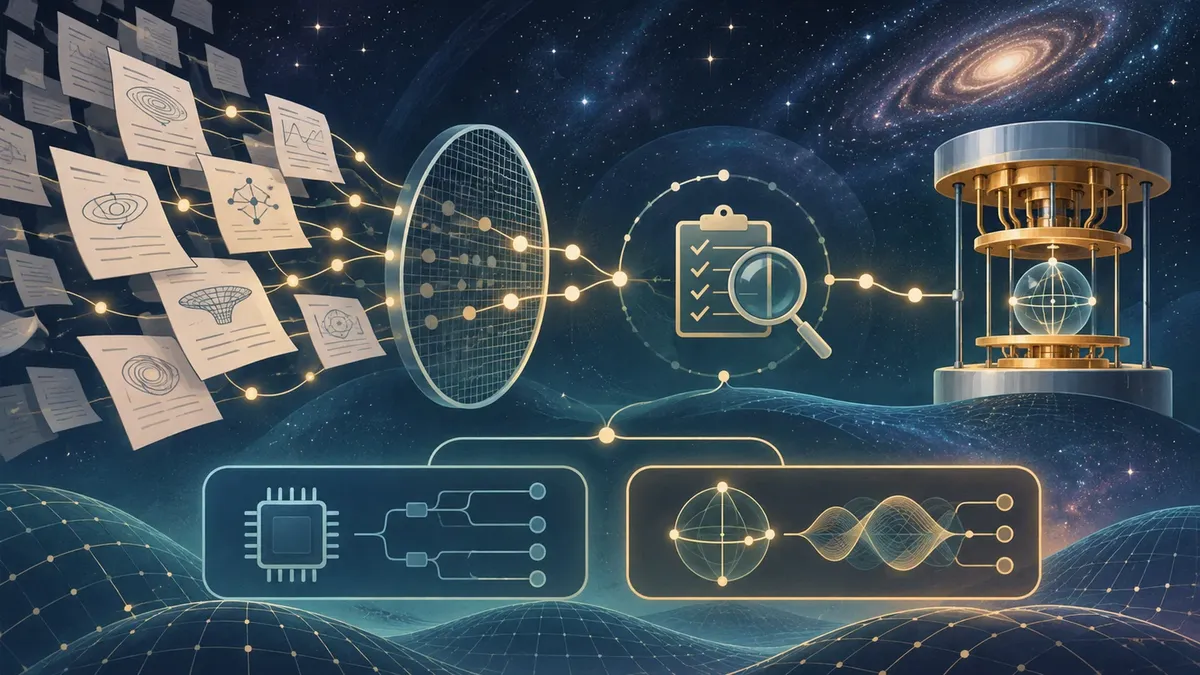
Quantum algorithms can look promising on paper, yet applying them to scientific problems takes both domain knowledge and quantum expertise. QuASAR explores whether a two-agent AI workflow can connect those skills—and whether its suggestions hold up when turned into code and compared with classical methods.
From papers to testable code
A quantum algorithm may offer a theoretical speedup, but deciding whether it fits a scientific calculation is not straightforward. Researchers need to understand both the original problem and how to encode it for a quantum computer. QuASAR, short for Quantum Advantage Screening, Assessment, and Research, tests whether large language model (LLM) agents can help bridge that gap.
The two agents had separate jobs. The first searched astrophysics literature for computational tasks that might have quantum-algorithm counterparts and proposed candidates with citations. The second, built with a different model family, checked those citations and whether the papers supported the proposed applications. For candidates that passed, it reconstructed the source method, devised or adapted a quantum mapping, implemented a small prototype, and benchmarked it against classical approaches.
The researchers screened ten candidate computations. Citation checks found problems in two: one lacked astrophysical support in its cited sources and was dropped as an astrophysics application; another had a citation that was corrected and disclosed. Nine astrophysics candidates went on to small-scale prototypes. The paper also describes a separate, non-astrophysical technical demonstration for the candidate whose sources did not support an astrophysical claim. Three of the nine astrophysics prototypes are discussed in detail: gravitational-wave Bayesian inference, survey scheduling, and stochastic simulation.
What the examples showed
The gravitational-wave example reconstructed part of an existing hybrid quantum algorithm. The prototype omitted components of the published method, and the authors documented those omissions. Its case for possible advantage rests on complexity claims in the source paper—not on a speedup measured in this study.
For survey scheduling, the agent adapted a general quantum optimization method to an astrophysical analogy that the source paper itself did not propose. In the tested instance, simulated annealing, a classical method, solved the problem essentially instantly. The quantum approximate optimization circuit needed extra depth and restarts to reliably find the correct answer.
The stochastic-simulation example adapted a quantum-accelerated multilevel Monte Carlo method to a small Ornstein–Uhlenbeck process. At a comparable sample budget, the quantum prototype produced a more accurate estimate than the classical baselines in that test. But the demonstration used only two discretization levels and a simplified estimator. It did not test the larger-scale regime needed to establish the source method’s asymptotic advantage.
None of the three detailed examples demonstrated or extrapolated a quantum advantage at the tested scales. This is not a verdict on how these methods might perform on future quantum hardware or at realistic scientific scales. The authors’ narrower claim is that the workflow can turn published ideas into executable prototypes, reveal citation or reconstruction issues, and record simplifications—giving researchers something concrete to inspect and test.
What remains uncertain
The prototypes were small simulations run on classical computers, not experiments on quantum processors. They therefore do not directly address hardware noise, decoherence, or device connectivity. Comparisons were limited to the tested instances and do not establish performance on real astrophysical datasets.
Citation verification also has limits: checking that a source supports an application does not establish that a proposed quantum mapping is scientifically appropriate. The paper says the reconstruction categories depend on Agent B’s judgment and have not had independent human review. It also notes that the astrophysical framing has not undergone expert validation. Using different model families for the agents provides some separation, but the authors cannot rule out shared biases because both models were trained on overlapping scientific and web material.
This is an exploratory preprint, not a validated astrophysical application or a new quantum algorithm. The authors provide code, prompts, and reconstruction records in an accompanying archive, and report rerunning the code locally to check the outputs. That supports inspection and further testing; it does not mean the work has been independently reproduced. For now, QuASAR presents a screening-and-prototyping process, not evidence that quantum computers outperform classical ones for these scientific tasks.
- QuASAR
- large language models
- quantum computing
- scientific computing
- astrophysics
- quantum advantage
- AI agents
Reviewed cross-references
These connections were reviewed by a model, not independently fact-checked by a human. Similarity does not imply agreement; consult the original papers and the evidence below.
Targeted AI repairs improve scientific code translation—but simple tests miss errors
Shared method: Both papers use role-separated LLM agents and executable checks: QuASAR assigns screening and citation verification before prototyping, while the code-translation framework separates translation, compilation diagnosis, and execution validation. Their checks address different failure modes, so this is a workflow-level connection, not evidence that either system validates the other’s outputs.
Model review: · openai-codex/gpt-6-luna
Evidence and provenance
Selected excerpts, not complete papers. PDF extraction can omit figures or damage equations, tables and reading order; sources may be preprints.
2611.27778v1 — Original paper
Excerpt reference:
static/papers/2611.27778v1.md:104-160
Basis: Paper text
Source SHA-256:4dcf8ad9648e29dbf84fa500d68e1a41f676bfe789360f04c057f64b90e5ddc22611.08947v1 — Original paper
Excerpt reference:
static/papers/2611.08947v1.md:132-203
Basis: Paper text
Source SHA-256:de224fcf2c0a62b65d7dbfea1b6fe755c2583bb2bfc1afd7d402fdb2ab2c5d23
Related reading
Automatically matched by shared topic keywords. These links do not imply that the sources agree or establish a consensus.
Targeted AI repairs improve scientific code translation—but simple tests miss errors
Source published
Shared keywords: ai agents, scientific computing
A local-information limit on a quantum optimization method
Source published
Shared keywords: quantum computing
Language model writes quantum circuit angles—but only when their meaning is clear
Source published
Shared keywords: large language models, quantum computing
Can a language model build a neural network from physical laws?
Source published
Shared keywords: large language models, scientific computing
Quantum-derived molecule scores change a drug-screening shortlist—not prove an advantage
Source published
Shared keywords: quantum computing