TRANSMISSION // 2611.27770v1
A small asteroid’s 225-day temporary capture by Earth
Source published
Asteroid 2026 QQ8 remained gravitationally bound to Earth for 225 days without completing an orbit. Observations support a natural origin and an unusual, long-duration trajectory.
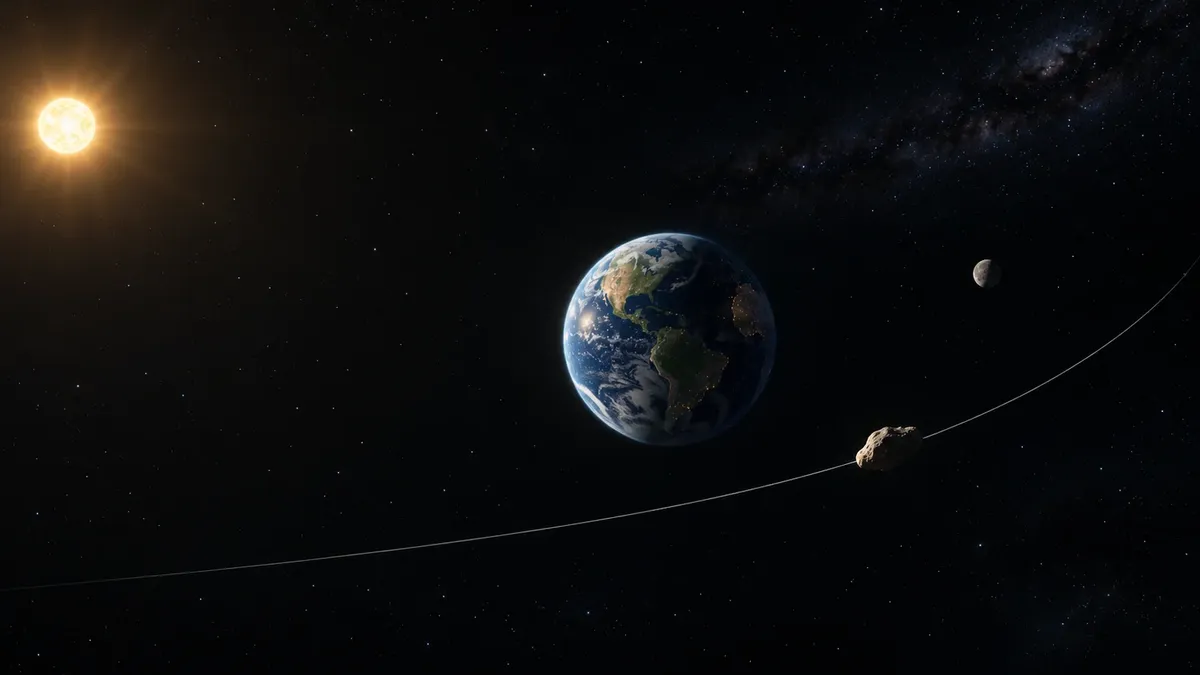
Most objects on Earth-centred orbits are artificial, but asteroids can also be temporarily captured by Earth. Researchers report that 2026 QQ8 was bound to Earth for 225 days. Its path was a “flyby” in the dynamical sense: it did not complete a full revolution before leaving.
An asteroid can become a temporary companion of Earth without settling into a lasting orbit. Astronomers distinguish temporary orbiters, which complete a full revolution around Earth during capture, from temporary flybys, which do not. A new study examines 2026 QQ8, a small object whose temporary capture lasted much longer than the authors describe as typical for a flyby.
The team estimates that Earth held QQ8 gravitationally bound from April 26 to December 7, 2026: 225 days. They say this is the first observed long-duration flyby associated with a trajectory known as an “orbit of maximum lunation.”
Following a faint, moving object
QQ8 was discovered on August 19, 2026, with a 60-centimetre telescope at Hungary’s Piszkéstető Mountain Station, using synthetic tracking to find faint objects moving against the background sky. Observatories then followed its position. Later observations required larger telescopes because the object was very faint; some attempts failed because of weather or bright moonlit skies.
The researchers combined measurements of QQ8’s position, brightness and colours with calculations of its motion. Astrometry—measuring an object’s position over time—helps determine its orbit. To reconstruct the trajectory before and after capture, they used orbital integrations, which calculate motion using gravitational models. The calculations used OrbFit software, DE440 planetary ephemerides and the vfcc17 astrometric weighting model.
The team also measured the effect of sunlight on QQ8’s motion. Sunlight carries momentum and exerts a small force called solar radiation pressure. For a tiny object, this signal can help assess whether it is natural or artificial, though it is one line of evidence rather than a stand-alone identification test.
Evidence for a natural asteroid
QQ8’s measured colours best match the S-complex in the visual part of an asteroid classification system. The researchers estimate its diameter at 1.3 to 1.9 metres. To calculate that range, they use its absolute magnitude, H = 31.34, and an assumed geometric-albedo range typical of S-complex objects. Albedo describes how much light a surface reflects, so the size estimate depends on that assumption; it is not a direct measurement of diameter.
The measured solar-radiation-pressure signal corresponds to an area-to-mass ratio of 0.5 ± 0.19 square metres per tonne. The authors say this is consistent with values measured for small natural objects and below the lowest estimate they cite for an artificial rocket booster. Along with the colour classification, this supports their conclusion that QQ8 was natural.
In a frame rotating with Earth, QQ8 did not complete a full revolution, making it a temporary flyby rather than an orbiter under the paper’s definition. The authors attribute its unusually long capture to an orbit of maximum lunation. In this kind of motion, an object can spend extended periods near Earth’s quadratures—the directions where the Earth–object line is at right angles to the Sun–Earth line. The paper presents QQ8 as the first observational evidence for this predicted orbit type.
The authors place QQ8 among the longest 0.3% of flybys in the comparison they cite. That ranking highlights how unusual its duration was, but one object cannot establish how common long captures are. The paper also says the broader population picture needs further scrutiny.
Classification and uncertainty
Earth-centred objects can be mistaken for artificial satellites. The authors report that QQ8 was removed twice from the Minor Planet Center’s confirmation page as “not-asteroids,” disrupting routine follow-up. They propose ways to keep plausible natural candidates available while their orbits and physical properties are investigated. This is a recommendation, not evidence that the centre has changed its procedures.
The orbit is reconstructed from observations rather than watched continuously, and the size estimate depends on assumed reflectivity. The findings concern one object; they do not show that every long-lived temporary capture follows the same trajectory.
This article is based on the version-one arXiv manuscript, which identifies itself as an Astronomy & Astrophysics manuscript. The supplied text lists an incomplete received date and does not establish review or publication status. The linked record may contain updates.
- 2026 QQ8
- temporary asteroid capture
- near-Earth asteroid
- solar radiation pressure
- maximum lunation