TRANSMISSION // 2611.27761v1
Testing Gaussian-process methods for LISA data
Source published
Simulations compare ways to model fractional delays in LISA’s time-delay interferometry. Gaussian-process approaches performed well in the tested settings, but the results are not a demonstration on flight hardware.
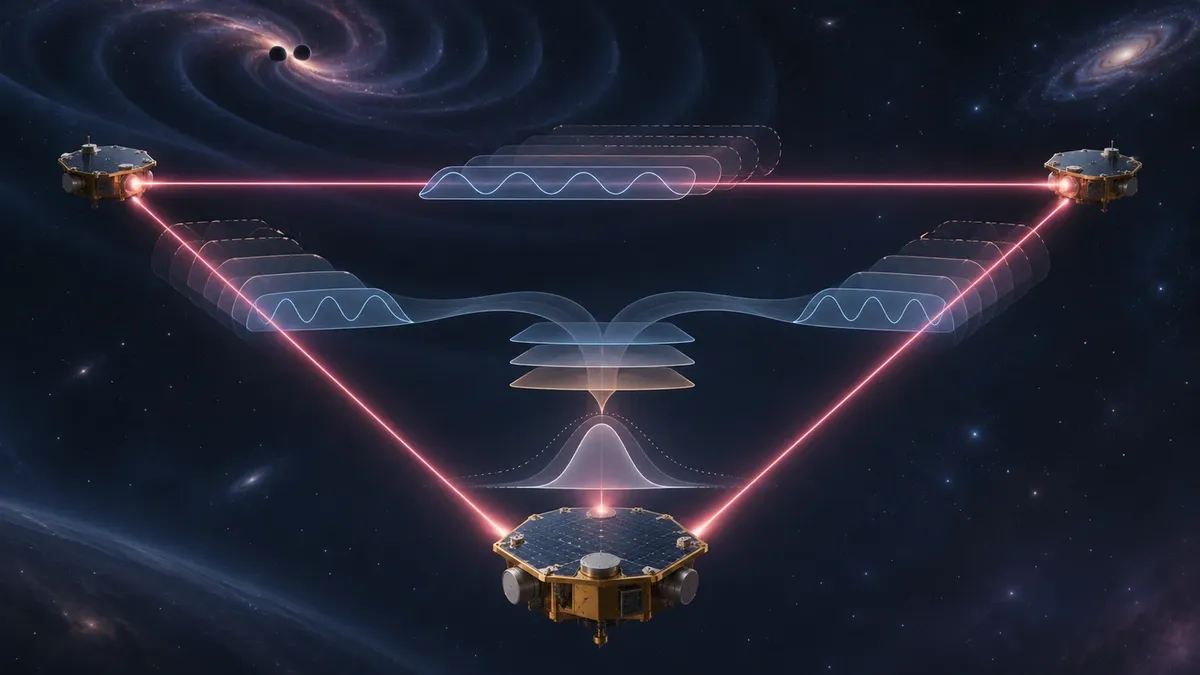
LISA data analysis must account for laser fluctuations that can overwhelm gravitational-wave signals. This preprint tests how Gaussian-process interpolation and different likelihood choices behave in simulations of filtered, downsampled measurements.
A problem of timing and noise
The planned Laser Interferometer Space Antenna (LISA) will use three spacecraft linked by lasers to observe gravitational waves. Laser frequency noise is expected to be far larger than other noise sources and the signals of interest. Time-delay interferometry (TDI) combines measurements so that shared laser noise can cancel, even though the spacecraft’s changing separations mean the relevant delays are not always whole numbers of samples.
TDI-∞ describes the measurements with a linear model of shared noise sources. It identifies combinations that cancel those sources, but its design matrix depends on how fractional delays are interpolated. Errors in that interpolation can leave residual laser noise. The paper asks how to handle those errors when measurements have also passed through an anti-alias filter and been downsampled to telemetry rate.
What the researchers tested
The authors compared Lagrange, cosine-sum and Gaussian-process (GP) interpolation. Their GP models the laser noise using its spectrum and carries uncertainty in interpolated values into the likelihood as a covariance. They tested two ways of representing the filtering: applying the filter after the delays, or incorporating it into the GP model. The simulations used a reduced 16 Hz rate to represent processing that the paper describes as occurring on board before data are sent at 4 Hz; they did not use flight hardware or simulate the full 80 MHz measurement rate.
They also compared the standard likelihood, which uses the design matrix’s null space to cancel primary noise, with one that retains the column space as well. The latter directions are weighted using the modeled primary-noise covariance. How much signal information they contribute depends on the matrix’s singular values and on the numerical threshold that separates the two spaces; they are not simply extra noise-free measurements.
Tests used simulated data from lisainstrument. The team assessed interpolation accuracy and residual laser noise, then ran parameter-estimation tests on 200 monochromatic, deliberately loud galactic-binary-like injections. Other signal parameters were fixed, and the sampling chains began near the injected values. These choices let the study examine posterior calibration and size in short simulated segments, rather than test a full source search.
Findings—and their boundaries
With a filter stopband at 1 Hz, all three interpolators reduced residual laser noise below the secondary-noise level in the tested simulations. At a 2 Hz stopband, equal to the Nyquist frequency for 4 Hz sampling, only the tested GP configurations did so. The authors note that Lagrange and cosine-sum interpolation were not designed for that wider range; the GP model includes information about the filter.
For the tested parameter-estimation configurations, the GP with the filter built into its kernel and the column-space likelihood had the smallest posterior volumes among configurations that passed the study’s calibration test in the reference setup. That is a result about a particular metric and simulation, not proof that this option is generally more accurate or best. In the 2 Hz tests, Lagrange and cosine-sum results failed calibration checks, with residual laser noise producing overconfident posteriors. In some gapped-data full-likelihood tests, results could also become overconfident as the threshold changed.
Splitting data into shorter chunks and introducing gaps generally cost information in these tests. Retaining the column space recovered some information in certain configurations, but the amount depended on the threshold and setup. For a single long segment, some of the apparent gain could instead be recovered by changing that threshold. The paper therefore does not show that gaps or short chunks improve inference.
The GP with the filter built into its kernel also had a computational cost: its likelihood build took roughly 2.5 times as long as the reference run in these tests. This is not a general runtime guarantee. The authors identify further work needed, including testing GP construction in double precision for full LISA data and accounting for correlations between chunks, which their analysis treated as independent.
These findings come from a preprint’s simulations, not observations or confirmed operations of LISA. The authors also caution that their injected signals were unrealistically loud and their segments short. The results suggest how interpolation and likelihood choices may be evaluated for filtered, downsampled data, but do not establish performance on real mission data. The supplied source identifies the work as a preprint; it does not establish peer-review status. The paper reports that code and configuration files are available through Zenodo.
- LISA
- time-delay interferometry
- Gaussian-process interpolation
- laser frequency noise
- gravitational-wave data analysis
- simulation
Related reading
Automatically matched by shared topic keywords. These links do not imply that the sources agree or establish a consensus.