TRANSMISSION // 2611.27758v1
A Global Telescope Network for the Universe in Motion
Source published
The proposed Time Domain Telescope would combine about 100 two-metre telescopes to study faint, changing objects with repeated spectra. Its projected performance has not yet been demonstrated.
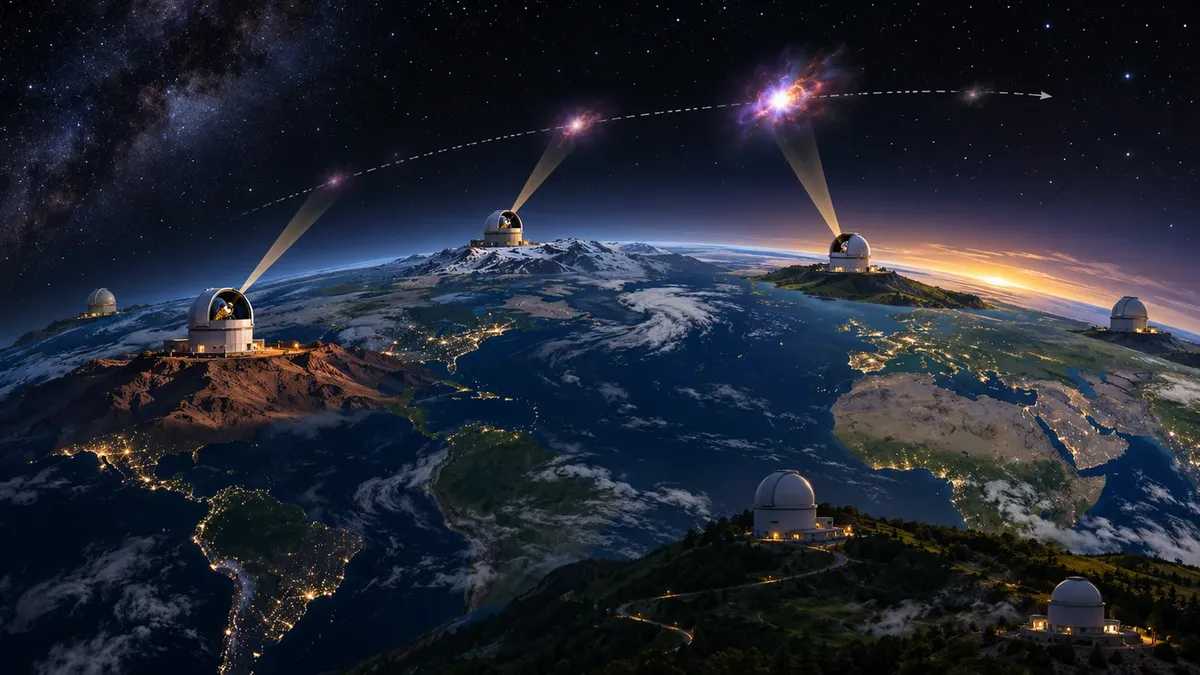
Astronomers can find changing objects across the sky faster than they can study many of them in detail. The proposed Time Domain Telescope aims to close that gap with rapid, repeated observations from a global network. Its performance figures are forecasts, not results from an operating facility.
Surveys can spot objects that brighten, fade or appear suddenly, but discovering one is only the beginning. To learn about an object’s composition, motion and physical conditions, astronomers often need a spectrum: light separated into its component wavelengths. Gathering spectra quickly—and returning to the same source as it changes—is difficult, especially when the target is faint or visible for only a short time.
A paper by P. J. Groot and colleagues outlines a proposed response: the Time Domain Telescope (TDT), a network for time-critical spectroscopy in optical and near-infrared light. The project is being developed in the context of the European Southern Observatory’s Expanding Horizons program. The paper presents a facility concept and science case; it does not report observations from a completed TDT.
Many telescopes, flexible observing
The proposed core would have 100 telescopes, each with a two-metre mirror, at an ESO site. Partner stations around the world could extend the network. Telescopes would work in clusters connected to spectrographs, instruments that separate light by wavelength. Depending on the science goal, many units could combine their effort on one faint target, or the array could divide its attention among several targets.
A survey might flag a transient, such as an exploding star, for follow-up. The TDT concept is designed to respond rapidly and revisit targets as they evolve. Stations at different locations could also help continue observations as a source becomes visible elsewhere on Earth. The paper distinguishes several coverage estimates: it says at least six stations are needed to cover all possible sky locations at any given time. Separately, it estimates that stations placed at currently operating observatories could provide 100% sky coverage with a redundancy factor of 2.4, allowing some buffer for weather and technical downtime. A smaller three-station array in the Southern Hemisphere is described as covering 70% of the sky, with a redundancy factor of 1.2. These estimates describe different configurations; the paper does not identify the six-station minimum as the configuration behind the 100% coverage estimate.
The proposed instruments would cover wavelengths from 0.35 to 1.8 micrometres, spanning optical light into the near-infrared, with a range of spectral resolutions. The design combines adaptive optics, which corrects for atmospheric blurring, with detectors intended to contribute very little electronic noise. At blue optical wavelengths, the goal is to concentrate a point source’s light into a small area. That could reduce the amount of night-sky light mixed into a measurement, helping with faint targets.
What the performance numbers mean
The paper uses an exposure-time calculator to forecast performance under specified assumptions. One detailed estimate gives a signal-to-noise ratio of 10 per spectral resolution element for a magnitude 24.8 target in a 1,800-second exposure, using all 100 telescopes at spectral resolution 5,000. The calculation assumes, among other things, a dark-sky brightness of 22 magnitudes per square arcsecond and detector read noise of 0.1 electrons per pixel. The abstract separately gives a 30-minute estimate of magnitude 25 at the same signal-to-noise ratio and resolution. These are stated projections, not measurements from a working array.
Real performance would depend on whether the proposed adaptive optics, detectors and other systems meet their design assumptions. The authors discuss a possible prototype at ESO’s Paranal site, adapting four existing auxiliary telescopes to test robotic adaptive optics, detectors and scheduling. They also identify unresolved technical needs, including blue-light adaptive optics, powerful laser guide stars, low-noise detectors and software to coordinate many telescopes around competing requests.
The proposed scheduling system would use automated agents to help manage telescopes, observations, data processing and maintenance. That is an intended design feature, not a demonstrated operating system.
A broad science case—and real uncertainty
The proposed science spans stellar explosions and the elements they produce, variable stars and compact binaries, black-hole-related transients, exoplanet atmospheres and the history of cosmic expansion. The central idea is to pair the timing of an observation with the information in a spectrum. For instance, spectra gathered at different stages of an explosion could help researchers track how its light and physical conditions change.
The TDT is presented as a complement to imaging surveys and other observatories: surveys can discover candidates, while spectroscopy can help characterize selected objects. That is the motivation for the proposal, not evidence that the facility will match every survey’s depth or follow every alert.
The main uncertainty is practical: the facility is proposed, and several essential technologies and the global infrastructure remain to be developed and tested. Weather, downtime and competition for observing time could also affect coverage and sensitivity. This source is an arXiv preprint presented as a proceedings-style concept paper. Its forecasts should be read as projections, not as confirmation that the TDT has been built or achieved its projected capabilities.
- Time Domain Telescope
- astronomy
- spectroscopy
- adaptive optics
- transient astronomy
- telescope arrays
- exoplanets
- time-domain astronomy
Reviewed cross-references
These connections were reviewed by a model, not independently fact-checked by a human. Similarity does not imply agreement; consult the original papers and the evidence below.
Catching a Neutron Star Merger’s Light Before It Fades
Shared method: Both papers describe time-resolved optical-to-near-infrared spectroscopy: the TDT proposal specifies a spectroscopic array for time-critical observations, while the Schmidt Observatory study models Lazuli spectroscopic monitoring of merger counterparts. This is a shared observing method, not evidence of the same instrument design or comparable demonstrated performance; the TDT is a proposal and the Schmidt study reports simulations.
Model review: · openai-codex/gpt-6-luna
Evidence and provenance
Selected excerpts, not complete papers. PDF extraction can omit figures or damage equations, tables and reading order; sources may be preprints.
2611.27758v1 — Original paper
Excerpt reference:
static/papers/2611.27758v1.md:17-58
Basis: Paper text
Source SHA-256:7e996bdab78dd9c901bf2f3156e8f97e8994a41bab495c7d5553e99b67326f4e2611.05461v1 — Original paper
Excerpt reference:
static/papers/2611.05461v1.md:63-125
Basis: Paper text
Source SHA-256:1666db03429f39fd6b51f8936988a0bd48791d93f755690625f205194e386cc12611.05461v1 — Original paper
Excerpt reference:
static/papers/2611.05461v1.md:1349-1429
Basis: Paper text
Source SHA-256:1666db03429f39fd6b51f8936988a0bd48791d93f755690625f205194e386cc1
Related reading
Automatically matched by shared topic keywords. These links do not imply that the sources agree or establish a consensus.
When Quasar Variability Hides in the Noise
Source published
Shared keywords: time domain astronomy
What Star Clusters Could Reveal About Faint Galaxies
Source published
Shared keywords: adaptive optics
Tracking atmospheric winds helps reveal a star’s debris disk
Source published
Shared keywords: adaptive optics