TRANSMISSION // 2611.27750v1
When Should a Science AI Say “I’m Not Sure”?
Source published
RoSci tests whether vision-language models notice flawed or incomplete science questions—and whether checking premises first helps them respond more cautiously.
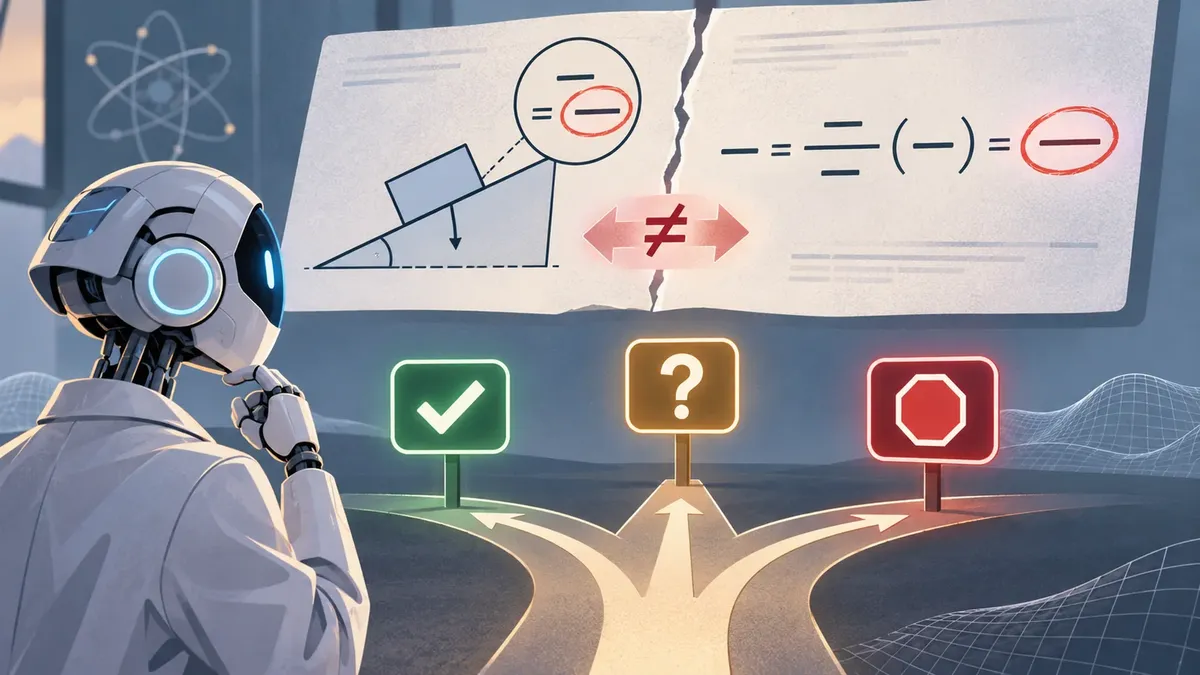
A science question can look solvable while containing a contradiction, a missing value or a crucial image that has disappeared. A new benchmark asks whether AI systems catch those problems before answering. Its proposed checking agent scores better than the standalone models tested, but the results come from a deliberately constructed test set and rely partly on automated judging.
A vision-language model (VLM) can combine images and text to answer questions about diagrams, charts and scientific problems. But what if the question itself is broken? A diagram might show one mass while the text gives another, or a problem might omit a value needed to calculate an answer. In such cases, a fluent response may be less useful than a warning or a request for clarification.
In RoSci: Exploring Robustness in Science VLMs, Junying Wang and colleagues examine whether models recognize these flawed premises. They call this ability “Scientific Model Robustness,” and divide it into two parts: spotting information errors, such as contradictions or violations of scientific methods, and spotting information loss, such as missing variables or images. The practical test is not only whether a model can solve a problem, but whether it can tell when the available information does not support a solution.
A benchmark of deliberately degraded questions
The researchers created RoSci-Bench from 305 science and multimodal reasoning problems selected from existing datasets and other sources. Domain experts altered each problem to introduce an error or remove needed information. The team then used GPT-5 to produce three wording or context variants for each altered problem, giving a total of 1,220 samples. The authors say experts reviewed the degradations and that the original problems were checked for solvability before alteration.
The six tested degradation types include minor and critical factual errors, violations of scientific laws or methods, contradictions between text and image, removal of key facts, and loss of an image needed in a multi-image task. For instance, a question might describe a block as having a mass of 100 kilograms while its image labels it as 10 kilograms. Some altered questions remain answerable; others should prompt a model to abstain or seek clarification.
The researchers evaluated 20 VLMs, including open and closed systems. They assessed accuracy on degraded questions that remained solvable, rejection of questions judged unanswerable, and the quality of explanations for correct rejections. An overall score was also used. Several measures rely on an AI judge to assess model responses; the paper reports that its judge and human experts agreed on pass-or-fail decisions for about 92.7% of a random sample of 150 responses.
Checking before answering
The team also developed RoSci-Agent, which uses a Parse-Verify-Decide process. First, a VLM organizes the question’s text and visual information into a structured representation. Next, it checks for inconsistencies and missing details. Finally, it answers, asks for clarification or rejects the question, depending on the detected problems. The researchers used GPT-5 as the agent’s backbone and tuned its decision thresholds on a held-out portion of the benchmark.
On RoSci-Bench, RoSci-Agent received an overall robustness score of 44.77, compared with 31.95 for the highest-scoring standalone VLM in the reported comparison. The paper also reports that seven of eight baselines in a detailed comparison scored lower on information loss than on information error. In other words, models often had particular difficulty with insufficient information, though the pattern was not universal. Human experts scored 98.90 on the benchmark, well above the evaluated models.
These results suggest that explicitly checking premises can improve performance on this test. They do not show that the agent is generally reliable in scientific research, or that it will behave the same way on questions outside the benchmark. The samples are constructed from a limited set of source problems, and the variants are generated with a language model. Real scientific uncertainty can be subtler than a missing value or a direct text-image mismatch.
There are also evaluation caveats. Some scores depend on automated judgments, and agreement with experts was checked on only a sample of responses. The agent’s thresholds were tuned using part of the benchmark, so the reported comparison is not a test on an entirely untouched set. The paper reports bootstrap analysis for the agent and three baselines, rather than every evaluated model. These details matter when interpreting a headline score as evidence of broader improvement.
RoSci’s central contribution is a way to test a behavior that ordinary question-answering benchmarks can miss: knowing when not to answer. Its benchmark and agent offer a starting point for studying that capability, not a demonstration that current VLMs can safely act as scientific authorities. The work is posted as an arXiv preprint, and its claims should be read as research results awaiting further scrutiny and testing.
- vision-language models
- scientific reasoning
- AI robustness
- multimodal AI
- selective abstention
- RoSci-Bench
Reviewed cross-references
These connections were reviewed by a model, not independently fact-checked by a human. Similarity does not imply agreement; consult the original papers and the evidence below.
Why a personal AI assistant needs to find the right person first
Supporting evidence: Both benchmark studies identify difficulty filtering problematic input: the RoSci authors report VLMs answering some scientific questions with invalid or incomplete premises, while the MPRBench authors report difficulty rejecting irrelevant personal information. This supports a limited observation across two different multimodal reasoning settings; it does not establish that the same models or failure mechanisms are involved.
Model review: · openai-codex/gpt-6-luna
Evidence and provenance
Selected excerpts, not complete papers. PDF extraction can omit figures or damage equations, tables and reading order; sources may be preprints.
2611.27750v1 — Original paper
Excerpt reference:
static/papers/2611.27750v1.md:13-54
Basis: Paper text
Source SHA-256:9c482f016224ac80501c0d2508ef787c26264693f92e5d57ee43b655f27b6c0b2611.06259v1 — Original paper
Excerpt reference:
static/papers/2611.06259v1.md:84-151
Basis: Paper text
Source SHA-256:de93fb9e81ff8d313dd50d33fcdf5b58782627e6dc4ae54acaf8c4bda34f5f8d
An AI moderator can spot hate—and still fail the trust test
Supporting evidence: Both papers examine whether models respond appropriately when inputs call for caution: RoSci reports models sometimes answering questions with invalid or incomplete premises, while TrustMod-SM reports low escalation recall on ambiguous moderation content. These are compatible concerns about handling uncertain inputs, but the tasks, response options, and evaluation measures differ, so the findings are not directly comparable.
Model review: · openai-codex/gpt-6-luna
Evidence and provenance
Selected excerpts, not complete papers. PDF extraction can omit figures or damage equations, tables and reading order; sources may be preprints.
2611.27750v1 — Original paper
Excerpt reference:
static/papers/2611.27750v1.md:13-54
Basis: Paper text
Source SHA-256:9c482f016224ac80501c0d2508ef787c26264693f92e5d57ee43b655f27b6c0b2611.12970v1 — Original paper
Excerpt reference:
static/papers/2611.12970v1.md:72-123
Basis: Paper text
Source SHA-256:d2e26cf1506100042161f3d2c45bdc0b3b9a3c02d83d6e0e7061ec024e9736b2
Related reading
Automatically matched by shared topic keywords. These links do not imply that the sources agree or establish a consensus.
Why a personal AI assistant needs to find the right person first
Source published
Shared keywords: multimodal ai, vision language models
Why Multimodal AI Can Forget—and How SAME Tries to Help
Source published
Shared keywords: multimodal ai, vision language models
AI image preferences can transfer through unrelated number training
Source published
Shared keywords: multimodal ai, vision language models
Why Multimodal AI Can Forget in Two Places
Source published
Shared keywords: multimodal ai, vision language models
RECAP speeds up vision-language models by recycling predictions in context
Source published
Shared keywords: multimodal ai, vision language models