TRANSMISSION // 2611.27746v1
Why AI Teams Need More Than Shared Files
Source published
A framework for keeping people and AI agents coordinated as goals, plans and roles change over time.
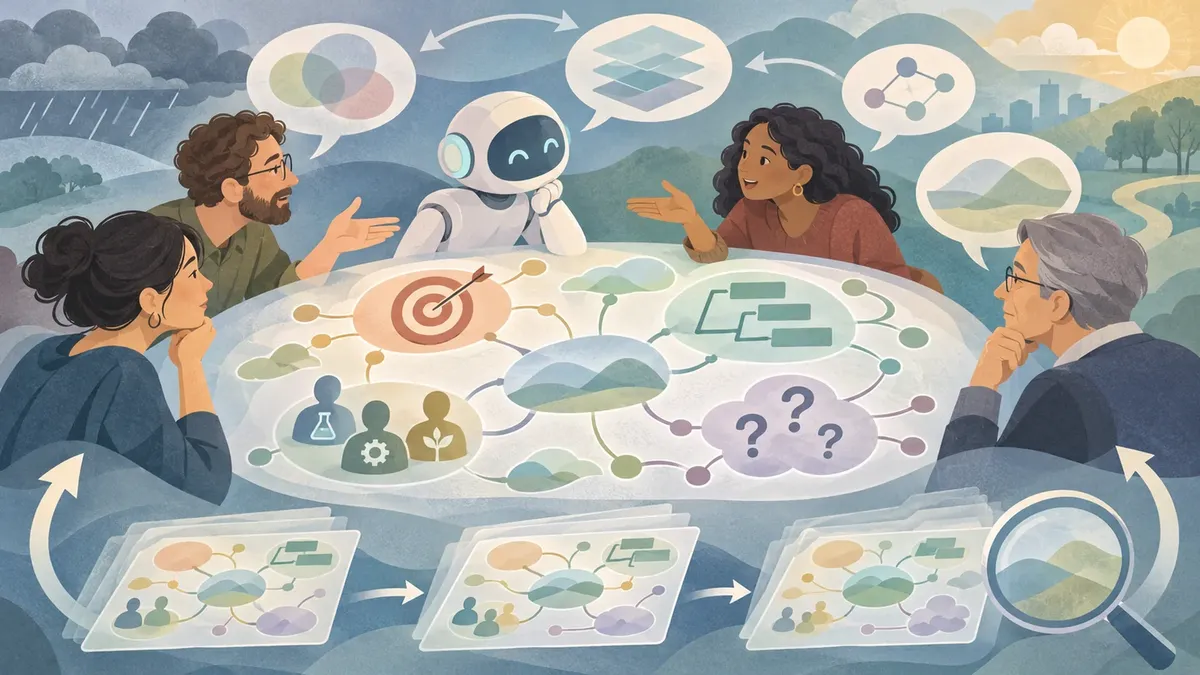
A shared repository can give everyone access to the same documents without giving them the same understanding of what those documents mean now. This paper argues that human–AI teams need ways to notice when context may be stale, surface differences, and rebuild a workable basis for action.
Shared information is not shared understanding
A project plan can remain in a repository after priorities have changed. An AI agent may still use it, while a teammate returning to the project assumes it is current. Everyone can access the same file and still act on different assumptions.
That gap is the focus of a paper by Siân Lindley and colleagues, which introduces coordination continuity: the extent to which people and AI agents sustain a workable basis for acting together as work progresses. The authors ask what teammates need to understand, how that understanding can be maintained, and when a system might prompt people to check or rebuild it.
The issue is especially relevant to extended, asynchronous work, where tasks are spread across people, agents, meetings, documents and tools. The authors use “understanding” for an agent operationally: it refers to the representations the system maintains and the actions it produces, not humanlike subjective comprehension.
Three cases, one design framework
The paper combines research on collaborative work with two qualitative team studies and a reflexive account of the authors’ own repository-based environment, called the Assembly. The first study followed a four-person scientific team from March to June 2026, drawing on interviews, observed work sessions and selected AI chat transcripts. The second examined a seven-person machine-learning research team from February to June 2026 through interviews, a workshop and a follow-up survey. The Assembly case draws on the authors’ use of their environment from March to October 2026, including reflections, meeting records and stored work materials.
These cases were used to develop ideas, not to test whether the framework improves team performance. In the scientific team, shared repositories and structured question loops helped clarify terminology and expose differing interpretations. But discussion and decision rationale did not always enter the records available to agents, complicating handoffs. In the machine-learning team, regular meetings helped people realign, while interpretations could diverge between those meetings. In the Assembly, goals and specifications were available to people and agents, yet could become outdated as the work evolved.
Across the cases, the authors propose three connected parts of coordination continuity:
- Representations: durable records of goals, plans, dependencies, roles and expertise.
- Coordination properties: the current status of those records—for example, whether a goal is still current, a plan has been superseded, or evidence has been verified. Teammates may judge that status differently.
- Interaction mechanisms: ways to reveal and change that status, such as clarification, verification, feedback and recording the reasons behind decisions.
The framework does not require everyone to know the same things or agree completely. Instead, differences should be visible enough for collaborators to judge whether they can still act together.
Build, act, drift, rebuild
The authors use a build → act → drift → rebuild heuristic to describe how coordination can change. A team establishes enough shared context to proceed, then acts. As circumstances and interpretations shift, drift may emerge. The team may then need to rebuild a workable basis for its next step. This is not necessarily a neat sequence: clarification and repair can happen throughout the work.
The paper highlights consequential moments: points when an action depends on an uncertain interpretation and a mistake could be costly to undo or spread to others. Handing work to someone else or returning to a project after time away are examples. The authors suggest systems prompt proportionate alignment at such moments, rather than interrupting over every minor difference.
Their eight design implications include making the status and sources of information visible, clarifying who has relevant expertise and verification responsibility, preserving uncertainty and disagreement, selectively recording decision rationale, and supporting targeted questions and feedback. These are design directions, not proven features of a finished system.
What the evidence can—and cannot—show
The paper’s central contribution is a conceptual framework grounded in prior research and situated examples. The authors say the cases are small and qualitative, the framework has not been prospectively tested, and the settings involve knowledge work with software-based agents. Analysis in the two team studies used AI assistance, with researchers checking proposed themes against the source material. The authors’ involvement in the Assembly also brings a risk of familiarity. Interviews and reflections provide evidence about reported practices, not direct measurements of participants’ internal mental models.
The paper therefore does not establish that a particular coordination tool will improve outcomes or that these patterns apply across teams and domains. It offers a way to frame a design problem: stored context can persist while its meaning changes, and keeping collaboration on track may require people and systems to revisit that meaning together. This is an arXiv preprint; its framework and case-based insights should not be treated as settled evidence.
- human-AI collaboration
- team coordination
- AI agents
- shared understanding
- asynchronous workflows
- collaborative work
Related reading
Automatically matched by shared topic keywords. These links do not imply that the sources agree or establish a consensus.
Researchers reported difficulty evaluating AI-generated material in a small pilot
Source published
Shared keywords: human ai collaboration, team coordination
A Rename Is More Than a Find-and-Replace
Source published
Shared keywords: ai agents, human ai collaboration
SlackBench tests how AI agents reconstruct a project from scattered evidence
Source published
Shared keywords: ai agents
Teaching AI Agents When to Ask for Human Help
Source published
Shared keywords: human ai collaboration
AI can do the work—but surveyed users still want a say
Source published
Shared keywords: human ai collaboration