TRANSMISSION // 2611.27742v1
Two cosmic signals could reveal how massive black holes grow
Source published
Tidal disruption flares and gravitational-wave inspirals offer different clues to massive black holes. A modelling study explores how combining their populations could constrain black-hole demographics.
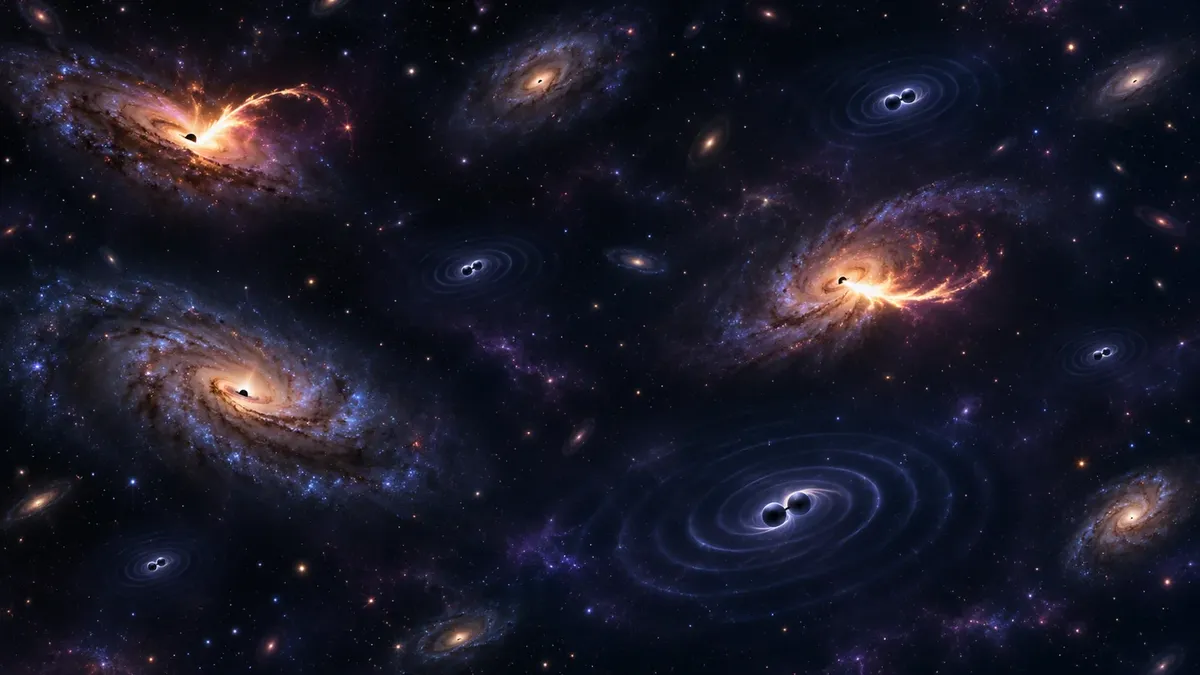
When a star is torn apart near a massive black hole, it can produce a bright flare. When a compact object spirals into one, it can send out gravitational waves. A study proposes combining these distinct signals to learn about the black-hole populations that produce them.
Massive black holes sit at the centres of galaxies, but how they formed and grew remains uncertain. One way to investigate is to study stars and compact objects that approach them. A star passing too close can be torn apart in a tidal disruption event (TDE), producing a flare seen with telescopes. A compact object spiralling into a much more massive black hole can create an extreme mass-ratio inspiral (EMRI), detectable through gravitational waves.
These events provide different kinds of evidence. Shashwat Singh and colleagues ask how observations of both could be combined to infer properties of the massive-black-hole population—even when researchers do not observe the same black hole through both messengers.
Modelling populations, not matching individual events
The authors build on two-dimensional Fokker–Planck simulations, which model how stellar systems change as objects interact and move around a central black hole. They use the simulations to predict TDE and EMRI populations under different assumptions about black-hole formation and the relationship between black holes and their host galaxies. The abstract identifies factors including the black-hole–host scaling relation, the fraction of galaxies with central star clusters, and the fraction that host black holes.
The analysis also accounts for the fact that surveys do not detect every event. A flare’s visibility depends on the electromagnetic survey; an inspiral’s detectability depends on the gravitational-wave observatory. The researchers use joint hierarchical inference, a statistical approach that combines information across populations while accounting for each type of observation’s selection effects.
The proposed comparison brings together TDE observations from the Zwicky Transient Facility (ZTF) and EMRIs that the planned Laser Interferometer Space Antenna (LISA) might detect. The paper also considers prospects for the future Legacy Survey of Space and Time (LSST).
Different signals contribute different clues
Using current ZTF TDE detections, the authors report that they can identify combinations of black-hole formation assumptions favoured by, or consistent with, the observed TDE population. From those combinations, they calculate corresponding predictions for the EMRI population detectable by LISA.
Across the astrophysical assumptions they consider, their estimates put the number of detectable ZTF TDEs at 2.7 to 84.3 times the number of detectable LISA EMRIs. This is a model-based forecast, not a count of events observed by both facilities. The authors say TDEs provide much of the information about shared population features, including black-hole mass and redshift distributions. Their LSST forecast gives a 90% credible width of 0.31 dex for the characteristic black-hole mass and a precision of 0.11 for the power-law index describing redshift evolution.
EMRIs are estimated to make up about 3.4% of the joint catalogue. Yet the authors find that they can carry more information than the whole ZTF sample: gravitational-wave signals provide access to black-hole spin and orbital eccentricity, properties the abstract describes as unavailable from TDE observations. In this framework, the more numerous flares help map the population, while the rarer inspirals add different details.
The authors also argue that TDE observations could constrain the abundance of low-mass massive black holes before LISA operates. EMRIs, if detected, could later add information that electromagnetic surveys alone cannot provide.
Forecasts depend on assumptions
These conclusions are projections from simulations and statistical models, not direct measurements of the full black-hole population. Predicted detection numbers and constraints depend on astrophysical assumptions and on how observatories select events. The TDE-to-EMRI ratio varies widely across the assumptions explored, so it should not be treated as a universal constant.
This account is based on the paper’s abstract; the full paper’s detailed methods, tables and sensitivity tests are not assessed here. The source is an arXiv preprint, version 1, and the supplied information does not establish its peer-review status. The results are best read as a proposed framework and forecast, rather than a settled observational conclusion. The central idea is that electromagnetic flares and gravitational waves may be most informative when analysed together, because each can reveal aspects the other cannot.
- massive black holes
- tidal disruption events
- extreme mass-ratio inspirals
- LISA
- ZTF
- black-hole populations
- gravitational waves
Related reading
Automatically matched by shared topic keywords. These links do not imply that the sources agree or establish a consensus.
Phentax adapts black hole waveform calculations for LISA’s crowded signals
Source published
Shared keywords: gravitational waves
Separating black hole signals from glitches in simulated LISA data
Source published
Shared keywords: gravitational waves
Gas disks could steer stars into growing black holes
Source published
Shared keywords: tidal disruption events
Can LISA spot black hole mergers before they happen?
Source published
Shared keywords: gravitational waves
Teaching LISA’s data models to expect the unexpected
Source published
Shared keywords: gravitational waves