TRANSMISSION // 2611.27741v1
Can AI Write a Game Controller, Not Just Pick a Move?
Source published
PlayScriptBench tests whether vision-language models can turn screenshots and game rules into reusable game-playing programs. The models struggled to combine perception, code and strategy.
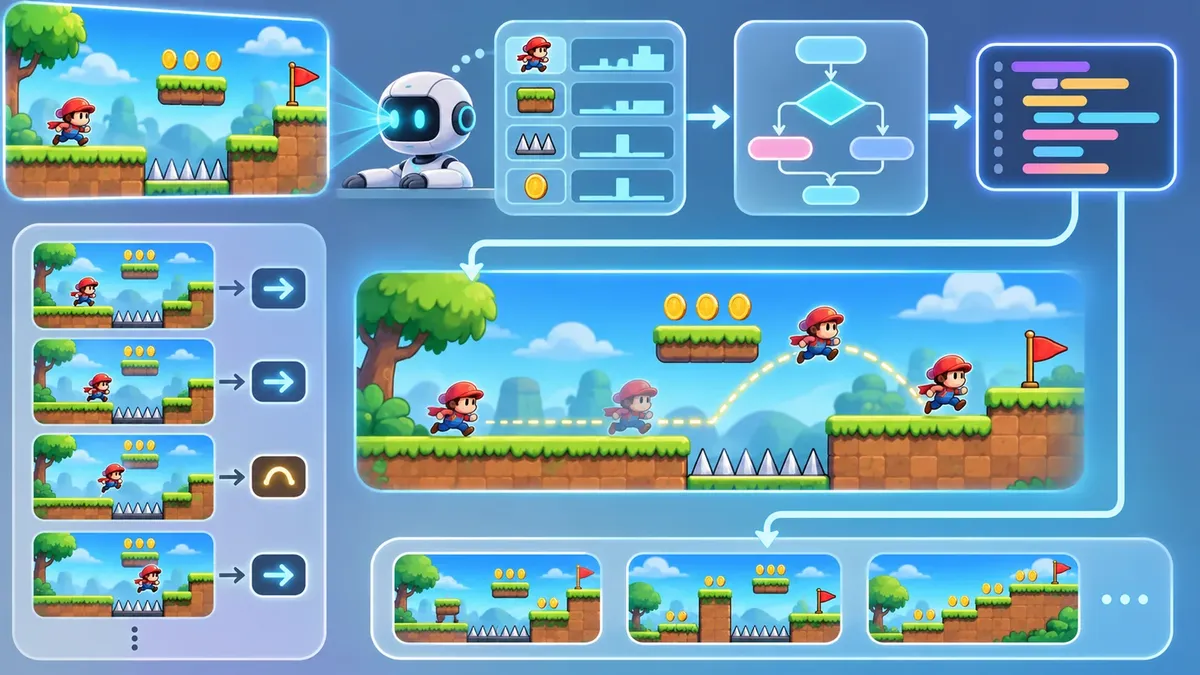
A model that can describe a game screenshot may still fail to play. PlayScriptBench tests a harder task: can a vision-language model write a program that reads game images and controls the game on its own?
Most game-playing tests ask an AI to look at the current screen, choose an action, then repeat. That setup can be costly and slow: the game may have to wait while the model processes each new image. But asking a model to write a reusable controller brings a different challenge. It must work out what is on screen, understand how the game changes, and turn that understanding into code that makes a sequence of useful decisions.
A preprint by Yao Tong and colleagues introduces PlayScriptBench, a benchmark for testing that ability. Instead of asking a vision-language model (VLM) to choose every move, the benchmark asks it to build a game-playing program from game rules and a representative screenshot. The finished controller then runs through gameplay without consulting the VLM at every frame.
From exploration to a working controller
The benchmark covers 16 HTML5 games across four genres: runners, arcade games, puzzles and platformers. The games use different visual formats and controls, including keyboard and mouse input. Models are not given game source code or a game-state API; they must extract information from screenshots and use the available controls.
The researchers break controller-building into four stages: Explore, Perception, API Construction and Strategy Composition. First, a model explores the game through a short scripted rollout, and an analyst model turns the resulting screenshots and notes into a description of game mechanics. Next, the model writes code to identify relevant objects and state from images. It then builds an interface that organizes that information for the strategy stage, which produces the game-playing controller.
This separation helps identify where a system goes wrong. The researchers score perception and interface construction against reference implementations, and test strategy with oracle perception: a reference system supplies the game state so that visual errors do not obscure the strategy score. They also test the complete pipeline using the model’s own perception and interface code. Controllers are run across multiple game seeds to check whether performance holds beyond one playthrough.
The study evaluates 13 VLMs. Overall, the results show that describing or recognizing a game state is not enough to play reliably. The average combined diagnostic score across models was 0.155. The authors report that strategy performance and observation performance did not track closely: a model with relatively strong state extraction did not necessarily produce strong gameplay, and some models performed better strategically than their observation scores would suggest.
The gap becomes especially clear when the researchers replace oracle perception with each model’s own perception and interface. For two examined models, the strategy score fell from 0.255 to 0.013 and from 0.600 to 0.052, respectively. These results suggest that mistakes in reading the screen can disrupt later reasoning and control. Yet better perception alone was not sufficient: even accurate state information did not guarantee a successful strategy. The paper describes failures ranging from incorrect visual-detection assumptions to runnable programs with weak decision logic.
What the results do—and don’t—show
The benchmark also illustrates why reusable controllers could be useful. In one comparison, a script-based approach made fewer model calls than a VLM asked to choose actions repeatedly. But that comparison is not a clean measure of which approach plays better: the reported strategy score for the script-based method used oracle perception, while the in-loop baseline used its own perception. The authors explicitly note this mismatch. The result supports the idea that a reusable script can reduce repeated calls, not a general claim that it is a better game-playing method.
PlayScriptBench is designed for deterministic, bounded-state games where a static controller can in principle work. Such a controller cannot adapt its strategy online in the way a model called repeatedly might. The benchmark therefore complements, rather than replaces, tests of real-time, reactive play. Its scores also depend on the chosen games, scoring rules, model prompts and evaluation setup; they should not be read as a complete ranking of VLM capability.
The work is presented as a preprint, so its findings should be treated as preliminary rather than as conclusions established through peer review. The supplied paper text reports experiments and limitations, but does not establish how the benchmark or results will hold up under independent replication or on other kinds of games. The central takeaway is narrower: in this test, turning visual understanding into an executable, dependable game controller remained difficult.
- vision-language models
- game-playing AI
- program synthesis
- AI benchmarks
- PlayScriptBench
- game controllers
Reviewed cross-references
These connections were reviewed by a model, not independently fact-checked by a human. Similarity does not imply agreement; consult the original papers and the evidence below.
AtariBench exposes AI models’ difficulty turning moving images into reliable actions
Supporting evidence: Both papers report that strong visual understanding does not by itself ensure reliable gameplay: PlayScriptBench finds failures in synthesized closed-loop controllers, while AtariBench reports motion, grounding, and sequential-decision failures. This supports that bounded observation across different benchmarks, not a direct performance comparison: PlayScriptBench tests autonomous scripts in deterministic, bounded-state games, whereas AtariBench tests sequential VLM decisions in Atari games.
Model review: · openai-codex/gpt-6-luna
Evidence and provenance
Selected excerpts, not complete papers. PDF extraction can omit figures or damage equations, tables and reading order; sources may be preprints.
2611.27741v1 — Original paper
Excerpt reference:
static/papers/2611.27741v1.md:132-170
Basis: Paper text
Source SHA-256:34d4020501128ce2a6c510620003059f53601b91f629f0fe6e81c5942d2d09622611.27741v1 — Original paper
Excerpt reference:
static/papers/2611.27741v1.md:171-249
Basis: Paper text
Source SHA-256:34d4020501128ce2a6c510620003059f53601b91f629f0fe6e81c5942d2d09622611.08755v1 — Original paper
Excerpt reference:
static/papers/2611.08755v1.md:13-65
Basis: Paper text
Source SHA-256:7170f1cc042f9f8fffef59d140fa844020041c70d3822af12c82c3ece264f6692611.08755v1 — Original paper
Excerpt reference:
static/papers/2611.08755v1.md:66-105
Basis: Paper text
Source SHA-256:7170f1cc042f9f8fffef59d140fa844020041c70d3822af12c82c3ece264f669
Related reading
Automatically matched by shared topic keywords. These links do not imply that the sources agree or establish a consensus.
Why a personal AI assistant needs to find the right person first
Source published
Shared keywords: ai benchmarks, vision language models
Testing Vision-Language AI Across Seven Languages
Source published
Shared keywords: ai benchmarks, vision language models
Hand-set neural networks master small games but struggle to turn tactics into plans
Source published
Shared keywords: game playing ai
A Safety Check for Video World Models at Walls
Source published
Shared keywords: ai benchmarks
F3-AGI tests a frugal route to abstract reasoning—with a calibration caveat
Source published
Shared keywords: program synthesis