TRANSMISSION // 2611.27728v1
Turning Vehicle Images Into Pavement Measurements
Source published
A camera-image method estimates crack-patch lengths by correcting perspective and scale, but its assumptions limit where measurements may apply.
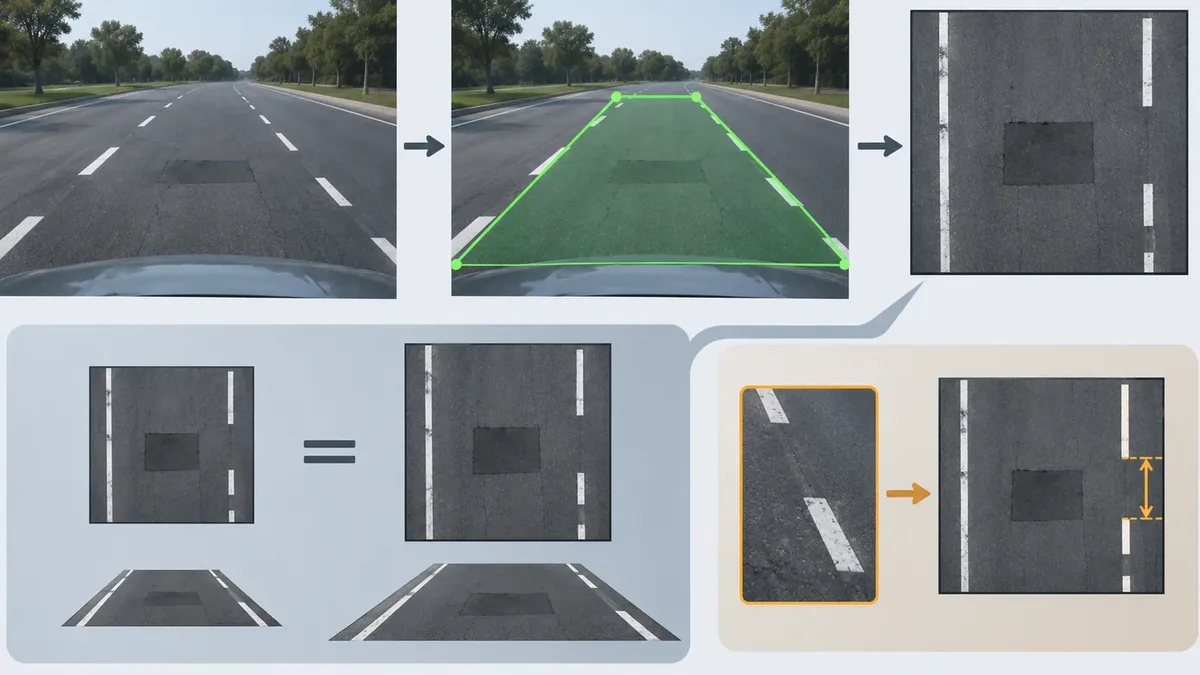
Road images can help identify pavement damage, but pixels alone do not give real-world lengths. Researchers describe a way to estimate crack-patch lengths from front-facing vehicle images by correcting perspective and using road markings to set scale.
Large volumes of onboard vehicle-camera images could help assess pavement conditions. But spotting a crack or patch is not the same as measuring it: perspective changes how large road features appear, and pixels have no fixed physical scale. This arXiv preprint proposes a method to estimate pavement distress dimensions without calibrating the camera on site.
The study focuses on crack patches—areas of pavement that have been patched—and asks whether their lengths can be estimated from front-view images. The goal is to turn image detections into physical measurements that could be examined alongside other road-condition data.
Correcting perspective and scale
The process begins with an operator selecting an image and setting the height of the road region to examine. A lane-detection model identifies lane markings; the method uses these results to generate the region’s edges, shifting them outward by 10 pixels. The resulting four-corner region is treated as a trapezoid. A perspective transformation maps it to a square image described by the paper as a vertical view, cropping away the rest of the original image. The authors say the transformation can be reused for images from the same camera, assuming its position and orientation remain unchanged.
Perspective correction does not, by itself, establish real-world dimensions. A separate step detects a broken road marking and uses its image aspect ratio to adjust image size. The paper says highway broken-line markings are commonly specified as 10 feet long and 4–6 inches wide; the calculation adopts a six-inch width. These are assumptions, not dimensions shown to apply to every road. The scale step therefore depends on a visible, recognizable marking whose actual dimensions suit the assumed reference.
A YOLO object-detection model then identifies crack patches in the corrected images. Rather than tracing each patch’s outline, the system estimates length from the diagonal of the rectangle around the detection. The authors trained models on a larger pavement-image dataset and refined them using a smaller, project-specific set. On the paper’s validation comparison, refinement improved mAP@0.5 for the reported YOLOv11s model from 0.599 to 0.881, while precision changed from 0.967 to 0.897 and recall from 0.225 to 0.813. The authors selected YOLOv11s as a balance between detection performance and speed; these results do not mean every metric improved for every model.
What the measurements showed
The researchers compared estimated patch lengths with SCRIM readings, a measure of pavement friction, along a test road. Longer estimated patch lengths tended to coincide with lower friction readings. The paper reports a moderate negative association in both Pearson and Spearman analyses. This is a relationship in the observed data, not evidence that patches caused lower friction.
The authors also compared corrected estimates with lengths measured from unadjusted images. In their analysis, corrected patch lengths had a stronger association with friction readings. That result supports the usefulness of perspective correction in this particular comparison; it does not show that the correction will improve measurements in every setting.
What remains uncertain
The approach relies on visible, standardized road markings to set scale and assumes the camera stays in the same position and orientation. Missing or worn markings, camera vibration, or a changed installation could make the correction less reliable. The bounding-box diagonal is also an approximation, not a measurement of the patch’s exact geometry.
The paper identifies comparison with field measurements as an important next step. Its test-road relationship with friction does not independently establish how closely estimated lengths match physical measurements across vehicles, roads, or conditions. The authors also propose investigating roads with missing or deteriorated markings and extending the method to other distress types.
This is an arXiv preprint and may not have undergone peer review. The authors describe the workflow as practical, but its reliance on suitable markings and a fixed camera setup—and the stated need for field validation—limits what can be concluded. The study presents a method for deriving estimated measurements from vehicle imagery; it does not establish a universally reliable calibration method or show that its estimates are exact pavement dimensions.
- pavement distress
- computer vision
- vehicle cameras
- road inspection
- perspective correction
- image measurement
Reviewed cross-references
These connections were reviewed by a model, not independently fact-checked by a human. Similarity does not imply agreement; consult the original papers and the evidence below.
PAVE gives AI a rulebook for mapping intersections
Shared method: Both papers use camera-image geometry to relate visual observations to roadway geometry: the pavement study applies a homography to rectify a selected road region, while PAVE uses camera projections to relate traced lanes to street views. The geometric tools serve different tasks, and this connection does not establish comparable measurement accuracy or shared performance.
Model review: · openai-codex/gpt-6-luna
Evidence and provenance
Selected excerpts, not complete papers. PDF extraction can omit figures or damage equations, tables and reading order; sources may be preprints.
2611.27728v1 — Original paper
Excerpt reference:
static/papers/2611.27728v1.md:113-173
Basis: Paper text
Source SHA-256:04e5ef2a10031de444282e8af1abf60650f7240b2b7618dcf00aea35b189ab3f2611.27352v1 — Original paper
Excerpt reference:
static/papers/2611.27352v1.md:201-272
Basis: Paper text
Source SHA-256:901d2f2a4f6dc169699198103febd75ddb765c8ff2884c4fed9c1b49e425d703
Related reading
Automatically matched by shared topic keywords. These links do not imply that the sources agree or establish a consensus.
SplatLab puts an AI research loop to work on 3D scenes
Source published
Shared keywords: computer vision
Why Shape-Aware Matching May Help Spot Surface Defects
Source published
Shared keywords: computer vision
How heat changes tomato pollen—and how researchers tracked it
Source published
Shared keywords: computer vision
Why AI explanations should pass through the decoder
Source published
Shared keywords: computer vision
Reading smoke’s motion to find hidden wildfire flames
Source published
Shared keywords: computer vision