TRANSMISSION // 2611.27710v1
AI reasoning can be shorter by reusing familiar phrases
Source published
CRAFT compresses AI training traces by finding reasoning phrases that recur with different names, numbers or wording. Its reported savings come with accuracy trade-offs and important limits.
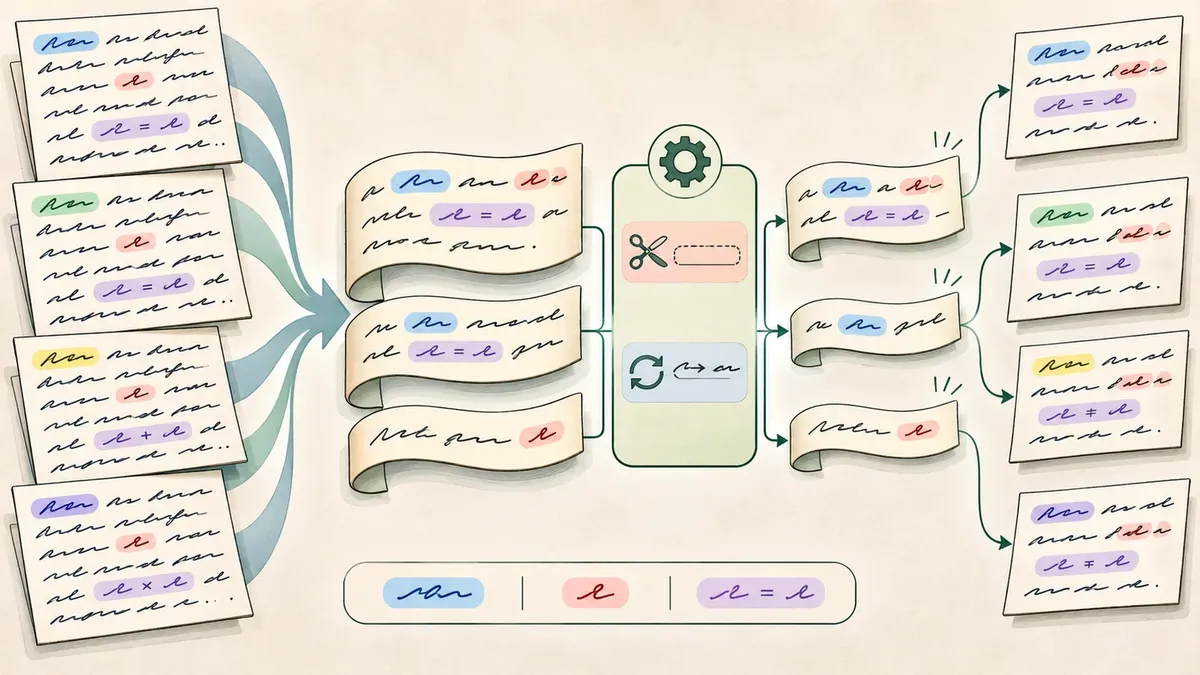
When many AI solutions explain similar steps in slightly different words, a compressor may repeatedly do the same work. A new method called CRAFT looks for reusable patterns across traces, then applies shared edits to make training examples shorter.
A step-by-step answer can help train an AI model to solve problems, but producing and processing long reasoning traces takes resources. One way to reduce that burden is to shorten traces before using them as training material. The challenge is to remove repeated wording without discarding too much useful information—and to avoid paying a powerful language model to compress nearly identical phrases over and over.
A paper by Shibo Wang and colleagues introduces CRAFT, a method for reusing compression decisions across examples. Its central observation is that similar reasoning expressions are not always identical. A sentence may use the same structure while changing a person’s name, a number or a formula; another version may express much the same idea with slightly different wording. Exact-text reuse can miss both kinds of variation.
Finding patterns beneath the differences
CRAFT first analyzes a collection of existing reasoning traces. It separates some problem-specific words into “slots,” leaving a partially lexicalized expression template: shared wording with places for details to vary. It then groups similar templates into families, using measures of wording, meaning and the order of slot types.
For each selected family, a compressor processes a representative expression and proposes a shared deletion or rewriting policy. CRAFT applies that policy to other occurrences, using each occurrence’s own details where the policy calls for them. The edits can still remove or rewrite content. The resulting examples remain ordinary text, which can be used as targets in standard supervised fine-tuning. The method is intended for preparing training material in batches, not for shortening a user’s request as it arrives.
The researchers tested CRAFT with Qwen2.5 models in 3B, 7B and 14B sizes and LLaMA-3.1 8B, across GSM8K and MATH math benchmarks, TabMWP table-based problems and LogicNLI logical reasoning. They generated model reasoning traces, kept traces that passed correctness filtering, compressed them with different methods, and fine-tuned the corresponding models. Accuracy and reasoning length were assessed on test sets; the study also compared the amount of compressor input and output, combined into a weighted budget measure.
Less repeated compressor work, with trade-offs
Against per-example rewriting, CRAFT’s shared rewriting reduced the weighted compressor budget by a median 90.7% in the paper’s headline comparison. The reported median accuracy change was a loss of 1.21 percentage points, while the resulting models generated shorter reasoning. Across 36 matched comparisons with per-example compression, the paper reports weighted-budget reductions of 77.8% to 96.8%. These are study-specific comparisons, not a guarantee that every model or task will see the same savings.
The comparison with cross-sample encoding also favored CRAFT on reasoning length: it produced traces 25.3% shorter on average across eight model–dataset settings and had higher accuracy in five. That does not mean it won every comparison. In other reported comparisons, CRAFT’s accuracy was lower, and matching methods at similar accuracy or similar length can yield different results. The paper’s ablations suggest that both slot abstraction and clustering help the method reuse edits beyond identical strings.
The key distinction is between compressor cost and model performance. Reusing one edit policy can greatly reduce how much compressor work is repeated, but that saving alone does not show that the final model reasons better, or that its shortened trace preserves every useful step. Shorter output is a measure of length, not proof of a faithful explanation.
What remains uncertain
The study covers English-language mathematical, tabular and logical reasoning. The authors say the approach needs further evaluation for multilingual material, code and open-ended reasoning. Its benefits also depend on finding recurring patterns: a more varied collection may offer fewer reusable edits. The policy banks were built separately for each model–dataset pair, and the reported transfer experiment concerns trained models rather than moving a policy bank between corpora.
There is a further practical caution: shared edits can spread an error across many examples. The authors warn that compressed traces may be harder to audit and recommend retaining original traces and independently checking consequential outputs. They also report token use as a resource measure, not as a measurement of energy use or carbon emissions.
This is an arXiv preprint, so its results should be treated as provisional rather than as settled evidence. The findings describe benchmark experiments and do not establish how the method would perform in other settings. CRAFT offers a way to reduce repeated work when constructing reasoning training data; whether its balance of efficiency and retained reasoning is appropriate depends on the task and on how carefully the compressed examples are checked.
- AI reasoning
- chain-of-thought compression
- language models
- CRAFT
- machine learning
Reviewed cross-references
These connections were reviewed by a model, not independently fact-checked by a human. Similarity does not imply agreement; consult the original papers and the evidence below.
A Reversible Code for Shorter AI Reasoning
Supporting evidence: Both papers report shorter generated reasoning with relatively small average accuracy changes in their evaluated settings: CRAFT reports a median 1.21-percentage-point accuracy loss against per-example rewriting, while the reversible-code study reports a 1.6-point average cost. This supports only the bounded observation that different compression approaches achieved these outcomes in their own tests; the methods and evaluation settings differ, so it is not a head-to-head comparison.
Model review: · openai-codex/gpt-6-luna
Evidence and provenance
Selected excerpts, not complete papers. PDF extraction can omit figures or damage equations, tables and reading order; sources may be preprints.
2611.27710v1 — Original paper
Excerpt reference:
static/papers/2611.27710v1.md:13-66
Basis: Paper text
Source SHA-256:590b3ee2a558ca7b0f9730e196edaa41b2aaaa7ce3283a26707ae4fa0104e7e42611.27326v1 — Original paper
Excerpt reference:
static/papers/2611.27326v1.md:13-42
Basis: Paper text
Source SHA-256:76ece2b006521c695fe9a96d4bb400852702741bcee4b12a72752ac979ff4488
Teaching AI When to Stop Reasoning
Supporting evidence: Both report substantial reasoning-length reductions while maintaining or improving accuracy in evaluated tasks: CRAFT reports shorter reasoning with a median 1.21-point accuracy loss against per-example rewriting, and LoCo reports 41.7%–45.4% shorter completions on mathematics while maintaining or improving accuracy. CRAFT shares edits across templates for offline supervision; LoCo learns state-conditioned preferences, so the results support a limited outcome-level connection, not a shared method or direct comparison.
Model review: · openai-codex/gpt-6-luna
Evidence and provenance
Selected excerpts, not complete papers. PDF extraction can omit figures or damage equations, tables and reading order; sources may be preprints.
2611.27710v1 — Original paper
Excerpt reference:
static/papers/2611.27710v1.md:13-66
Basis: Paper text
Source SHA-256:590b3ee2a558ca7b0f9730e196edaa41b2aaaa7ce3283a26707ae4fa0104e7e42611.04814v1 — Original paper
Excerpt reference:
static/papers/2611.04814v1.md:15-63
Basis: Paper text
Source SHA-256:f50512ef91c577daf9750121639337376a0b1e4dcb243e63f03b0f26ac6ac3b2
Related reading
Automatically matched by shared topic keywords. These links do not imply that the sources agree or establish a consensus.
AI reasoning needs more than a correct answer
Source published
Shared keywords: ai reasoning
The words that quietly steer AI reasoning
Source published
Shared keywords: ai reasoning
CreditFilter Tries a New Way to Weight AI Training Tokens
Source published
Shared keywords: ai reasoning, language models
Could the shape of word connections help evaluate AI reasoning?
Source published
Shared keywords: ai reasoning
Why AI Reasoning Training May Favor Familiar Problems
Source published
Shared keywords: language models