TRANSMISSION // 2611.27693v1
A neutron star’s possible ultrafast wind remains uncertain
Source published
X-ray spectra from RX J0209.6-7427 show absorption features that could signal fast outflows, but other explanations fit the data too.
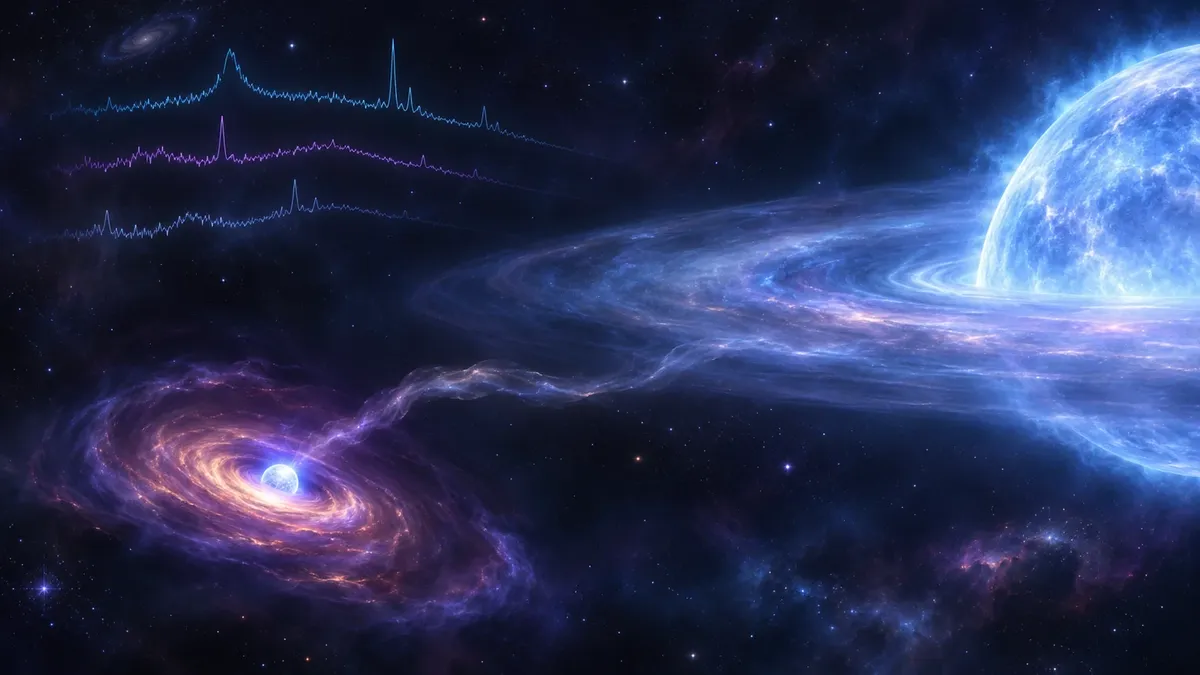
A bright 2019 outburst gave astronomers a rare chance to look for powerful winds around a neutron star. The X-ray evidence points to possible fast-moving gas—but does not settle what caused the observed absorption.
During a 2019 outburst, the neutron-star system RX J0209.6-7427 reached a peak bolometric luminosity exceeding 10³⁹ ergs per second. At such extreme brightness, strong winds are expected. But did this neutron star launch gas at a significant fraction of the speed of light?
A team led by F. Barra examined X-ray observations of the system, a binary in which a neutron star draws material from a Be-type companion star. The neutron star spins once every 9.3 seconds. Its relative proximity and high-resolution X-ray data make it a useful place to investigate winds that are difficult to study in more distant ultraluminous X-ray sources.
Reading the X-ray spectrum
The researchers analysed one 2019 observation from the European Space Agency’s XMM-Newton telescope. Its Reflection Grating Spectrometer (RGS) recorded about 105,000 counts, while the EPIC-pn instrument provided complementary data. The observation lasted about 18.6 kiloseconds, and the source’s brightness varied on short timescales.
First, the team modelled the broad X-ray continuum: the smoother emission attributed to the accretion flow and the neutron star’s accretion column. They then investigated narrower features—emission and absorption at particular X-ray energies. These features can reveal which elements are present and how the gas is moving. Motion toward us shifts spectral features to higher energies, a change called blueshift.
To interpret the lines, the researchers scanned a range of gas temperatures and velocities and compared plasma models. Some describe gas ionised chiefly by radiation from the neutron star; others describe gas heated through collisions. This comparison matters because detecting absorption alone does not establish that a wind caused it.
Emission at rest, absorption with competing explanations
The emission features are consistent with multiphase, photoionised gas moving approximately at rest relative to the source. The emitting material therefore does not appear to be racing toward the observer at relativistic speeds.
The absorption features are harder to interpret. One model explains them with photoionised gas moving toward us at about 0.1 times the speed of light. A second, faster component near 0.2 times the speed of light is also possible, but more tentative. If this interpretation is correct, the blueshift would indicate an ultrafast outflow.
But an alternative model—collisionally ionised absorbing gas at rest—also gives a comparably acceptable fit. The specific interstellar absorption models tested did not reproduce the full feature complex, but that does not establish a unique origin. The absorption-line identifications remain uncertain, and the faster wind candidate relies particularly on a limited set of features.
The authors therefore describe ultrafast outflows as plausible, not confirmed. The slower photoionised absorber is one possible explanation, but the data do not settle the absorption’s origin or establish that either proposed wind speed is real.
What the result can—and cannot—tell us
If the absorption comes from outflowing gas, the inferred column densities—the amount of material along the line of sight—appear lower than those reported for some persistent ultraluminous X-ray sources. The authors suggest this could reflect differences in the accretion flow or the shorter super-Eddington phase in RX J0209.6-7427. These are possible explanations, not conclusions established by the spectrum.
A key limitation is that the analysis rests on one observation during one outburst. More high-resolution observations could help distinguish a wind from other sources of absorption and test whether the features change as the system varies. The paper identifies further observations as necessary to resolve the ambiguity.
This account is based on the manuscript text supplied for the study. It is presented as an Astronomy & Astrophysics manuscript, but the supplied header contains incomplete editorial details. The evidence provided here does not establish its publication or peer-review status, so its findings should be treated as provisional rather than settled.
- neutron stars
- X-ray astronomy
- ultrafast outflows
- RX J0209.6-7427
- accretion
- XMM-Newton
Related reading
Automatically matched by shared topic keywords. These links do not imply that the sources agree or establish a consensus.
Steep X-ray Continua in Early Quasars
Source published
Shared keywords: x ray astronomy, xmm newton
Falling merger debris could fuel—and frustrate—a second cosmic jet
Source published
Shared keywords: x ray astronomy
A pulsar’s gamma rays brighten when its X-rays fade
Source published
Shared keywords: neutron stars
Fading radio lobes suggest a black hole disrupted its galaxy group’s cool core
Source published
Shared keywords: x ray astronomy
AR UMa’s soft X-rays point to dense clumps burying accretion shocks
Source published
Shared keywords: xmm newton