TRANSMISSION // 2611.27689v1
A Robot Learns From Its Own Attempts
Source published
Embodied-Harness uses memory and evidence-based reflection to refine a robot agent’s operating instructions, reporting strong results in simulations and three physical tasks.
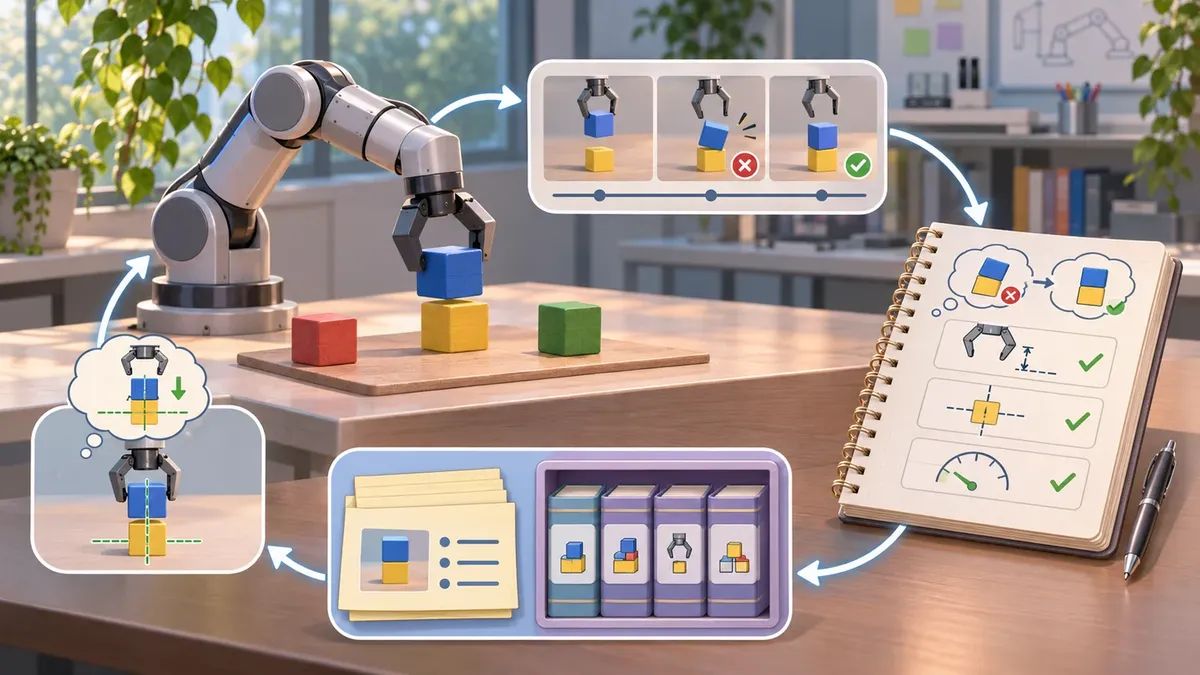
A robot’s mistake is useful only if it can work out what went wrong—and carry that lesson into the next attempt. Embodied-Harness gives a vision-language-model agent a separate reflection process and layered memory, then tests whether refining its operating guidance can improve manipulation without retraining the model.
Robots often need to do more than recognize an object and move it. A longer task may require tracking which steps are complete, remembering earlier actions, and adjusting after something goes wrong. Vision-language models can help plan such tasks, but an execution trace may show that a grasp failed without revealing why. If useful lessons are not retained, an agent can repeat the same mistake.
A team of researchers proposes Embodied-Harness, a system designed to address those challenges by improving the agent’s operating instructions rather than changing the underlying model’s parameters. The central question is whether a robot agent can make better use of experience by keeping organized memories, diagnosing failures from observed evidence, and refining its guidance over repeated attempts.
An actor and a reflector
Embodied-Harness divides the work between two roles. The Actor uses a vision-language model to interpret instructions and observations, then acts through a robot-control interface. The Reflector reviews what happened: the task instruction, the action sequence, feedback from the environment, and whether the task succeeded. It then produces a diagnosis and guidance that may shape later attempts.
The system’s memory is arranged at two timescales. During a task, short-term working memory keeps a compact record of progress alongside more detailed observations and actions. Across attempts, long-term experiential memory stores task-specific outcomes and guidance, as well as more general operational knowledge intended to transfer between tasks. In the authors’ example categories, this knowledge can concern contact and pose control, movement coordination, spatial grounding, task requirements, or tracking progress and recovering from errors.
The proposed cycle is repeated execution, reflection, and revision. The Reflector is meant to ground its diagnosis in the recorded interaction, rather than simply produce an explanation after a failure. It turns that diagnosis into corrective guidance, which is incorporated into the execution harness—the instructions and operational structure that guide the Actor. The model itself remains frozen during this process.
What the tests report
The researchers evaluate the framework on RoboTwin 2.0, RoboSPA, and RMBench, three simulation benchmarks covering different manipulation challenges. They report success rates of 82.4% on RoboTwin 2.0, 76.7% on RoboSPA, and 94.4% on RMBench. RoboSPA includes fine-grained spatial reasoning and long-horizon procedural tasks; the paper reports separate results for these settings, including a 94.0% average success rate on the highest-difficulty spatial-reasoning tasks and 59.5% on long-horizon planning. These figures refer to different task groupings, not a single overall score.
The team also reports tests on three real-world manipulation tasks using a Piper robotic arm. The average success rate across those tasks was 96.7%. This is a result from a small set of specified tasks, not evidence that the system will achieve the same performance across robots, homes, workplaces, or unfamiliar conditions.
Ablation tests—experiments that remove one part of the system at a time—offer clues about what may contribute to its results. On RoboSPA’s long-horizon tasks, removing short-term working memory, long-term experiential memory, the Reflector, or evidence grounding lowered the reported success rate compared with the full system. Removing short-term working memory produced the largest decrease among those listed ablations. The authors also report rising benchmark scores over successive harness-refinement rounds, with gains that became smaller in later rounds.
What remains uncertain
These results suggest that organizing execution history and turning it into reusable guidance can help this particular system on the tested tasks. They do not establish that reflection always identifies the true cause of a failure: the paper describes diagnoses as potential causes inferred from available evidence. Nor do the reported results show that guidance learned in one setting will transfer reliably to other robots or environments. The authors identify transfer across tasks and embodiments as future work.
The headline success rates also need context. Simulation benchmarks and three real-world tasks are limited evaluations, and success rates alone do not describe every aspect of reliability or safety. The paper reports comparisons with selected baselines, but results depend on the benchmark, task definitions, model, and evaluation procedure; they should not be read as a general ranking of robotic approaches.
This is an arXiv preprint, not necessarily peer-reviewed research. The article’s account is based on the available paper text; extraction can obscure details in tables, figures, or equations, so those limitations matter when interpreting precise comparisons. Embodied-Harness offers a promising test of a practical idea—improve the instructions around a fixed model by learning from attempts—but its broader usefulness remains to be demonstrated.
- robotics
- robot manipulation
- vision-language models
- agent memory
- failure reflection
- recursive self-improvement
Related reading
Automatically matched by shared topic keywords. These links do not imply that the sources agree or establish a consensus.
MomentMem teaches robots to save visual memories
Source published
Shared keywords: robot manipulation, vision language models
Can a large vision model use a smaller model’s visual memory?
Source published
Shared keywords: vision language models
Can AI agents improve how they work, not just their answers?
Source published
Shared keywords: recursive self improvement
Robot-coding agents need better failure diagnosis, not just more feedback
Source published
Shared keywords: robot manipulation
A robot twin built from first-person video
Source published
Shared keywords: robot manipulation