TRANSMISSION // 2611.27669v1
Why nuclear measurements may not settle neutron-star tides
Source published
A model-based study finds that improved nuclear measurements alone may leave much of neutron stars’ tidal response uncertain. Pairing a pulsar radius with a binary-star tide could reveal more about internal structure.
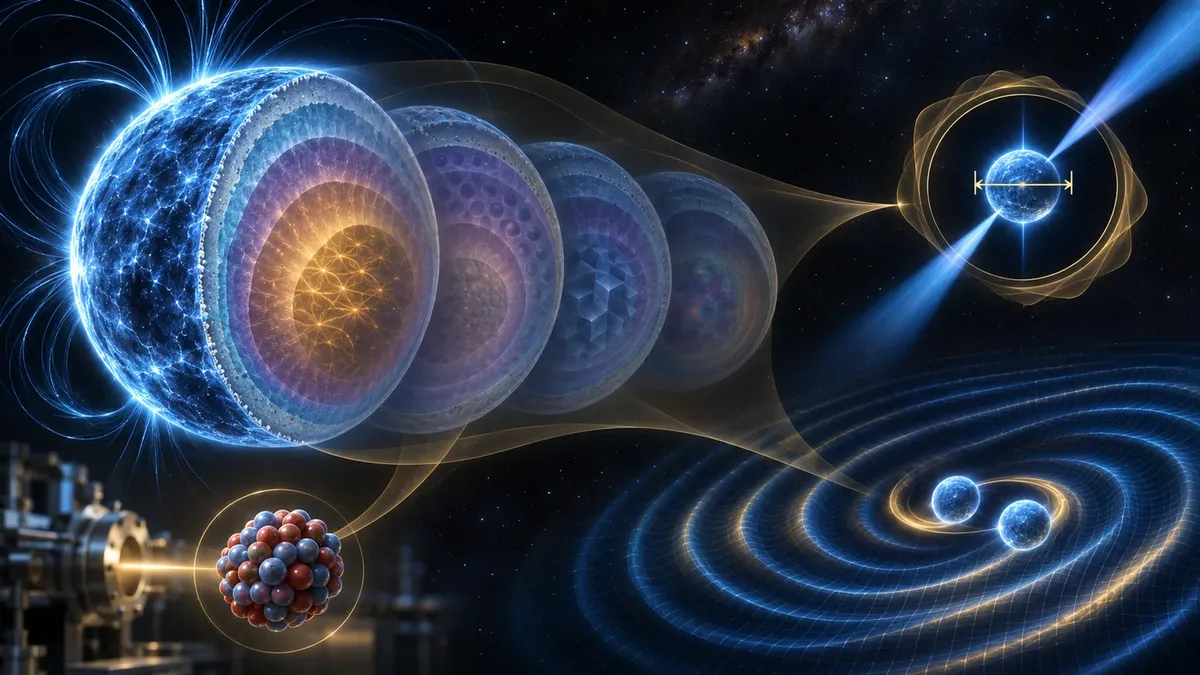
Laboratory measurements of neutron-rich nuclei can inform models of neutron-star matter, but they do not uniquely determine a star’s dense core. A new preprint explores how much nuclear measurements might constrain different stellar properties—and how radius and gravitational-wave tidal measurements could add complementary information.
Neutron stars pack more mass than the Sun into objects only a few tens of kilometres across. Their interiors reach densities that laboratory experiments cannot reproduce, so scientists connect measurements of nuclei to models of matter at stellar densities. But that connection is not one-to-one: different assumptions about the core can share the same nuclear inputs and still predict different stellar structures.
Hisham Anwer, A. Adel and E. Omar ask how much improved nuclear measurements could tell us about neutron-star radii and tidal responses, and what remains uncertain after those measurements. Their results are forecasts within specified models, not direct measurements of neutron-star interiors.
Building model families
The authors use neutron-skin measurements—the difference between the distributions of neutrons and protons in a nucleus—as a link between laboratory nuclear physics and neutron-rich matter. They combine nuclear descriptions with alternative prescriptions for higher-density core matter, then calculate stellar properties such as radius and tidal response. The equation of state, or EOS, describes how pressure changes with density and helps determine a star’s structure.
The primary analysis starts from a particular empirical UNEDF0 nuclear prior and a prescribed family of two-segment cores, allowing certain core transitions. The authors also test other nuclear calibrations, including UNEDF1 and a covariant model, and a separate construction in which the core’s sound speed varies continuously. These comparisons probe sensitivity to modeling choices; they do not cover every possible neutron-star interior.
The stellar predictions are updated using existing gravitational-wave and NICER observations. The paper defines a “nuclear-only ceiling”: the largest fraction of an observable’s variance that nuclear information could remove, on average, within a given conditioned model family. This is a variance-based bound tied to the chosen observable, data and model—not a universal physical limit. A specific experiment will generally achieve less, depending on its precision and which nuclear parameters it can distinguish.
The study also forecasts hypothetical future measurements. These include a pulsar radius measured with a standard deviation of 0.3 kilometres and a binary’s effective tidal deformability measured to 0.1 in its logarithm, approximately 10% precision. The estimates average over possible measurement outcomes and assume independent measurement errors.
Why a radius does not determine a tide
A Love number describes how a star’s internal structure responds to an external tidal force. The total dimensionless tidal deformability also depends strongly on the star’s radius. In the primary model, nuclear inputs that predict a larger radius can also predict a smaller Love number. These opposing changes can partly cancel, leaving the tidal prediction less sensitive to nuclear measurements than the radius prediction.
For a 1.4-solar-mass reference star, the authors estimate that an independent lead neutron-skin measurement with a 0.030-femtometre standard deviation would reduce radius variance by 14.7%, but the variance in the logarithm of tidal deformability by only 0.26%. These are projected, outcome-averaged variance reductions in the specified model—not guaranteed changes in the uncertainty of an observed star.
In the primary ensemble, the authors associate the compensation with changes in density profiles: among nuclear inputs, larger conditional radii accompany more centrally concentrated mass distributions and a lower normalized Love response. This interpretation describes that model ensemble after its observational update; it is not established as a universal pattern across all possible EOSs.
What paired observations could add
A second forecast combines a radius measurement for one pulsar with a tidal measurement from a different binary. Across four data-conditioned EOS families, the assumed measurements reduce the current variance of the logarithmic Love number by 44–68%. Put another way, 31.6–56.4% of that variance remains after the pair, depending on the family. Radius alone leaves more variance in these forecasts; the binary tide supplies complementary information about the density profile.
Those percentages are conditional on the modeled families, existing data, assumed source masses and independent measurement errors. They describe variance in a model parameter, not a direct measurement of the Love number. Different nuclear and core choices produce different starting uncertainties and forecast gains. The authors report numerical and sampling checks, while noting that their finite-ensemble sensitivity ranges are not physical confidence intervals.
The stellar calculations use nonrotating models. Translating a 0.3-kilometre precision target to a real spinning pulsar therefore requires careful radius modeling, including rotational effects. The forecasts should be read as a framework for comparing information sources, not as a prediction that future observations will achieve those precisions or resolve the core uniquely.
This work is available as an arXiv preprint. The source record provided here does not establish whether it has undergone peer review. Its central message is conditional but useful: laboratory measurements constrain shared nuclear properties, while combining stellar radii and tides may help distinguish core structures that nuclear information alone leaves ambiguous.
- neutron stars
- nuclear physics
- equation of state
- tidal deformability
- Love number
- gravitational waves
- NICER
Reviewed cross-references
These connections were reviewed by a model, not independently fact-checked by a human. Similarity does not imply agreement; consult the original papers and the evidence below.
How Neutron-Star Vibrations Shape Gravitational Waves
Supporting evidence: Both studies suggest that tidal measurements can reveal neutron-star structure not fixed by nuclear inputs alone: Anwer et al. find that pairing radius and static-tide measurements reduces modeled Love-number variance, while Gao and Steinhoff model how mode-specific dynamical tides encode stratification, crust and phase-transition properties. The latter is a theoretical extension, not a direct validation of the former’s variance estimates; its phase-shift result is for one representative binary.
Model review: · openai-codex/gpt-6-luna
Evidence and provenance
Selected excerpts, not complete papers. PDF extraction can omit figures or damage equations, tables and reading order; sources may be preprints.
2611.27669v1 — Original paper
Excerpt reference:
static/papers/2611.27669v1.md:586-644
Basis: Paper text
Source SHA-256:ff08c3593aad0abda81f01f73161baddac96e6cc7d64f9980798b5a2934a1a9d2611.14243v1 — Original paper
Excerpt reference:
static/papers/2611.14243v1.md:12-96
Basis: Paper text
Source SHA-256:b7e72504ad408deddabd922a4b973e6f078c6653362eca40db35d88eab194a78
Simulated detector network sharpens the search for neutron stars’ faint internal vibrations
Supporting evidence: The studies address complementary routes for tides to probe internal structure: Anwer et al. quantify prospective constraints from paired radius and bulk tidal observations, whereas Sun et al. test whether simulated third-generation detector data can distinguish resonant g-mode signatures beyond the adiabatic tide. The classifier results are specific to their simulated dataset and do not establish that such resonances have been observed or validate the other study’s forecasts.
Model review: · openai-codex/gpt-6-luna
Evidence and provenance
Selected excerpts, not complete papers. PDF extraction can omit figures or damage equations, tables and reading order; sources may be preprints.
2611.27669v1 — Original paper
Excerpt reference:
static/papers/2611.27669v1.md:12-67
Basis: Paper text
Source SHA-256:ff08c3593aad0abda81f01f73161baddac96e6cc7d64f9980798b5a2934a1a9d2606.11959v2 — Original paper
Excerpt reference:
static/papers/2606.11959v2.md:12-59
Basis: Paper text
Source SHA-256:33568cd7b629d93308b9b13723f9baa6ffdbe0c059bbdce9ef3eb3741db75732
Related reading
Automatically matched by shared topic keywords. These links do not imply that the sources agree or establish a consensus.
Neutron Star Tides Could Complicate Tests of Einstein’s Gravity
Source published
Shared keywords: equation of state, gravitational waves, neutron stars, tidal deformability
How neutron-star tides could reveal the stars’ hidden vibrations
Source published
Shared keywords: gravitational waves, neutron stars
Simulated detector network sharpens the search for neutron stars’ faint internal vibrations
Source published
Shared keywords: gravitational waves, neutron stars
A dark-star model links a mass ceiling to gravitational-wave signatures
Source published
Shared keywords: gravitational waves, tidal deformability
A spinning white dwarf’s tidal response depends on how the star changes shape
Source published
Shared keywords: tidal deformability