TRANSMISSION // 2611.27651v1
A LISA null-stream method has limits
Source published
A simulated LISA analysis tests a sky-dependent null stream. It reduces laser noise with moving spacecraft, but its geometric sky-localization regions remain broad.
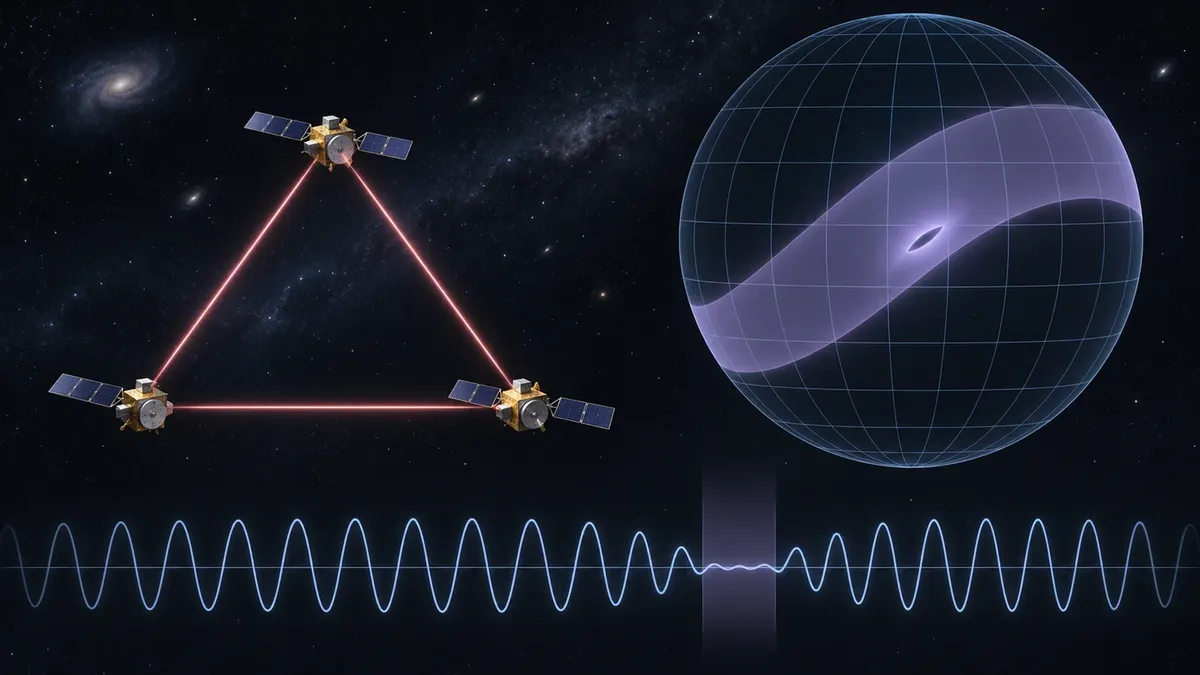
LISA is a future space-based gravitational-wave observatory, and its data will require methods to suppress laser noise and analyze signals from multiple sources. Researchers tested a sky-dependent data combination that should cancel a point-like source’s signal when evaluated at the source’s position. Their simulations show progress on noise handling, alongside a key limitation: the method alone gives weak sky constraints.
LISA, a planned space-based gravitational-wave observatory, will use measurements from three spacecraft. A central challenge in analyzing those measurements is laser frequency noise, which can overwhelm the much smaller effects researchers want to study. Time-delay interferometry, or TDI, combines measurements with time shifts to reduce that noise.
This paper studies a distinctive TDI combination called coronagraphic TDI. It depends on the sky position being tested and has a special property: for a point-like gravitational-wave source, its signal cancels when the combination is evaluated at the source’s sky position and frequency. The authors use a coronagraph as an analogy for this signal-canceling behavior. In principle, looking for positions where the data are consistent with noise could help locate a source without first fitting a detailed waveform model.
The researchers ask whether this idea can handle three complications: spacecraft motion, multiple sources, and instrumental noise. They derive a second-generation version of the combination and an analytic model of its noise. They test these developments using computer simulations, including instrument simulations, pairs of Galactic binaries, and a simulation with one massive black hole binary and 49 verification binaries.
A moving-spacecraft noise test
In an instrument simulation with moving spacecraft and laser frequency noise, the second-generation combination reduced laser noise to the level of the modeled secondary noises, including test-mass acceleration and optical metrology noise. In the same comparison, the first-generation combination’s noise was nearly three orders of magnitude above that secondary-noise level. A separate simulated-source test found that the second-generation sky-map minimum was about 3 degrees from the source position, compared with about 44 degrees for the first-generation version.
These are results from specific simulations, not observations by LISA. There is also an important limitation: the method’s sky-dependent coefficients were calculated for a frozen configuration of the spacecraft, rather than following their motion. The authors say this restricts the current approach to short segments, on the order of weeks; their simulations used segments of just a few days.
When sources share a frequency
Tests with pairs of Galactic binaries showed that the sources could be localized independently when they did not overlap in frequency, even if they shared a sky position. When two sources overlapped in frequency, the method could locate the louder one only if its amplitude was roughly 100 times greater than the other’s.
In the more complex simulation with a massive black hole binary and 49 verification binaries, the black hole binary’s location was recovered to within one sky-map pixel on average across its frequency range. That average hides variation: some frequencies were more biased, including parts of the lower-frequency range and frequencies occupied by particular binaries. The authors say a larger Galactic-binary population needs further study.
Statistical regions are calibrated but broad
To analyze data with instrumental noise, the researchers compared the combined data stream with their analytic noise model. They used this comparison to define confidence regions on the sky. In the simulations, the statistical test showed the expected coverage: for the reference 90% confidence setup, the source was missed in about 10% of trials. This calibration result applies to the simulated tests, not to real LISA data.
The regions remained large. For simulated binaries with signal-to-noise ratios from about 1,200 to 12,400, the loudest case had a median 90% confidence-region area of about 3,400 square degrees—roughly 8% of the sky. Narrowing the frequency window around the source reduced the area, but requires knowing which frequency range to examine. The authors conclude that the geometric response alone provides weak sky constraints, even for very loud sources.
The analysis also has a mirror-position ambiguity in its current LISA-frame treatment. The paper discusses time-dependent response coefficients as a possible way to break this degeneracy, but does not test that improvement here. Its analytic noise model assumes equal arm lengths and identical noise levels across spacecraft; extending it to unequal arms is left for future work.
The study therefore shows progress, not a ready-to-use localization system. It is a preprint based on simulations, not LISA observations. The authors discuss possible future uses, including glitch discrimination, but do not demonstrate that application in this work. Their results suggest coronagraphic TDI may contribute useful geometric information, while precise localization will require further development and, likely, information beyond the geometric response alone.
- LISA
- gravitational waves
- time-delay interferometry
- coronagraphic TDI
- sky localization
- Galactic binaries
Related reading
Automatically matched by shared topic keywords. These links do not imply that the sources agree or establish a consensus.
Testing Gaussian-process methods for LISA data
Source published
Shared keywords: time delay interferometry
The Milky Way’s leftover signals could blur LISA’s search for a gravitational-wave background
Source published
Shared keywords: galactic binaries, gravitational waves
Separating black hole signals from glitches in simulated LISA data
Source published
Shared keywords: gravitational waves
LISA could find elusive black holes long before their companions fall in
Source published
Shared keywords: gravitational waves
How the early Universe’s changing particle soup could reshape gravitational waves
Source published
Shared keywords: gravitational waves