TRANSMISSION // 2611.27640v1
Dicke states from every qubit, with no extras
Source published
A new circuit construction claims exact preparation of any Dicke state using only its output qubits, with linear gate count and logarithmic depth. The result is theoretical and assumes ideal gates and unrestricted connectivity.
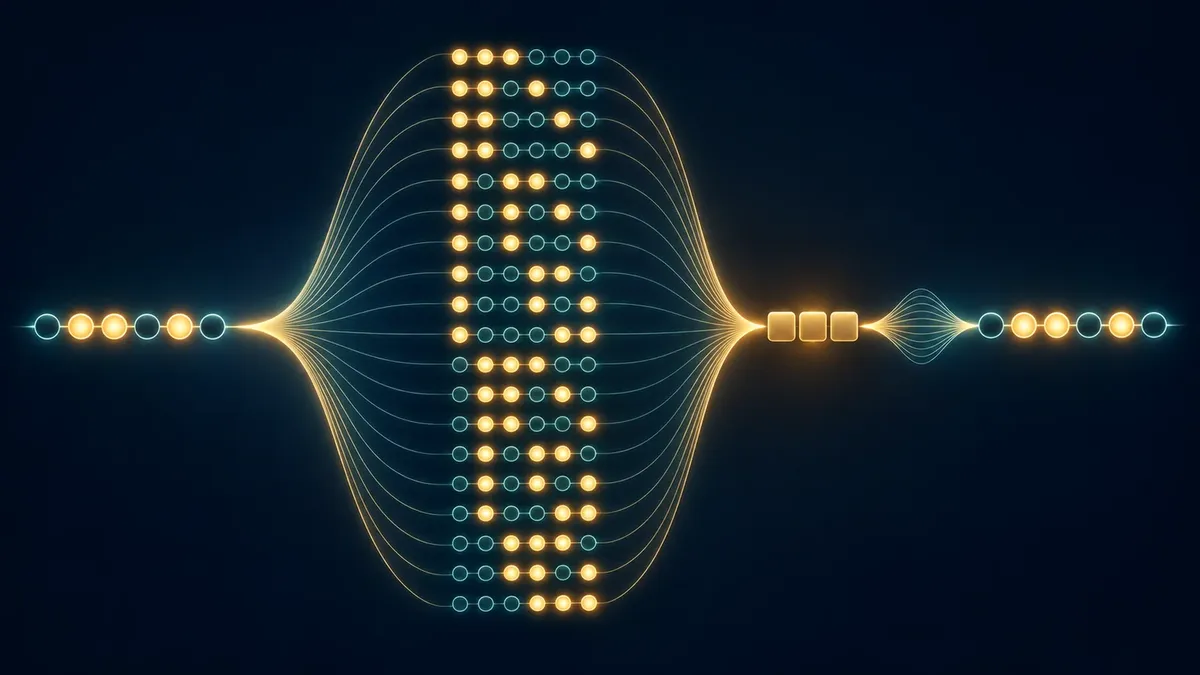
Dicke states spread quantum information evenly across bit strings with a chosen number of 1s. A new preprint presents a way to prepare them using no spare qubits—and argues that its gate count and depth are optimal in their scaling.
A Dicke state is a quantum superposition of every possible arrangement of a fixed number of 1s across a register. For example, a state with three 1s gives equal amplitude to every bit string containing exactly three 1s. Such states are useful in settings including quantum metrology and quantum algorithms for locating errors.
The preparation problem is deceptively demanding: a circuit must create the right equal-weight superposition while coordinating many qubits. Can this be done efficiently for any number of 1s, without adding workspace qubits beyond the register that holds the result? Yunqi Huang, Wei Zi, Jianhao He, Zekun Ye and Shenggen Zheng say yes in a new arXiv preprint.
Compress, correct, amplify
The authors give a theoretical circuit construction for an n-qubit Dicke state of weight k—the number of 1s—using a number of gates that grows linearly with n, and circuit depth that grows logarithmically. It uses arbitrary single-qubit gates and CNOTs, and no ancillary qubits. The claim covers every nontrivial weight, from 1 through n−1. The all-zero state needs no preparation, while the all-one state can be made by applying X gates to all qubits.
The central device is a way to perform operations that depend on the total number of 1s without borrowing extra qubits. The circuit groups qubits into small blocks and temporarily compresses each block’s symmetric state into an encoding of its weight. The remaining qubits can then serve as workspace: the circuit adds the block weights, applies a phase selected by the total, reverses the arithmetic, and decompresses the blocks. The authors show that this weight-dependent phase operation can be done with linear gate count and logarithmic depth.
That capability supports the rest of the preparation. First, the circuit makes a product state whose measurement outcomes have a binomial distribution centered on the desired weight. By itself, this state does not have enough overlap with the target Dicke state to make exact preparation efficient for all weights. The authors therefore apply a collective rotation and a weight-dependent sign correction to create a starting state with overlap bounded below by a positive constant. Exact amplitude amplification then boosts the target component in a constant number of steps. The paper also describes how to choose the circuit’s phases and gates exactly, rather than relying on approximate numerical settings.
What “optimal” means here
The authors call the scaling asymptotically optimal. Their argument draws on lower bounds: for nontrivial Dicke states, at least a number of gates proportional to n is needed, and depth must grow at least logarithmically with n. Their construction matches those growth rates. This is a statement about how resource use scales, not a claim that the circuit has the smallest possible gate count or is fastest on a particular quantum computer.
The result is especially notable for balanced states, where the number of 1s is near half the register size. The paper says its logarithmic-depth construction contradicts a previously conjectured lower bound proportional to k for preparing such states. That conclusion concerns the circuit model used in the paper; it does not establish a practical speedup on hardware.
Important caveats
The construction assumes arbitrary single-qubit gates and does not account for the cost of expressing them in a device’s native gate set. It also counts depth by layers of operations on disjoint qubits, without imposing a restricted connectivity layout. Real hardware may need extra routing operations, and imperfect gates can introduce errors. The paper identifies adapting the method to finite gate sets and restricted connectivity as future work.
This is a mathematical circuit result, not a reported hardware demonstration. The source is an arXiv preprint, which may not have undergone peer review. The authors also disclose that ChatGPT (Codex) assisted with the abstract and sections of the manuscript, including literature comparison, proof development and checking, drafting, figures, and resource accounting; they state that the authors are responsible for the claims and results. The paper’s proofs and assumptions therefore matter: the asymptotic bounds should be read as claims within its stated idealized model, not as evidence that current devices can already prepare these states at the advertised practical cost.
- Dicke states
- quantum circuits
- quantum state preparation
- ancilla-free
- amplitude amplification
Related reading
Automatically matched by shared topic keywords. These links do not imply that the sources agree or establish a consensus.
Preparing a quantum range without extra qubits
Source published
Shared keywords: ancilla free, quantum circuits, quantum state preparation
An exact theory explains the speed limits of measurement-driven quantum preparation
Source published
Shared keywords: dicke states, quantum state preparation
Quantum memory helps track changing solutions, but does not guarantee cheaper computation
Source published
Shared keywords: quantum state preparation
Why finite quantum circuits cannot reproduce the quantum switch
Source published
Shared keywords: quantum circuits
A small memory makes quantum measurement records predictable
Source published
Shared keywords: quantum circuits